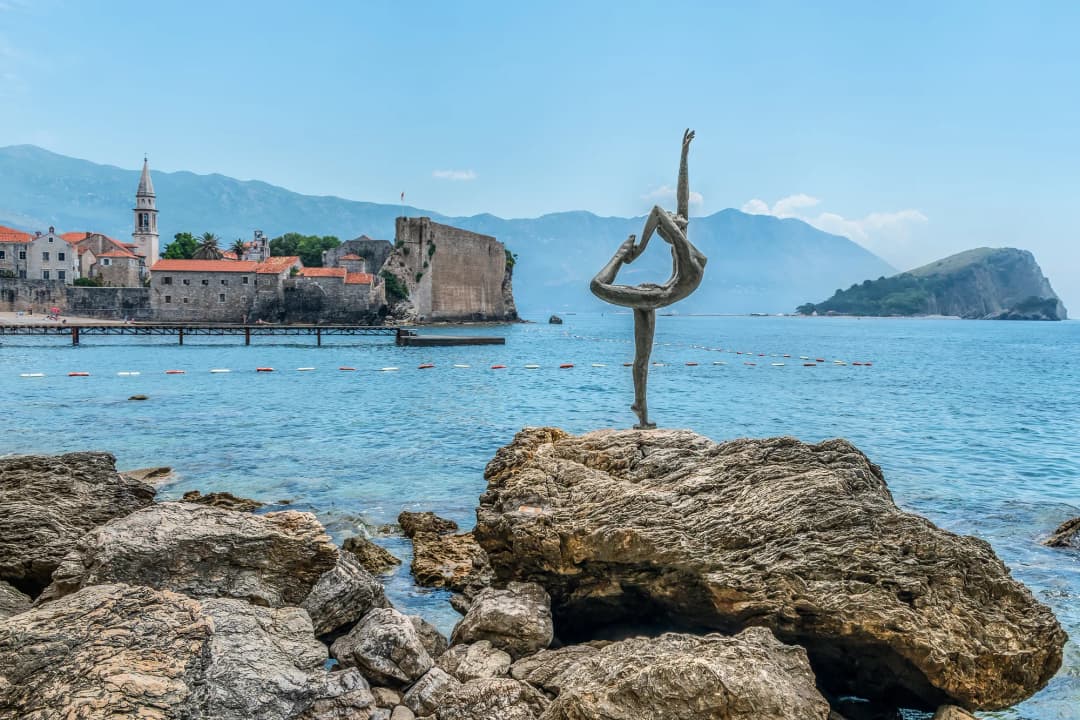
Budva’s bronze figure is usually called the Ballerina, but the name already contains a small warning: the work is also documented as Igračica, the Dancer, and the young woman who modelled for it was an athlete rather than a professional ballerina. The sailor’s fiancée who waits forever on the shore belongs to local legend. The model, sculptor and storm damage belong to a different, evidence-based story.
This 2026 guide keeps those stories together without confusing them. It explains what can be sourced, what remains folklore, why references disagree about the installation year, and how to see the sculpture without climbing onto a wave-exposed rock or treating public art as a lucky charm to rub.
The Budva Ballerina at a glance
| Question | Best-supported answer | Limit |
|---|---|---|
| Artist | Gradimir Aleksić (1922–2002) | The sculpture is also called Dancer or Igračica |
| Model | Olga Kalivoda, then a teenage athlete | She was not the literal girl in the sailor legend |
| Installed in Budva | Mid-1960s (modelled in 1962) | Published sources disagree between 1965 and 1966 |
| Location | On the coastal route from the Old Town side toward Mogren | Path conditions depend on sea and maintenance |
| Storm history | Swept from the rock around New Year 2020–21; restored in 2021 | Its exposure is real, not a romantic metaphor |
| Cost | No separate statue ticket identified | That does not mean the path is safely accessible at every hour |
One sculpture, three kinds of story
The cleanest way to understand the figure is to separate three evidence layers. The artwork layer has an identified sculptor and a public-space setting. The model layer comes from later reporting about a teenage athlete photographed and sketched in 1962. The legend layer tells of a young woman waiting for a sailor who never returned. Local tradition, as retold in regional media such as Original magazin and Istorijski zabavnik, presents the waiting-girl narrative as a legend, not as a documented biography.
| Layer | Detail | Standing |
|---|---|---|
| Artwork | Aleksić · public sculpture | strong documentation |
| Model | Kalivoda · athlete | later reported testimony |
| Legend | girl waits for sailor | cultural tradition |
| Takeaway | A meaningful legend does not need to be mistaken for archival fact |
Source: srpskaenciklopedija.rs, rtcg.me, originalmagazin.com
Gradimir Aleksić and a figure in motion
The Serbian Encyclopedia identifies Gradimir Aleksić as a sculptor born in 1922 who graduated from Belgrade’s Academy of Fine Arts in 1948. It specifically lists Budva’s Igračica among his public works and characterizes his figures as realist forms often shown in movement. That institutional record is stronger evidence of authorship than travel-blog repetition.
The figure’s extended leg and carefully balanced torso fit that interest in arrested motion. “Ballerina” is an affectionate tourist label, not a technical identification based on costume or choreography. “Dancer” is closer to the encyclopedia’s title; “athletic figure” is closer to the reported origin of the model. None of those names changes the physical work.
| Period | Milestone |
|---|---|
| 1922 | born |
| 1948 | academy graduate |
| 1950s–80s | exhibitions and public work |
| 2002 | died |
| Note | Realist modelling + movement are recurring features, not proof of a literal legend |
Source: srpskaenciklopedija.rs, skulptura-hronologijaizlaganja.rs
Olga Kalivoda: model, not mythical heroine
Later reporting identifies Olga Kalivoda from Novi Sad as the model. RTCG describes her as a member of the Vojvodina athletics club and says she modelled for Aleksić during a 1962 stay in Makarska. A longer account based on her reported recollections says she was a 14-year-old track athlete and believed Aleksić was seeking proportions rather than her face. This is a model-to-artwork history; it does not establish that the finished figure represents Kalivoda’s personal life.
Calling her a gymnast, a ballerina or the fiancée of a lost sailor collapses three different stories. The supported formulation is narrower: a teenage athlete reportedly supplied the physical reference. The finished bronze became a generalized figure and later accumulated local meanings far beyond the modelling session.
| Stage | What it is | Evidence |
|---|---|---|
| 1962 reference | teen athlete | photos and sketches |
| Sculpture | artist's transformation | generalized figure |
| Public meaning | Dancer · Ballerina | waiting-sailor legend |
| Takeaway | The model is documented; the legend is inherited cultural interpretation |
Source: rtcg.me, originalmagazin.com
Was it installed in 1965 or 1966?
Many accounts give 1965, including Original magazin, Istorijski zabavnik and the Serbian Wikipedia entry on the sculpture. RTCG’s 2023 report says the Budva example has stood there since 1966. No inscription, municipal commissioning file or catalogue raisonné resolving the one-year difference was located for this review. The most defensible wording is “mid-1960s,” followed by a transparent note about the published disagreement.
The uncertainty is small but instructive. Repetition can make an exact year appear settled even when reliable sources conflict. It is also unclear whether some writers mean casting, public display elsewhere, gifting, or installation on the present rock. Budva’s bronze is also one of several casts: RTCG reports that the first stands on the terrace of Hotel Berane, with others in Mataruška Banja and Zaječar. Until a primary record distinguishes those events, a single exact date carries more confidence than the accessible evidence warrants.
| Year | Reported by |
|---|---|
| 1965 | Original magazin and common accounts |
| 1966 | RTCG report |
| Best evidence | mid-1960s; sources disagree on the exact year |
Source: originalmagazin.com, rtcg.me
The waiting sailor: tradition, not case history
Local tradition, as retold in regional media, gives the familiar version: a girl dies at this place while hopelessly waiting for her sailor fiancé, and the sculpture becomes a symbol of the city. Variants add poverty, a promised wedding, daily vigils or a protective power. Those details make the story memorable, but no named couple, dated voyage, ship record or contemporary account appears in any version found for this guide.
The legend still matters. Coastal communities have long used stories of departure and return to give emotional shape to uncertain lives at sea. Here the bronze pose, open horizon and repeated photography create an unusually strong stage for that theme. Read the story as public memory—much as the Five Danicas guide separates commemorated lives from later promenade storytelling—not as a death certificate encoded in bronze.
The storm that disproved “she never moved”
The inherited postcard line says the Dancer survived every storm without moving. The 2020–21 winter proves otherwise. Vijesti reported that large waves swept the statue from its rock around New Year, damaged the Mogren path and tore out railings. It was recovered from the water, transferred for conservation in March and returned to the rock on 3 June 2021.
The conservation history deepens the artwork rather than diminishing it. The sea is an active condition of the site. Salt, spray, metal fatigue, fixings and wave force are material facts; the romantic horizon exists because the sculpture stands in an exposed marine environment. Its return was a municipal and community effort, not evidence that visitors should test the rock themselves.
| Date | Event |
|---|---|
| Late Dec 2020 | waves remove statue; path also damaged |
| 1 Jan 2021 | recovered from sea |
| 25 Mar | conservation begins |
| 3 Jun | returned to rock |
| Note | The storm record is the clearest possible warning about rough-sea access |
Source: vijesti.me
Practical visit guide for 2026
Budva Tourism describes a 350-metre concrete path from the Hotel Avala side toward Mogren. The sculpture is encountered along the coastal approach, but the official Mogren page gives the decisive safety rule: during a southerly wind and strong waves, the path is unsafe and should be avoided. That instruction outranks a photo plan, sunset timing or the fact that other people are walking through.
- Check the sea before the path. If waves are reaching the walkway, a barrier is closed or local staff redirect pedestrians, turn back. Do not step around a locked gate.
- Photograph from the public path. A clear composition does not require climbing onto the statue’s rock. Zoom or change angle; keep shoes on and children beside an adult.
- Do not touch the bronze. The “rub for luck” custom is not supported by an official conservation source. Hands, salt and climbing add wear and risk.
- Expect an exposed route. Verify surface, railings and mobility suitability on the day. A short distance is not the same as step-free access.
- Use a safe alternative. If conditions are poor, photograph the Old Town from a public waterfront viewpoint and return in calmer weather.
The Mogren Beach guide covers the wider route and beach trade-offs. The complete Budva guide helps place the stop within the city rather than making one exposed photo the day’s objective. If accommodation location determines whether you can reach the path comfortably, compare districts in where to stay in Budva.
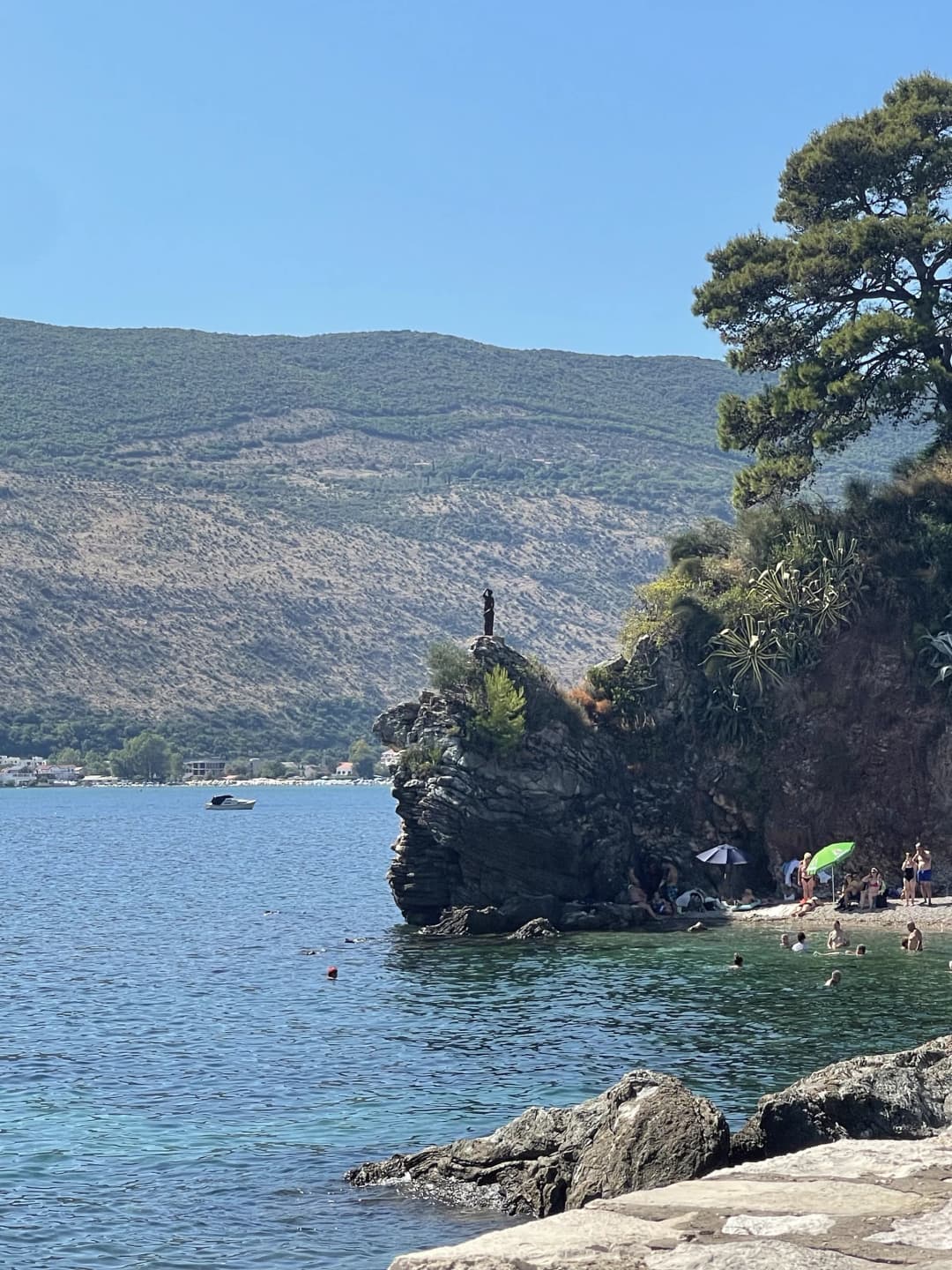
How to look at the sculpture
First look at balance. The raised leg extends the body into the surrounding air, while the planted foot makes the small contact point feel improbable. Then look at direction: the pose is open enough that different viewpoints can make the figure seem to face sea, town or horizon. Finally look at scale. Against the walls and water, the bronze is modest. Photography enlarges its symbolic role.
That interaction between movement, public space and repeated performance is why the work belongs in Budva’s cultural story. The city’s seasonal stages are explored in the Theatre City guide, while Montenegro’s gallery guide offers a useful contrast between art encountered under institutional care and art exposed to weather and public contact.
Frequently asked questions
Is the Budva Ballerina a real ballerina?
The sculpture is real; “Ballerina” is a popular name. The identified model, Olga Kalivoda, was reported as a teenage track athlete. Aleksić’s work is also documented as Igračica, or Dancer.
Who made the statue?
Gradimir Aleksić, a Belgrade-trained sculptor whose public works and realist figures are documented by the Serbian Encyclopedia.
When was it installed?
Use “mid-1960s.” Original magazin, Istorijski zabavnik and other accounts say 1965; RTCG says 1966. No primary installation record resolving the difference was found during this review.
Is the sailor story true?
It is an established local legend and part of the sculpture’s public meaning, but no retelling found for this guide documents a named historical couple or voyage.
Was the statue washed into the sea?
Yes. Large waves removed it around New Year 2020–21. It was recovered, conserved and returned to its rock on 3 June 2021.
Can I climb onto the rock or rub the statue?
Do neither. Use the public path, respect barriers and avoid the route during strong waves or southerly wind. A photograph is not worth a fall, wave strike or avoidable damage to the bronze.