Eduardo Vuletich reached one of the most powerful labour offices in mid-century Argentina. By November 1952, the son of a Montenegrin migrant was secretary general of the Confederación General del Trabajo (CGT), the country's dominant trade-union confederation. He later became first vice president—not president—of the Eva Perón Foundation and represented labour in the difficult productivity debate of 1955.
A family-assisted Montenegro.com account preserves Vuletich’s birth, parentage and later-life details. Argentine archives document his CGT office, his position beneath Juan Perón on the Foundation board and the judicial allegations made after the 1955 coup. Together, these records trace both his family origins and public career.
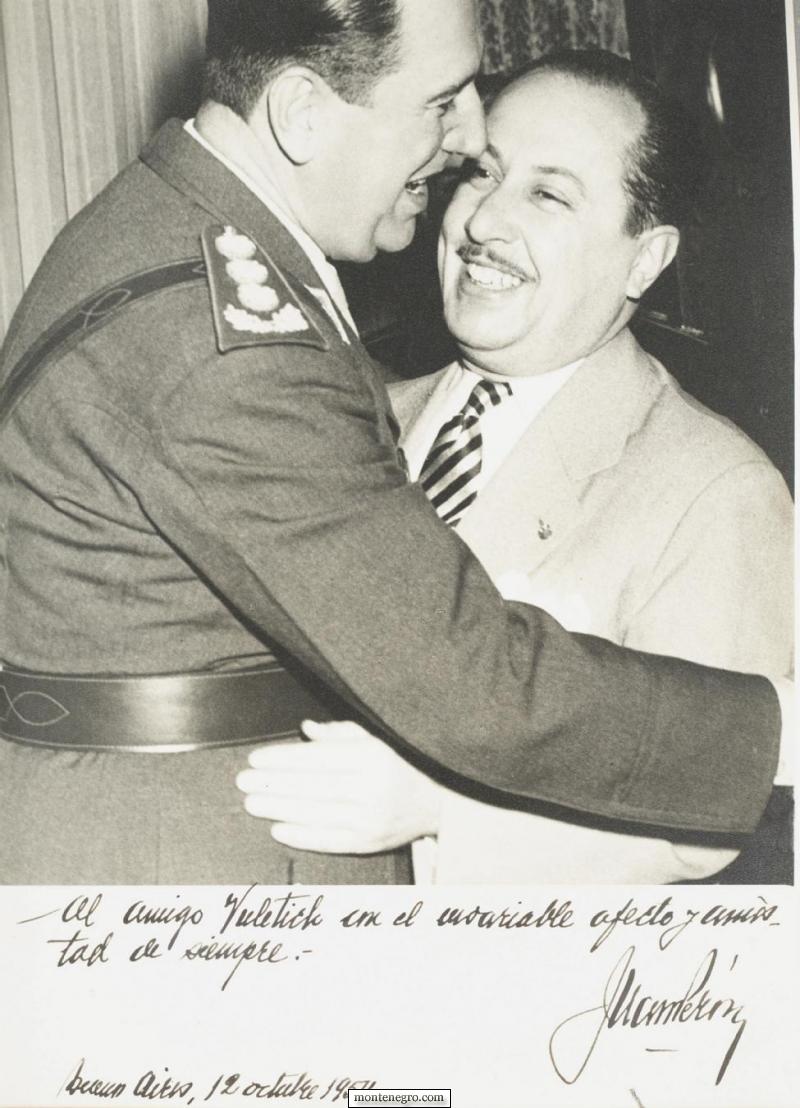
What can be established at a glance
| Question | Details | Source context |
|---|---|---|
| When and where was he born? | 29 September 1909, Dolores, Buenos Aires Province, according to the family-assisted archive. | The date comes from the family-assisted biography. |
| What was his Montenegrin connection? | The family account identifies his father as Dušan Vuletić, a migrant from Montenegro. | That provenance is family testimony. |
| When did he lead the CGT? | He was demonstrably secretary general by 29 November 1952; a union history dates his resignation to 1 July 1955. | Sources often summarize the tenure simply as 1952–1955. |
| Did he lead the Eva Perón Foundation? | He became first vice president on 12 January 1953, beneath president Juan Perón. | Calling him the Foundation's president is incorrect. |
| What happened after the 1955 coup? | He was detained; a union history reports transfer to Ushuaia, and a November report records judicial allegations. | Detention and allegation do not prove guilt or conviction. |
| When did he die? | The family archive reports 1983 and Parkinson's disease. | The date and illness come from the family-assisted biography. |
A Montenegrin surname in the River Plate
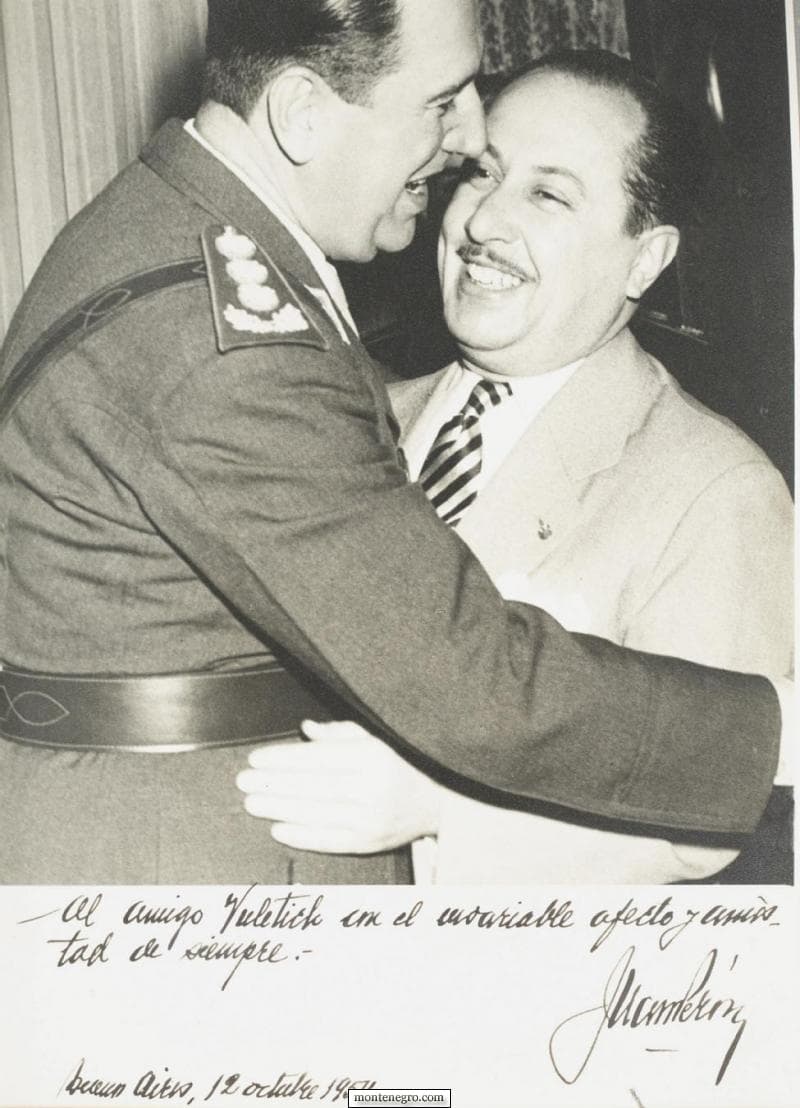
The family-assisted Montenegro.com biography, assembled with help from Vuletich's son Dr Jorge Daniel Vuletich, says Eduardo was born in Dolores on 29 September 1909. It names his father as Dušan Vuletić, a Montenegrin emigrant, and his mother as Juana Paredes, from Uruguay. It also says his father died when Eduardo was five and that mother and son then moved to Buenos Aires.
Spelling carries some of that migration history. Vuletić is the South Slavic form; Vuletich is the form found in Argentine public life and Spanish-language records. Neither spelling makes him more or less Argentine. Together they show how a name was made legible across alphabets and bureaucracies.
The same family source reports study in pharmacology at a school in Ameghino and early work in radio journalism. Both experiences preceded his work in pharmacy-union organization. Readers interested in how such testimony survives can compare the Montenegro.com South American diaspora archive, which explains the interviews, photographs and personal contacts behind this collection.
| Evidence level | Items |
|---|---|
| Institutional record | CGT office by Nov 1952; Foundation first vice president; 1955 productivity congress; November legal allegations |
| Family testimony | birth and parentage; schooling and radio work; illness and 1983 death; family photograph |
| Not established | exact appointment day; Foundation presidency; exact prison duration; release bargain |
Source: montenegro.com, atom.cedops.isco.unla.edu.ar, editorial.unca.edu.ar
From pharmacy workers to the CGT
Vuletich first built authority in the pharmacy workers' movement. The historical archive maintained by that movement describes his rise through the Federación Argentina de Trabajadores de Farmacia before he reached the CGT. This sectoral base matters: he did not arrive in national labour politics merely through proximity to Perón. He came from an organized workforce with its own negotiations, institutions and internal rivalries.
A Buenos Aires provincial archive catalog entry dated 29 November 1952 explicitly calls him secretary general of the CGT. The confederation's modern leadership chronology summarizes his term as 1952–1955.
Eva Perón died on 26 July 1952. Vuletich’s documented rise belongs to the political reorganization after her death, when the CGT and the charitable institution closely identified with her both faced transitions.
| Date | Event |
|---|---|
| 29 Nov 1952 | CGT title in archive record |
| 12 Jan 1953 | Foundation first vice president |
| 17 Oct 1954 | productivity congress announced |
| 21 Mar 1955 | congress opens; labour case argued |
| 1 Jul 1955 | resignation in union history |
Source: atom.cedops.isco.unla.edu.ar, agrupdipascuale.ar, editorial.unca.edu.ar, bcn.gob.ar
His role in the Eva Perón Foundation
The Foundation had received legal personality in July 1948 and became the best-known institutional expression of Eva Perón's social assistance. After her death, its governance changed. Research based on the Foundation's own board minutes records a decisive meeting on 12 January 1953: Juan Perón became president, Eduardo Vuletich first vice president and Roberto Dupeyron second vice president.
Vuletich therefore held a major office. As CGT leader and first vice president, he stood at a junction between organized labour and an institution with hospitals, homes, schools and social-assistance programs. The board minutes identify Juan Perón as president and Vuletich as first vice president.
| Role | Holder |
|---|---|
| President | Juan Perón |
| First vice president | Eduardo Vuletich |
| Second vice president | Roberto Dupeyron |
Source: editorial.unca.edu.ar, argentina.gob.ar
The productivity argument of 1954–1955
Vuletich's most revealing documented intervention concerned productivity. Argentina faced inflation, industrial bottlenecks and pressure to produce more. Employers wanted changes in work organization; unions feared that “productivity” could become a formula for faster work, weaker agreements or lower labour costs. As CGT leader, Vuletich had to negotiate between the government's economic priorities and the protections expected by workers.
The National Congress Library's scan of the 17 October 1954 speeches preserves Vuletich's announcement of a proposed productivity congress. The CGT and the employers' Confederación General Económica subsequently organized it. The congress opened on 21 March 1955; a surviving publication catalog lists speeches by Perón, Vuletich and business leader José Ber Gelbard.
The disagreement was not a simple yes or no. An academic study of the congress shows Vuletich accepting greater productivity as legitimate while drawing boundaries around how it should be achieved. Labour protections and living standards could not be the variable sacrificed to economic adjustment, and workers could not bear the entire burden. That position captures his institutional role better than a generic label such as “close Peronist”: he was publicly translating an economic program into terms a union movement might accept.
| Position | Content |
|---|---|
| Accepted objective | increase output; improve organization; negotiate through CGT + CGE |
| Rejected shortcut | weaken labour guarantees; reduce living standards; put the full cost on workers |
Source: temasydebates.unr.edu.ar, bcn.gob.ar
Resignation, coup and detention
The pharmacy workers' historical account dates Vuletich's resignation from the CGT to 1 July 1955, more than two months before the military uprising that removed Juan Perón in September. His union tenure therefore ended before the fall of the government.
After the coup, the new authorities proscribed Peronism and detained many of its officials and union leaders. A pharmacy-union biographical history says Vuletich was arrested and transferred to the prison at Ushuaia. A contemporary report in the 22 November 1955 edition of La Nación adds a different kind of evidence: it says a federal judge ordered the detention of Perón, former CGT leader José Espejo and Vuletich on allegations of treason and illicit association, while noting that Vuletich was already in custody.
The newspaper reports allegations and judicial proceedings, not guilt or a conviction. Available records do not give a definitive prison duration, release date or documented connection between his release and a Perón–Arturo Frondizi electoral agreement.
| Status | Item |
|---|---|
| Documented or reported | 1 Jul · CGT resignation |
| Documented or reported | Sep · military overthrow |
| Documented or reported | After coup · detained / Ushuaia |
| Documented or reported | 22 Nov · named allegations |
| Not established here | exact total time imprisoned |
| Not established here | final disposition of every case |
| Not established here | release date |
| Not established here | release through electoral pact |
Source: agrupdipascuale.ar, arpa.udp.cl
Later life and what remains unknown
The family-assisted account says imprisonment and mistreatment led Vuletich to withdraw from political life. It reports that he died in 1983 after suffering from Parkinson's disease and that his descendants remained in Buenos Aires, while descendants of his father's brother lived mainly in Montevideo. These details come from the family-assisted biography.
If the reported 1983 death date is correct, Vuletich was 73 or 74. His life after 1955 is less extensively documented in the accessible public record than his years in national labour leadership.
Why Vuletich matters to Montenegro's diaspora history
Vuletich's significance is not that he remained culturally unchanged after his father's migration. His public career was Argentine: a Spanish-speaking labour organizer operating inside Peronism, the CGT, the Foundation and a national argument over industrial policy. His Montenegrin connection matters because it places one migrant family within institutions that shaped millions of Argentine lives.
Other Montenegro.com records show how varied that diaspora became. The report from Montenegrins in General Madariaga follows community memory outside the capital; the third Argentina field report preserves another group of meetings and testimony. A separate reflection on Argentina and its people captures the emotional register of that research, while the biography of Vaso Ćuković in the United States offers a useful contrast between labour leadership and philanthropy.
Language change is part of the same story. The Montenegro language guide explains the modern relationship among Montenegrin and neighboring standards; Vuletić becoming Vuletich shows one small way a surname travels beyond them.
Vuletich’s place in Argentine labour history
Vuletich led the CGT during a consequential period, served as first vice president of the Eva Perón Foundation, articulated labour's conditions in the productivity debate, resigned before the September 1955 coup and then entered a punitive post-coup legal and prison system.
His story also keeps two archives in view. Family testimony preserves a Montenegrin father, a Dolores birth, a photograph and memories of later life. Argentine institutional records establish the offices, policy debates and judicial sequence. Read together, they show how a migrant family story intersects with Argentina’s national political institutions.
Practical research guide
Civil registers in Dolores and Buenos Aires, CGT minutes, prison files and a death record could add detail to Vuletich’s early and later life. Public records trace his offices and legal proceedings; the family-assisted biography records his parents, schooling, radio career, illness and death.
Frequently asked questions
Was Eduardo Vuletich president of Argentina's CGT?
He was its secretary general, the confederation's leading executive office, by 29 November 1952. Modern summaries give the term as 1952–1955, while the pharmacy workers' history records his resignation on 1 July 1955.
Was he president of the Eva Perón Foundation?
No. Research based on board minutes says Juan Perón became president on 12 January 1953 and Vuletich became first vice president. The vice presidency was significant, but it was not the top office.
Was Vuletich imprisoned without charges after the 1955 coup?
He was detained, and a union history reports transfer to Ushuaia. A November 1955 newspaper records named judicial allegations, so “without any charge” is inaccurate. That report does not prove a conviction, fair process or acceptable prison conditions.
Which details come only from the family?
The family-assisted archive is the source for his exact birth details, parents, schooling, radio work, reported Parkinson's disease, 1983 death and later family locations. These details are reported by the Vuletich family.