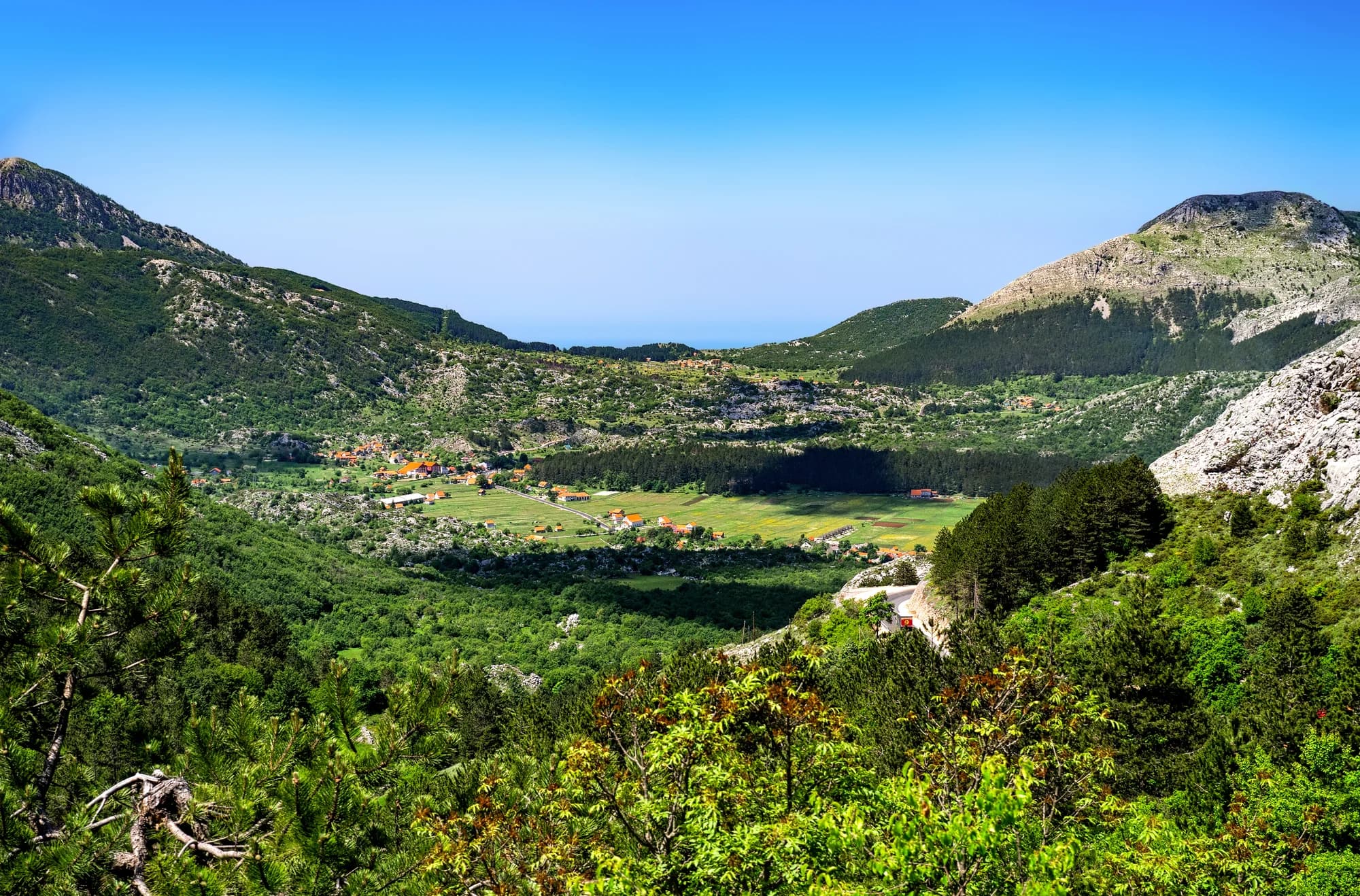
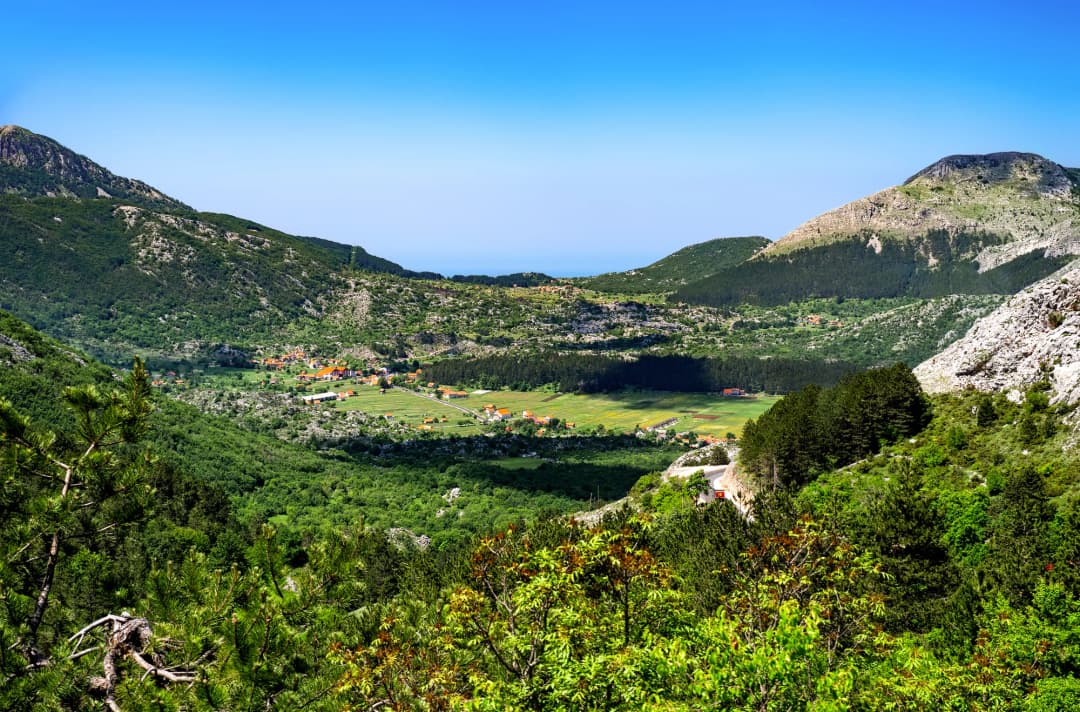
Njeguši is not merely a tasting stop above Kotor. It is a dispersed highland settlement inside the Lovćen landscape, the birthplace of Petar II Petrović-Njegoš, and the legally defined home of Njeguški pršut. A useful visit connects those three layers without turning the village into a roadside checklist.

The practical difficulty is the road. The spectacular Kotor approach is narrow and highly seasonal, while the Cetinje side is the less theatrical planning option. In 2026, an official traffic order also changes how the Kotor route can be used at certain hours. Choose direction before choosing lunch, and confirm both museum access and road status on the day.
What the old journey recorded—and what needed repair
The inherited Montenegro.com story followed reporters from the Bay through Tivat, Budva and Cetinje before reaching Njeguši. It preserved the energy of an improvised drive: ferry waiting, roadside views, animals in the carriageway, a museum door unexpectedly open and food at the destination. That personal sequence remains useful as an archive of travel style, not as present-day route advice.
Several details could not survive as fact. The article did not identify the date, the restaurant, museum staff or the bishop it said the reporters met. Its images carried camera-style filenames rather than dependable subject metadata. It also provided no opening hours, protected-food standard, current road control or distinction between Njeguši village and Lovćen National Park. This revision retains the sense of arrival while grounding decisions in institutions.
Choose the road before building the day
Njeguši can be approached from Cetinje or from the Bay of Kotor. The Cetinje side uses the R-1 corridor and is normally the clearer choice for drivers who do not want the steep historic serpentines. Government reporting says a 1.6-kilometre phase at the Cetinje end was completed in 2024, but a completed phase is not a guarantee that every later section is free of works, weather damage or event controls.
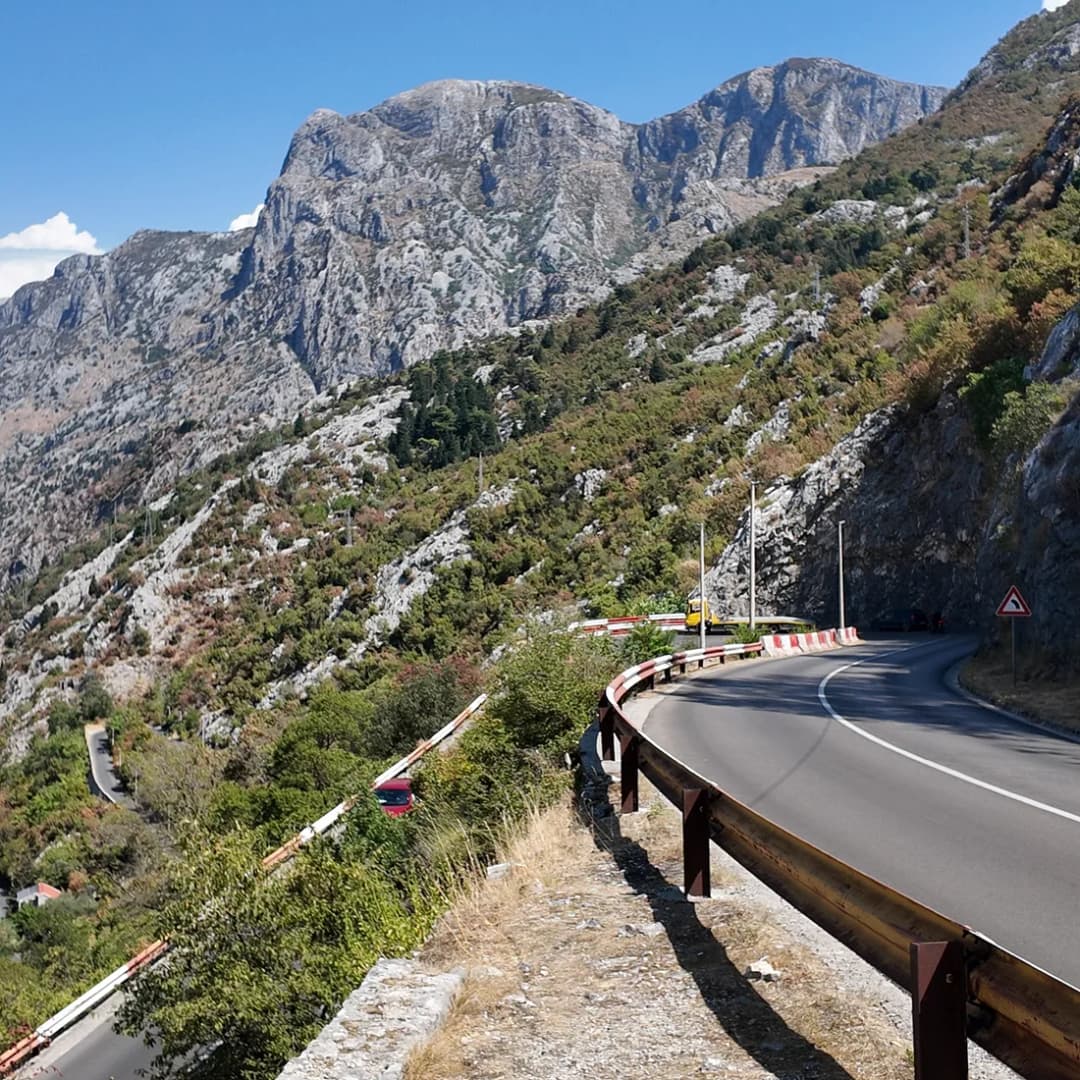
The Kotor side is the scenic route associated with the famous switchbacks. It also concentrates hairpins, coaches, motorcycles, cyclists, viewpoints and drivers unfamiliar with the road. Do not stop in a traffic lane for a photograph, follow a tour bus through a turn you cannot see, or infer that a rental car is suitable simply because navigation software offers the route.
| Point / direction | Detail |
|---|---|
| Cetinje | R-1 approach |
| Njeguši / Krstac | decision point |
| Trojica / Kotor | serpentine side |
| Njeguši → Kotor | closed 08:00–15:00 |
| Kotor → Njeguši | closed 14:00–19:00 |
| R-25.1 parking → mausoleum | no vehicles, either direction |
Source: gov.me
The current 2026 traffic order is specific. From 25 May through 15 October, all vehicle categories are prohibited on the Krstac–Trojica section from Njeguši toward Kotor between 08:00 and 15:00, and from Kotor toward Njeguši between 14:00 and 19:00. The overlap makes the section impassable in either direction from 14:00 to 15:00. The order also prohibits vehicles in both directions on R-25.1 from the parking area to the Lovćen mausoleum. Temporary closures, crashes, races and police controls can impose further limits.
If driving narrow mountain roads is stressful, make an out-and-back visit from Cetinje or use a professional transfer whose route is confirmed in writing. Travellers beginning around the Bay can compare the urban side of the journey in the Tivat history guide and the Buća Palace and Great Park story, but neither requires recreating the inherited article's long coastal loop.
Njegoš's Birth House: use the museum's schedule
The National Museum of Montenegro identifies the stone house in Erakovići as the birthplace of Petar II Petrović-Njegoš in 1813. It says the building was constructed by his uncle Petar I Petrović in 1779 and converted into a memorial museum in 1973. The displays include ethnographic material and small crafted weapons; it is not presented as a fully preserved room-by-room snapshot of the poet-ruler's childhood.
The institution's page checked on 29 August 2026 lists daily opening from 09:00 to 17:00 between 11 April and 15 November, with the house closed from 16 November to 10 April. It lists an €8 adult combined ticket for the mausoleum and birthplace and €4 for pupils and students. Treat those as dated operational facts, not timeless promises.
| Step | What to check |
|---|---|
| 1. Seasonal hours | 11 Apr–15 Nov |
| 2. Current alert | events can override |
| 3. Site check | door, staff, ticket |
Source: en.narodnimuzej.me
The museum's 10 July 2026 notice closed the house for the weekend of 11–12 July because of a hill-climb car race. That closure has expired; its value is procedural. A race, maintenance issue or official event can override the standard calendar. Check the museum's news feed before making the house the fixed point of a mountain itinerary.
Inside, read labels closely and separate the building's history from the biography of its most famous resident. The government's Biljarda cultural-property record identifies Njegoš as ruler and bishop and says that museum's permanent display covers his life, government and creative work. A short birthplace visit gains depth when paired with the Biljarda in Cetinje or the mausoleum on Lovćen, but the three sites need not be rushed into one ticket-driven sequence.
What protected Njeguški pršut actually means
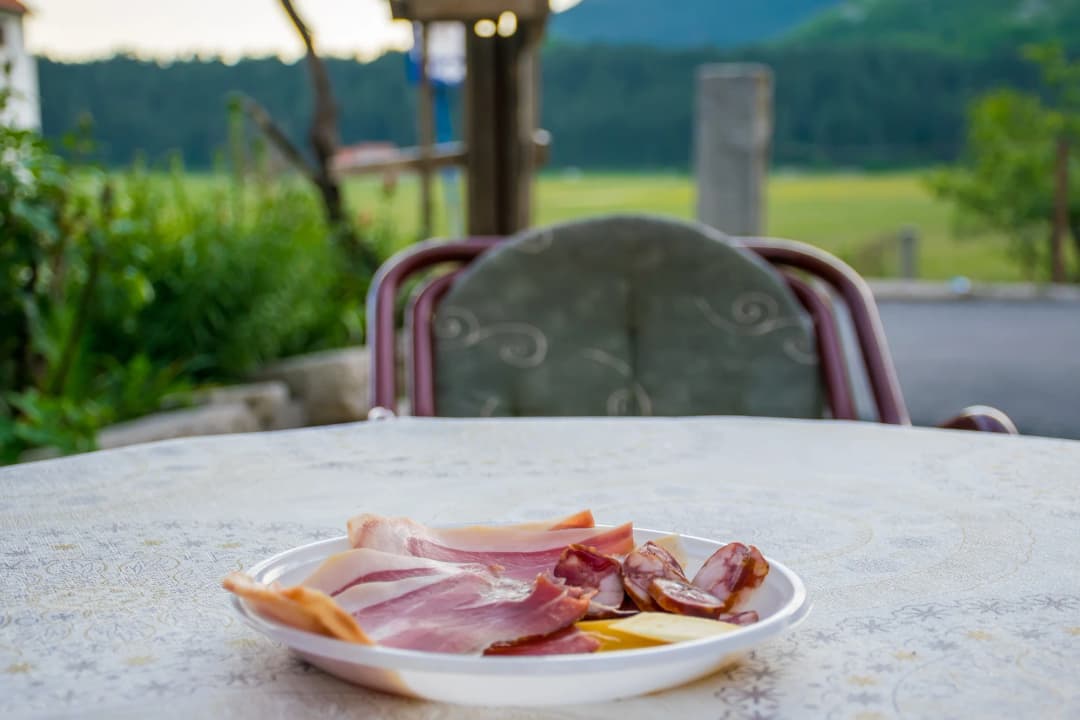
Montenegro's Agriculture Ministry registers Njeguški pršut as a protected geographical indication. Its registration notice defines it as a durable dry-cured product made from a bone-in pig leg, dry-salted with sea salt, smoked through slow burning of dry beech wood, then dried and matured for at least nine months. Production carrying the protected name is tied to the specified Njeguši territory and its named villages and hamlets.
| Stage | Requirement |
|---|---|
| Defined leg | with bone |
| Dry salted | sea salt |
| Slow smoke | dry beech |
| Dry + mature | minimum 9 months |
| Produced in | defined territory |
Source: gov.me
This matters at the table. “Local-style,” “mountain ham” and “Njeguši plate” are descriptions, not proof that the protected product is certified. Ask who produced the ham, whether it carries the protected designation and whether the seller can identify its origin. A small producer may offer excellent food without every item holding a geographical indication; accuracy is not a judgment of taste.
Njeguši cheese, sausage, honey and drinks can be part of the visit, but do not silently grant them the pršut's legal status. The broader Montenegro food guide helps distinguish regional dishes. Order a quantity you can finish, confirm the total before accepting an assorted platter, and ask about pork, dairy, alcohol and allergens rather than treating a traditional plate as universal.
Read the Lovćen landscape, not just the menu
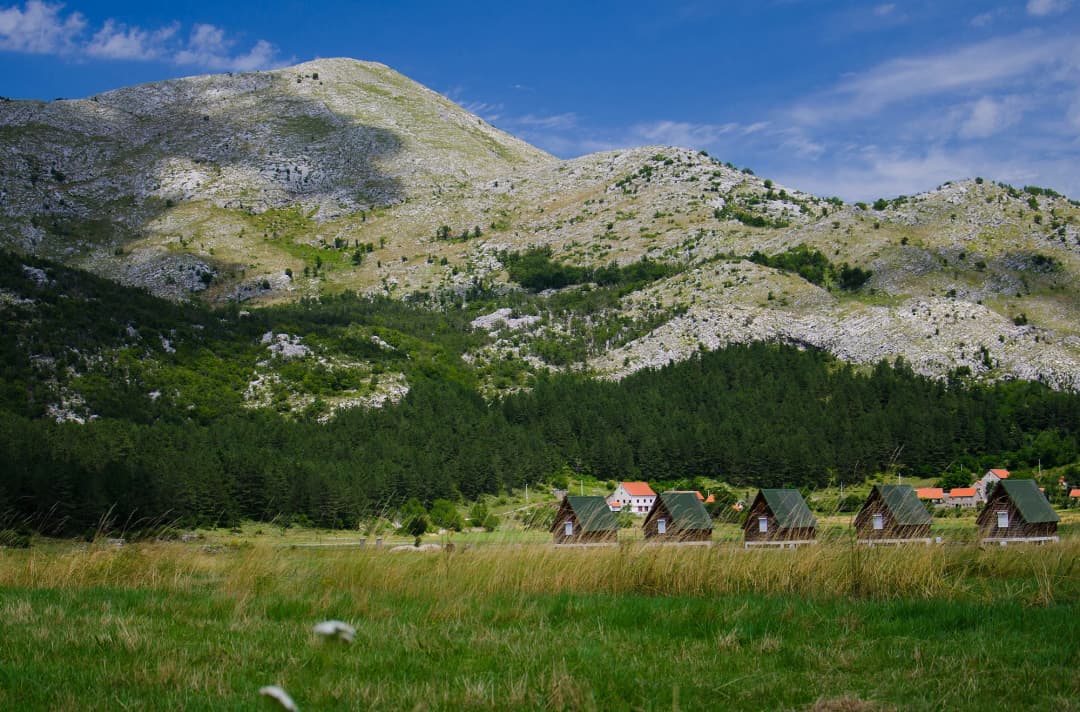
The draft Lovćen Management Plan for 2026–2030 describes a visitor centre at Ivanova Korita, marked walking routes, viewpoints and active control/payment points at Bjelosi and Krstac. Those facilities belong to the national-park system, while Njeguši also contains homes, farms, workshops, roadside businesses and museum property. One landscape does not mean one admission rule.
Before adding a walk, ask the park about the exact trail, weather, access point and current fee. Limestone ground can be loose or polished, summer storms arrive quickly, and shade can make conditions feel very different from the coast. Carry water, sun protection, a warmer layer and footwear with grip. Do not cross fences, enter smokehouses without invitation or treat private courtyards as public viewpoints.
The national park plan lists infrastructure; it does not promise that each bungalow, path, visitor service or road is operational today. A closed facility is not permission to improvise access. Families should choose a short signed walk around the least confident person, and drivers should retain daylight for the mountain road.
Practical half-day and full-day structure
| Priority | Core sequence | Live check | What to leave out |
|---|---|---|---|
| History | Birth House → slow village walk → Cetinje museum context | National Museum hours and alerts | Do not force the mausoleum if weather or time is poor |
| Food | Producer questions → small tasting → landscape stop | Origin, price, allergens and designation | Do not infer certification from a menu name |
| Scenic road | Choose a direction and time that avoids both closure windows | 08:00–15:00 downhill; 14:00–19:00 uphill; same-day controls | Do not assume either serpentine direction remains open all day |
| Walking | Park information → signed route → village stop | Trail, weather, fee, daylight and vehicle limit above mausoleum parking | Do not combine a long hike with rushed museum hours |
For a half-day, choose the Birth House plus one food stop and one short landscape pause. For a full day, add either Lovćen's visitor infrastructure or Cetinje's museums, not every possible attraction. The first-time Montenegro guide helps place the excursion in a wider itinerary.
If starting on the coast, separate the travel day from unrelated sightseeing. Tivat, Budva and Kotor each deserve their own time. The inherited reporters could stop repeatedly because their story had no ticket window; a visitor today may lose the museum visit by copying that rhythm. Travellers using Budva as a base can pair a different day with the Budva Ballerina history rather than treating it as a roadside interruption.
Food, heritage and residents deserve the same care
Ask before photographing people, smokehouse interiors, food preparation or private buildings. Buying a plate does not buy access to a family's working spaces. Park only where the vehicle is fully clear of the road and entrances; a seemingly empty verge may be needed by farm machinery or emergency vehicles.
Carry waste out if no proper bin is available. Do not light fires, remove stone, build cairns or feed animals. In dry periods, a cigarette or hot vehicle part can cause damage well beyond the stop. Our Montenegro wildfire explainer provides the wider fire context, but posted park and emergency instructions take priority.
Spend where the service is real and clearly priced. A tasting, guide, museum ticket or locally made product can support the area, but nostalgia should not replace traceability. Keep receipts for packaged meat if crossing borders and check the destination country's animal-product rules before buying food to take home.
Frequently asked questions
Is Njeguši inside Lovćen National Park?
It sits within the Lovćen landscape and is closely connected to the park, but individual homes, businesses, museum property, roads and park facilities have different managers and access rules. Check the exact place rather than assuming one ticket or rule covers everything.
When can I drive between Kotor and Njeguši in 2026?
From 25 May through 15 October, the published order closes Njeguši→Kotor from 08:00 to 15:00 and Kotor→Njeguši from 14:00 to 19:00; both directions are closed during the 14:00–15:00 overlap. It also closes the R-25.1 parking-to-mausoleum section to vehicles both ways. Recheck official notices before departure.
When is Njegoš's Birth House open?
The National Museum page checked on 29 August 2026 lists 09:00–17:00 daily from 11 April to 15 November and winter closure from 16 November to 10 April. Check current news before travel; event closures can override the calendar.
Is all ham served in Njeguši protected Njeguški pršut?
No. The protected name has a defined specification and production territory. Ask for the producer and designation rather than inferring status from location or menu wording.
Do I need the Kotor serpentines to visit?
No. An out-and-back trip from Cetinje avoids making the steep Bay descent essential. It is often the simpler choice for an uncertain driver, poor weather or a schedule built around museum hours.
Can I combine Njeguši, Lovćen and Cetinje in one day?
Yes if priorities are limited and live access aligns. Protect the fixed museum or park window first, then add one substantial second stop. A complete tasting, long hike, mausoleum, multiple Cetinje museums and both road approaches is usually too much.