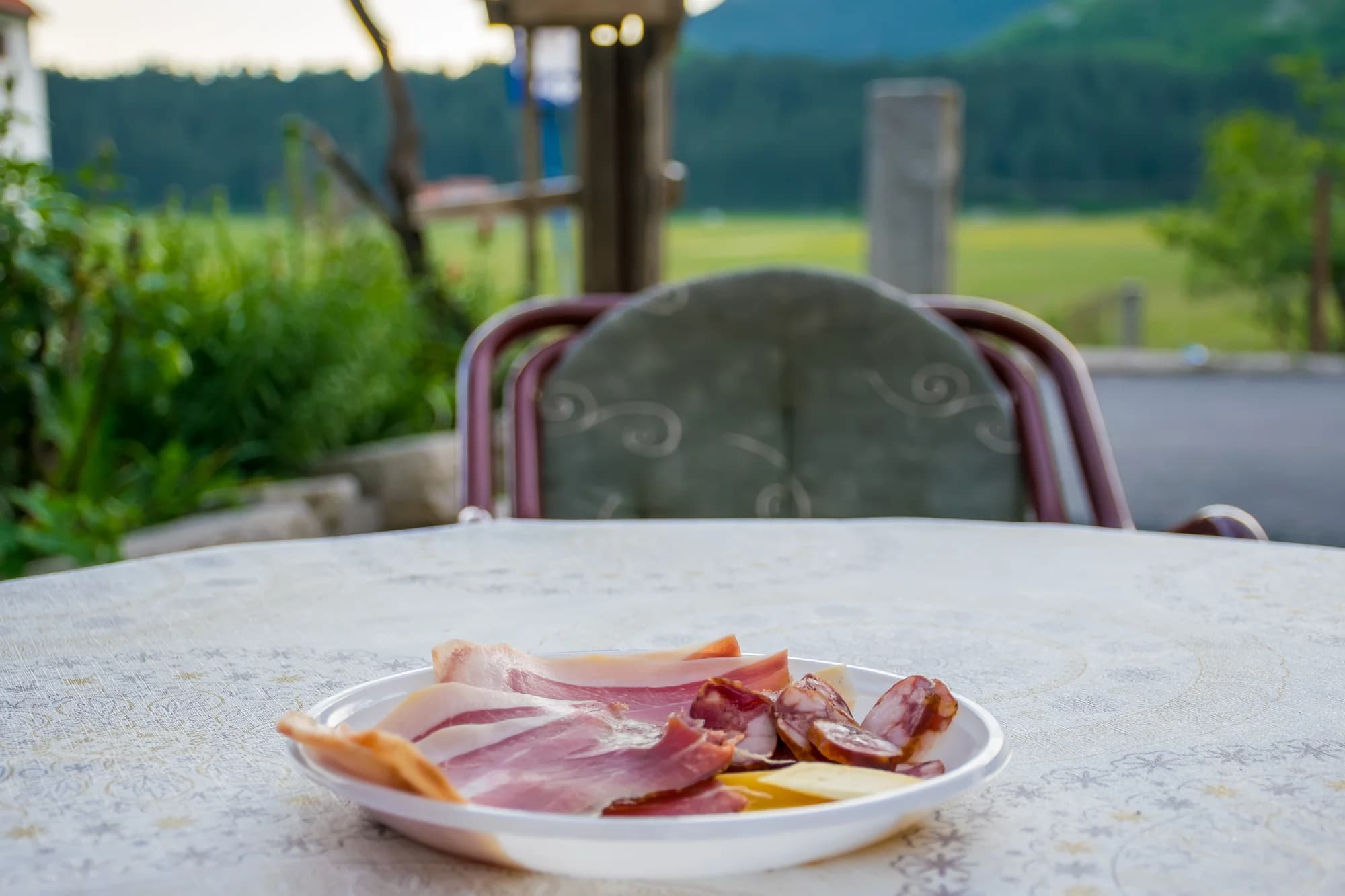
Thirty-three people live in Njeguši. The field around it gave Montenegro its dynasty and its protected ham — twenty-five hairpins above the Bay of Kotor.
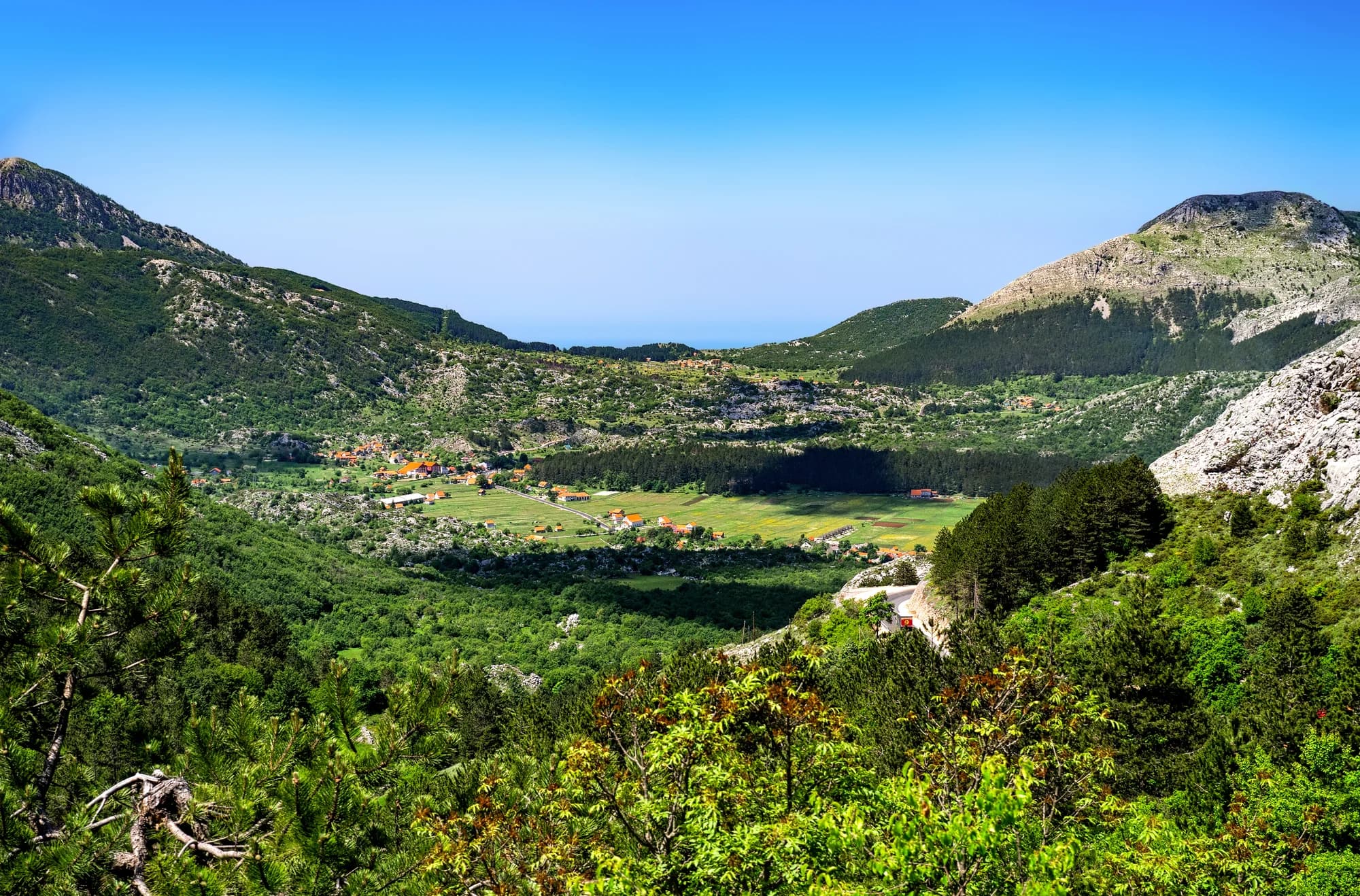
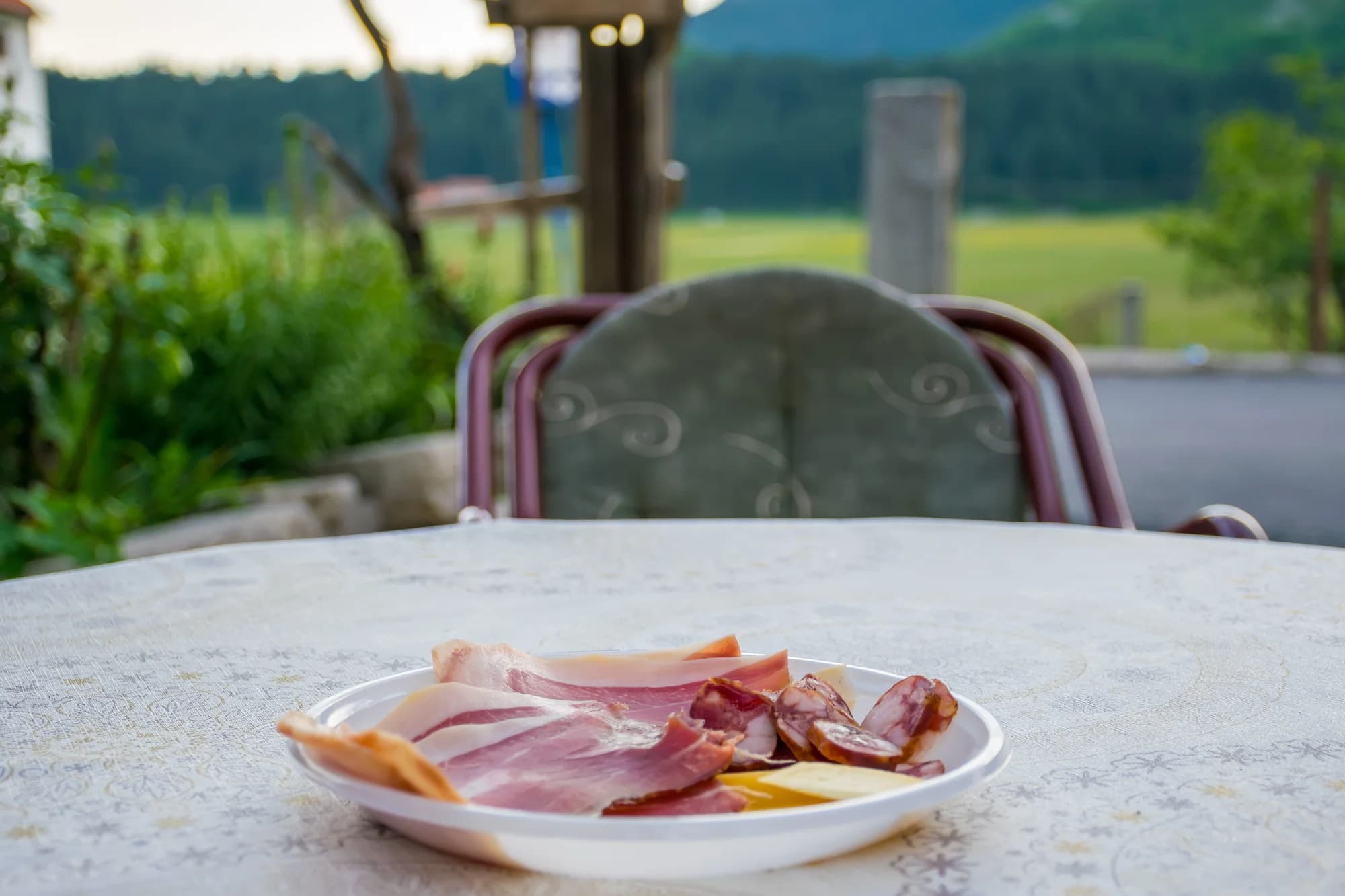
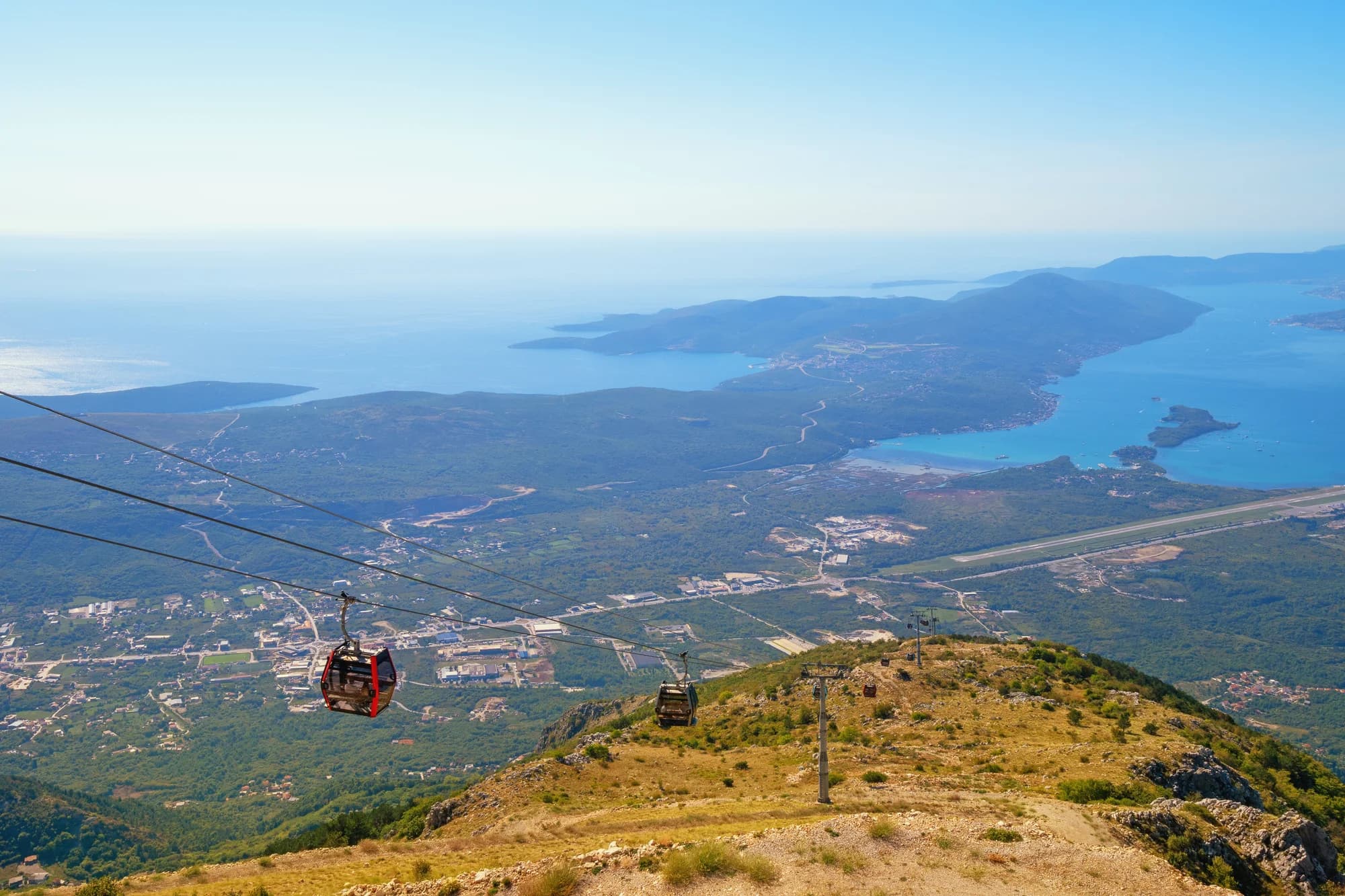
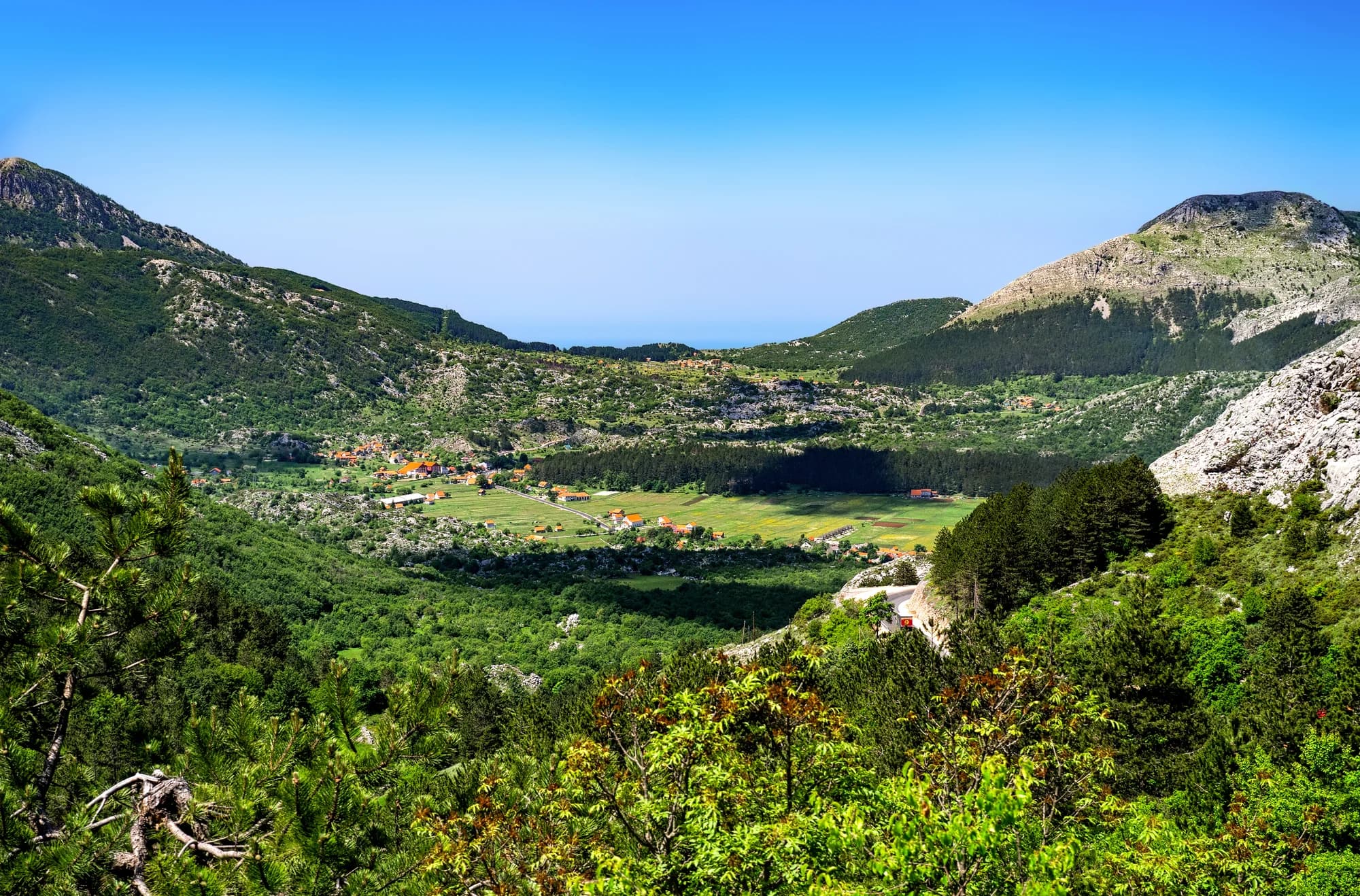
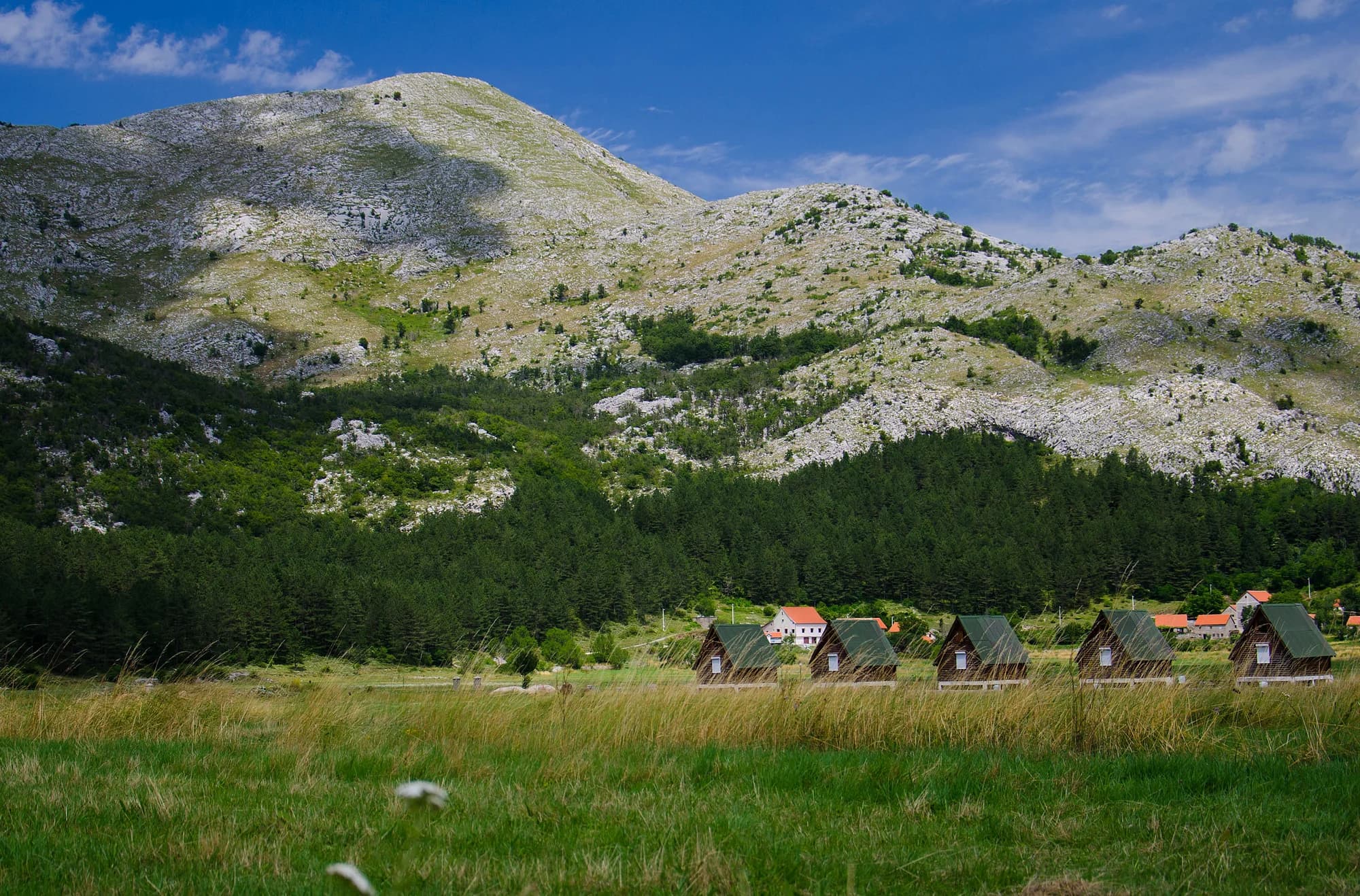
Njeguši is a mountain village on the shoulder of Lovćen, in a shallow karst basin between the summit and the Bay of Kotor, at around 900 metres. Stone houses with heavy slab roofs stand in loose rows among meadows and drystone walls, with the bare grey ridge of the mountain closing the horizon. The village belongs to Cetinje municipality and sits on the old road that links the coast with the old royal capital. Its name runs through Montenegrin history. The Petrović-Njegoš family came from here and ruled the country from 1696 until 1918. Petar II Petrović-Njegoš — bishop, ruler and author of the epic The Mountain Wreath — was born in the village in 1813, and his birth house is preserved as a small museum. King Nikola I, the last sovereign, was born in Njeguši in 1841. For a settlement of a few hundred people, that is an extraordinary concentration of national history. The other reason people stop is food. Njeguši produces the country's best-known smoked ham, njeguški pršut, salted, smoked over beech and then dried in the dry air that moves between the sea and the interior, along with a firm cheese often kept in oil. Family houses along the road sell both, usually with bread, olives and a glass of rakija, and the village fills with cars and vans in season. The road itself is part of the appeal: the Austro-Hungarian serpentine from Kotor climbs the escarpment in twenty-five hairpins, each with a wider view over the bay, while the older stone mule path known as the Ladder of Kotor runs beside it for walkers. Njeguši suits anyone driving between Kotor and Cetinje or heading up to the Njegoš Mausoleum, and it rewards an unhurried lunch rather than a photo stop. Late spring to October is the comfortable season; the basin holds snow in winter and the serpentine can turn icy or close.
A few hours
Two hours, and most of it is the drive — which is the point.
One full day
Njeguško polje
Best for waking in the field itself — Erakovići (93 residents) and Raičevići (52) are the two hamlets with more than fifty people left, and both lie inside the protected pršut’s territory
Lovćen national park
Best for the park’s own bungalows and tent pitches inside the boundary, €30 and €3 a day on its price list
Cetinje, 21 km east
Best for the old royal capital — hotels, museums and dinner, half an hour on the road rebuilt in 2018
Kotor, 21 km down
Best for the bay and the sea, with the whole climb still ahead of you in the morning
The field, hamlet by hamlet
Residents by settlement in Njeguško polje, 2023 census
Two hundred and fourteen people across the five hamlets that still carry a published number. Dugi Do is marked “z” — the statute suppresses any figure under ten — and Majstori and Žanjev Do are recorded with no inhabitants at all. In 1927 the tribe counted 450 households.
Who visits Montenegro
Share of foreign overnight stays, 2025
MONSTAT · 2025
Census population, Njeguši municipality
Njeguši is one settlement in a field the tribe once filled: 450 households in 1927, across the villages of the polje and the hamlets above and below it. Where six households make a village the line jumps — 17 people in 2003, 35 in 2011, 33 in 2023.
What changed here over five centuries is which of the field’s own families led the country. Widths are to scale: the Petrović vladikas of Njeguši held Montenegro for 155 years.
sr.wikipedia (the Njeguši tribe; the Cetinje–Njeguši–Kotor road) · en.wikipedia (Petrović-Njegoš dynasty, Principality of Montenegro, Lovćen).
Twenty-five hairpins
The Kotor road: sea level to the Krstac saddle, then down onto the field
Josip Šilović Slade, an engineer from Trogir, laid out the first cart road in Montenegro between 1878 and 1884: 36.3 km from Kotor to Cetinje, at most five metres wide, climbing from one metre to nearly a thousand on twenty-five 180º turns, none of them steeper than 8%. Profile sampled on SRTM 30 m at 21 even points along the 20.9 km to Njeguši, plus the Krstac saddle at 944 m.
A day on the road
Njeguši keeps the hours of the Kotor road — under the 2026 order, from 25 May to 15 October, the serpentines run one direction at a time
Meanwhile, in 1813
Njeguši, 13 November 1813: Radivoje “Rade” Petrović is born in Erakovići, in the house his uncle Petar I had built in 1779 — the middle of Tomo Petrović and Ivana Proroković’s five children, his mother from Mali Zalaz on the field’s northern rim. At twelve the monks at Cetinje teach him to read and write; at sixteen he is Prince-Bishop of Montenegro; he is dead at thirty-seven, having written Gorski vijenac.
The Boka — the same year Petar I, the ruling vladika and also born at Njeguši, declares the Bay of Kotor united with Montenegro. By 1815 the Austrian Empire has annexed the bay into Dalmatia, and no cart road connects the field to it until 1884.
Leipzig, 16–19 October 1813: some 560,000 soldiers meet at the Battle of the Nations, the largest engagement of the Napoleonic wars, and Napoleon loses Germany.
London, 28 January 1813: T. Egerton of Whitehall publishes Pride and Prejudice in three volumes.
“At Christmas the revelry here was unrestrained. The sausages hanging over a weak hearth fire went onto the flames; in the next house the crockery, the benches and a window were broken, and nobody was drunk. Bowls, soap and cakes were carried off, eaten or given to poorer houses — and nobody was angry or grudged the damage, because it was held that God would repay it.”
Pavle Rovinski, Russian ethnographer of Montenegro
Translated from the summary of Rovinski’s account of Christmas at Njeguši in the settlement’s Serbian Wikipedia article, which cites Ровински (1998), p. 126.
“Njeguši, from Njeguš — the personal name, of the same root as Njegomir and Njegoslav.”
Konstantin Jireček, historian of the medieval Balkans
Jireček’s derivation, set against Ilija Ruvarac’s older reading, which took the name from a founder called Njeguš appearing in a Latin charter of about the year 1000 as Negusius Podcupica. Both are given in the Serbian Wikipedia account of the tribe.
Search thousands of hotels and apartments with live prices.
We may earn a commission from partner links. This helps us keep Montenegro.com free for travelers.
Search hotels, apartments and guest houses with live availability.
We may earn a commission from partner links. This helps us keep Montenegro.com free for travelers.

Plan the dramatic route from Perast and Kotor to Njeguši and the Njegoš Mausoleum, with 2026 traffic controls, museum ho

Plan an evidence-led Njeguši visit with current museum access, protected-origin pršut, Lovćen context, route choices and
Njegusi is a village on the Lovcen plateau at about 900 m, on the old road between Kotor and Cetinje. It is roughly 45 minutes up the serpentines from the bay, inside Lovcen national park, and consists of a handful of stone hamlets around a green karst field.
For two things: it is the ancestral village of the Petrovic Njegos dynasty that ruled Montenegro, and it gives its name to the country's best-known cured ham. Petar II Petrovic Njegos, the prince-bishop and poet, was born here in 1813.
Ham salted, smoked over beech and then air-dried in the draught that crosses the plateau — the combination of sea and mountain air is credited with the flavour. It is served in paper-thin slices, usually with the local cheese in oil and a glass of rakija.
Yes. The family house in the village is open as a small museum, with period rooms and objects relating to the dynasty. It is modest, which is the point: it shows how plainly the rulers of Montenegro actually lived.
The road from Kotor is the attraction as much as the village — twenty-five hairpins with the bay opening below at every turn. It is narrow and slow, and best driven uphill from Kotor rather than down, which is also how most traffic runs.
An hour or two. Eat, see the house, walk out into the field, then continue to Cetinje or up to the Njegos mausoleum. Most people combine it with Lovcen in a single day out from the coast.
No — the nearest is Tivat Airport (TIV), 23 km away by road.
9.8 km by road, about 16 min by car.
The UK Foreign, Commonwealth & Development Office (FCDO) has no advisory against travel to Montenegro; it last reviewed its guidance on 13 August 2026. That is their assessment of the country as a whole, not ours and not a judgement about Njeguši, so read it yourself before you travel. The emergency number in Montenegro is 112.
The local plate
Montenegro registered the name in 2016, and the registration is a recipe: a bone-in pig leg with the skin and the fat under it, dry-salted with sea salt, smoked over the slow burn of dry beech, then dried and matured for at least nine months. The protected name belongs only to hams made in the Njeguši territory — the villages of the polje, the two Zalazi, Žanjev Do, Mirac, Majstori and the hamlets up to Krstac. “Mountain ham” on a menu is a description, not the designation.
Where The family konobas along the old Kotor road, on the field itself
The nearest places to Njeguši, at their true positions — Rijeka Crnojevića is about 17 km away in a straight line.
Schematic. Positions and straight-line distances from the coordinates we hold for each place; mountain roads make the drive longer. Coastline and Lake Skadar © OpenStreetMap contributors.
Njeguši in numbers
2023 census, Njeguši settlement — 61 people lived here in 1948
the Njeguši in the Venetian archives, at a strength of 400 houses
the floor of Njeguško polje, measured at the village on SRTM
Tivat (TIV) by road, half an hour down — Podgorica (TGD) is 55 km
Lovćen national park, 62.2 km² — the village lies inside it
MONSTAT, Broj stanovnika po naseljima, Popis 2023 · sr.wikipedia (Njeguši; the Njeguši tribe) · en.wikipedia (Lovćen) · road distances measured on OpenStreetMap data, elevations on SRTM 30 m
Best time: April · May · October
| Place | By road | Driving |
|---|---|---|
| Cetinje | 9.8 km | about 16 min |
| Čevo | 14.9 km | about 17 min |
| Lovćen | 20.9 km | about 28 min |
| Rijeka Crnojevića | 27.3 km | about 35 min |
| Kotor | 28.4 km | about 41 min |
| Budva | 38.5 km | about 50 min |
| Podgorica | 45 km | about 53 min |
Road distances routed over OpenStreetMap data, © OpenStreetMap contributors. Driving times are free-flow and take no account of summer traffic or a queue at the ferry ramp.
The classic crossing of the mountain — coast to old capital, with Njeguši as the hinge.