Berane is a historic town in northeastern Montenegro, situated in the fertile Polimlje valley along the banks of the Lim River. Surrounded by the majestic mountains of Bjelasica, Cmiljevica, Turjak, and Komovi, Berane serves as an important cultural and administrative center in the north of the...
Updated Originally published 24 min readby Pavle Obradović
Berane is a historic town in northeastern Montenegro, situated in the fertile Polimlje valley along the banks of the Lim River. Surrounded by the majestic mountains of Bjelasica, Cmiljevica, Turjak, and Komovi, Berane serves as an important cultural and administrative center in the north of the...
Overview
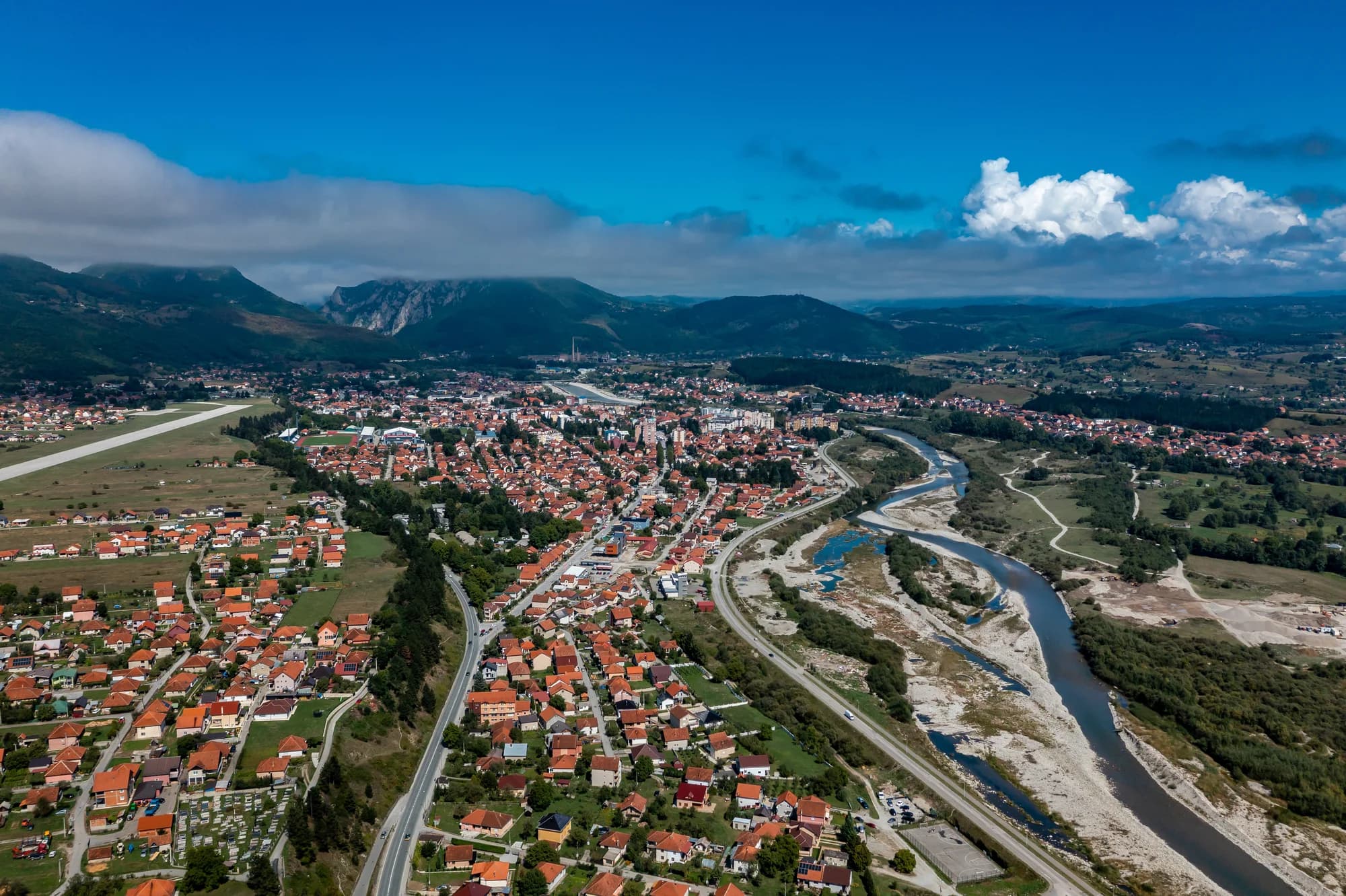
Berane is a historic town in northeastern Montenegro, situated in the fertile Polimlje valley along the banks of the Lim River. Surrounded by the majestic mountains of Bjelasica, Cmiljevica, Turjak, and Komovi, Berane serves as an important cultural and administrative center in the north of the country. With a population of 9,923 in the town center and 25,162 in the municipality (2023 census), Berane offers visitors a unique blend of medieval Serbian heritage, Ottoman influences, stunning natural landscapes, and authentic northern Montenegrin culture.
Top Attractions
Đurđevi Stupovi Monastery (Pillars of St. George)
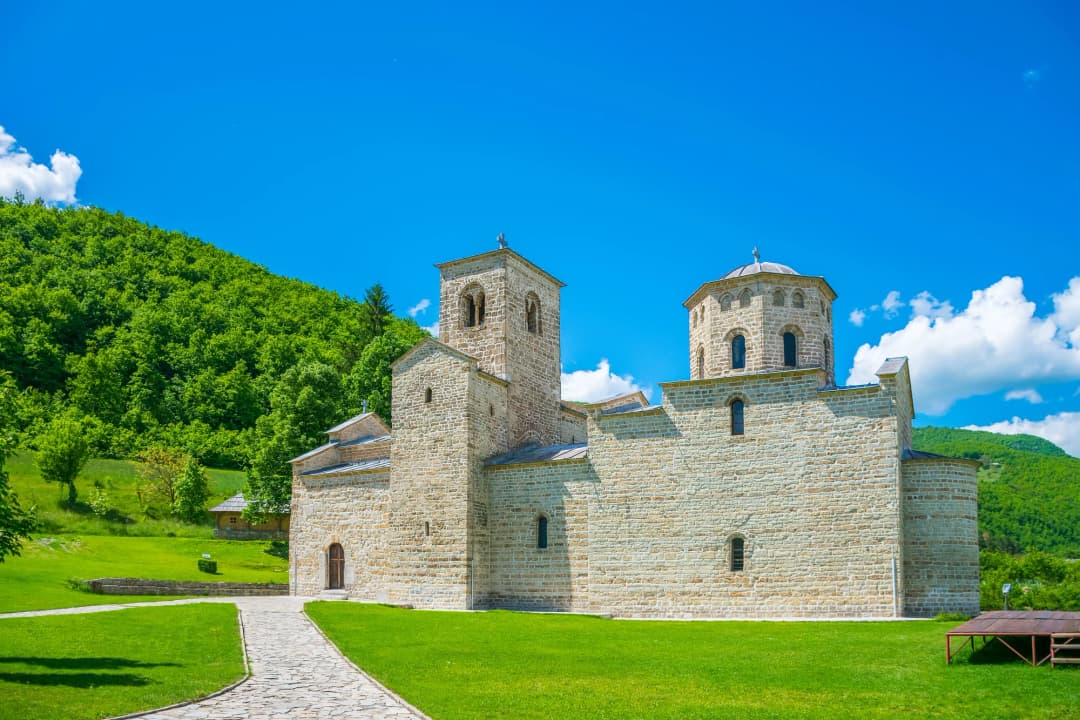
The Đurđevi Stupovi Monastery is the most important historical and cultural monument in the Berane area. Built in 1213 by County Prefect Stefan Prvoslav, the monastery sits on the left bank of the Lim River beneath the Rastovac point on the plateau Stupovi. The church is dedicated to the great martyr Saint George.
In 1219, Saint Sava established the Budimlje Diocese at Đurđevi Stupovi Monastery, making it one of the earliest seats of Serbian Orthodox ecclesiastical authority. Despite being burned multiple times by Ottoman forces throughout history, the monastery survived through the determination of local people and remains active today.
Since 2001, the Đurđevi Stupovi Monastery has again served as the seat of the Budimlja-Nikšić Diocese. The monastery celebrated eight centuries of existence, marking its profound historical and spiritual significance to the region.
Museum of Polimlje (Polimski Museum)
The Museum of Polimlje in Berane was established in 1953 as a regional museum serving the territory of Gornje Polimlje (Upper Polimlje): Berane, Plav, Andrijevica, Rožaje, and Bijelo Polje.
The museum holds diverse collections including archaeological, ethnographic, artistic, numismatic, heraldic, nature collections, and a collection of photographs. According to current records, these collections hold more than 4,500 items.
Neolithic treasures: The archaeological collection features figurines and ceramics from the Beran krš (Beran’s rocks) site, showing connections to the ancient Vinča culture
Thirteen amber items from Lisijevo polje depicting hunting scenes—items of particular archaeological value
Medieval chain-mail tunic: Found near Berane at Donja Ržanica, weighing 18.5 kg and presumed to date back to the Crusaders’ time
Ethnographic treasures: National costumes, ornaments, manufacturing tools, and items related to the daily life of the local population
Illyrian and Roman artifacts: Weapons, tools, ceramics, and ornaments
The Lim River and Riverside Promenade
The Lim River flows through the heart of Berane, creating the fertile Polimlje valley that has sustained the region for centuries. At 219 km (136 mi) long, the Lim flows through Albania, Montenegro, Serbia, and Bosnia and Herzegovina. Its uniquely green and emerald-green waters are remarkably pure and icy-cold, flowing through numerous high and steep canyons and ravines.
The Riverside Promenade in Berane is known for its lively atmosphere, especially during local festivals and markets where visitors can experience Montenegrin culture firsthand. The town also offers a traditional romantic promenade called the “corsoe,” a beloved local tradition during summer months.
Berane Fortress and Old Town Center
Visitors can explore the Berane Fortress to immerse themselves in local history and culture. The town has many important historical sites that attract those who love history and architecture, reflecting both its medieval Serbian heritage and Ottoman influences.
Natural Attractions Near Berane
Ursulovačko Jezero (Ursulovac Lake): A stunning mountain lake located in the heart of the Bjelasica mountain range at 1,895m elevation, this glacial lake is one of the most scenic destinations for hikers in the region.
Pešića Lake (Pesica Lake): A secluded glacial lake situated high in the Bjelasica mountain range at 1,820m, often considered the most beautiful of Bjelasica’s five glacial lakes.
Biogradska Gora National Park: Located approximately 20 kilometers northeast of Berane, this park is known for its untouched forests, crystal-clear lakes, and diverse wildlife. The park contains one of Europe’s last remaining primeval forests.
Nearby Monasteries: Beyond Đurđevi Stupovi, the region includes other important Orthodox monasteries including the Monastery of Šudikovo (destroyed in 1738) and the Morača Monastery, a medieval Serbian Orthodox monastery near Kolašin dating back to the 13th century.
Nature & Outdoor Activities
Hiking and Mountaineering
Berane serves as an excellent base for exploring some of Montenegro’s most spectacular mountain ranges.
Bjelasica Mountain
Bjelasica is known as the greenest mountain in Montenegro, spanning over 630 km² and renowned as one of the country’s most picturesque and verdant ranges. The largest peaks include Crna Glava (Black Head) at 2,139m, Zekova Glava at 2,117m, and Troglava at 2,072m.
Hiking trails: There are ten marked hiking trails, mostly starting from Kolašin or Mojkovac, with some beginning from Berane and Andrijevica. Trails are medium-hard difficulty with an average length of 12 km, with the largest being 35 km long and taking around 8 hours to finish.
A 120 km long mountain transversal ‘CT-1’ crosses Bjelasica, taking six days in total or three days if hiking only the Bjelasica and Biogradska Gora National Park section.
Popular routes from Berane: Starting from Katun Reljina, a breathtaking trail takes you to Crna Glava (2,139m), offering panoramic views of Montenegro’s mountain ranges. Katun Vranjak, at 1,800m altitude in the green meadows of Bjelasica, serves as a starting point for many trails.
Komovi Mountain Range
The Komovi Mountains are one of Montenegro’s three most impressive mountain ranges, situated in eastern Montenegro and stretching between the Lim River to the east and the Tara River to the west. The highest peaks are Kučki Kom (2,487m), Ljevorijecki Kom (2,469m), and Vasojevički Kom (2,460m).
The Komovi Peaks Route is a demanding trek with rewarding views at each summit. There are numerous well-marked climbing and hiking trails, as well as operational mountaineering clubs organizing traditional treks.
Peak highlights: Vasojevićki Kom (2,460m) has a medium difficulty track ideal for all hikers, even children and the elderly, requiring about two and a half hours to climb. Kučki Kom (2,487m) is the hardest and biggest, with demanding climbing and descending requiring careful navigation.
Starting point: At the foot of Vasojevićki Kom is the vast plateau of Štavna, the starting point for almost all popular hiking tours to Komovi.
Best time to visit: Late spring through early autumn (May to September), when temperatures are mild and weather is generally stable with minimal rainfall.
Kuči Mountains
The Kuči Mountains are ideal for hiking and trekking adventures with breathtaking views over unspoiled nature, offering another excellent option for outdoor enthusiasts visiting Berane.
Fishing
Berane offers excellent fishing opportunities along the Lim River. There is a 3-kilometer-long fly fishing zone near the town with fish species including: - Grayling - Brown trout - Chub - Large huchen (Danube salmon)
A catch & release route on the Lim River near Berane has been established with better control and a healthy population of huchen that typically grow larger in this section.
Rafting and Water Activities
Visitors can enjoy 3-hour rafting tours down the Lim River canyon to Berane, which offer relaxed freshwater fishing and the opportunity to enjoy colorful plants found only in their native canyon environment. The river’s emerald-green waters and dramatic canyon landscapes make for memorable aquatic adventures.
Rural Tourism and Farm Stays
Berane offers authentic rural tourism experiences that combine clean nature, fresh air, exploring the unknown, and enjoying forgotten flavors of local specialties.
Kljajic House: A recipient of Wild Beauty Awards in 2014 and 2018 (category: Rural Tourism) given by the National Tourism Organization of Montenegro. Built over 100 years ago, the house offers homemade food including bread and cheese, baked vegetables, cakes, and honey.
Rural Household Malo Selo: Located 15 km from Berane municipality in the village Kurikuće at the foot of Bjelasica mountain, near Biogradska Gora National Park.
Farmstay Oka i Po: Features a garden, outdoor pool, and lake views.
These experiences offer quiet retreats with organic farm-to-table goodness, opportunities to join in small working farm activities, communities formed by generations, and nature that invites appreciation and adventure.
Culture & Traditions
Multiethnic Heritage
Berane is an ethnically mixed municipality with a relative Serb ethnic majority at 41.43%, indicating significant multiethnic population diversity. The town is part of the Sandžak region, predominantly populated by Serbs, Bosniaks (Muslims), and Montenegrins. This diversity has shaped the region’s cultural landscape throughout history.
Orthodox Religious Heritage
The main influence on the development of culture in this area, historically and up to recent times, came from the Serbian Orthodox Church and its monasteries: Šudikovo, Đurđevi Stupovi, and others, which served as cornerstones of spirituality for the Serb population.
The Budimlja episcopate, known as the Budimlja-Nikšić eparchy, was restored in 2002 upon the appointment of Bishop Joanikije, continuing centuries of ecclesiastical tradition.
Traditional Cuisine
The Polimlje region’s cuisine features:
Traditional dishes: Hearty foods like ćevapi (grilled meat) and kačamak (cornmeal mash), reflecting Montenegro’s mountain heritage.
Local beverages: Montenegro’s famous wine and rakija (fruit brandy).
Culinary influences: A blend of Ottoman, Italian, and Balkan cuisine, reflecting the region’s multicultural history.
Agricultural foundation: The cuisine is rooted in livestock rearing (cattle and sheep) and crop cultivation (potatoes, fodder crops, and tobacco), with the mountainous terrain particularly suitable for pastoralism.
Festivals and Events
While Berane hosts various cultural and community events during summer months, the town has recently welcomed regional youth gatherings and cultural exchanges. The Riverside Promenade becomes especially lively during local festivals and markets, offering visitors authentic experiences of Montenegrin culture.
In June 2025, Berane hosted “Youth in Action: SHAPE THE FUTURE 2025,” a regional summer camp designed to connect youth and give them tools to lead, organized by GIZ (German Development Cooperation), the Ministry of Sports and Youth of Montenegro, and the Regional Youth Cooperation Office (RYCO).
Practical Information
Getting There
Berane is located in northeastern Montenegro, close to the border with Serbia to the north and Kosovo to the east, at the confluence of the Lim River and Lješnica River.
Accommodations
Berane offers approximately 103 hotels, guesthouses, and rural farm stays catering to diverse traveler needs, from welcoming hotels to charming countryside accommodations.
Hotel Berane: Located 25 miles from Plav Lake, providing accommodations with a garden, free private parking, a private beach area, and a shared lounge, with a restaurant, room service, and 24-hour front desk, plus free WiFi.
Hotel Komovi: A 3-star property located 8 miles from Berane, perfect for business travelers and pet owners.
Villa Eksenia: Just 8 miles from Berane, offering a unique and welcoming experience with a focus on inclusivity.
Best Time to Visit
For budget travelers: June through August offers generally the lowest hotel prices.
For hiking: Late spring through early autumn (May to September) offers mild temperatures and stable weather with minimal rainfall, ideal for mountain activities.
For cultural experiences: Summer months feature the most vibrant community events and festivals.
Geographic Context
Berane sits at the heart of the Polimlje valley, meaning “Lim valley.” The fertile valley has been an important agricultural region for centuries, especially for cultivating fruits and stockbreeding. The valley represents an area around a composite river valley, made of several gorges and depressions, divided into three large parts: Montenegrin, Stari Vlah, and Bosnian.
Why Visit Berane
Berane offers an authentic experience of northern Montenegro that remains largely undiscovered by mass tourism. Visitors will find:
Rich medieval heritage: Including the 800-year-old Đurđevi Stupovi Monastery and connections to Saint Sava
Stunning mountain landscapes: With access to Bjelasica, Komovi, and Kuči mountain ranges
Authentic cultural experiences: Rural tourism, traditional cuisine, and multiethnic heritage
Outdoor adventures: Hiking, fishing, rafting, and nature exploration
Historical depth: From medieval Budimlja through Ottoman influences to Yugoslav industrialization
Unspoiled nature: Glacial lakes, primeval forests, and the emerald waters of the Lim River
For travelers seeking to explore Montenegro beyond the coastal crowds, Berane represents the authentic heart of the country’s northern region—a place where history, culture, and nature converge in spectacular fashion.
Berane in one day: the decision table
A realistic heritage-day sequence
Stop
Why include it
Time to reserve
Check before going
Main street and centre
Orientation, food and the town’s social core
30–60 min
Parking, street works and your verified bus stop
Polimski Museum
Regional archaeology, history and ethnology
60–90 min
Opening, address, entrance, exhibition and access
Đurđevi Stupovi
Active monastery founded in the early 13th century
60–90 min plus travel
Worship, visitor access, photography and mobility
Lunch or long break
Keeps the day flexible and avoids rushing sacred spaces
60–90 min
Dietary needs and opening hours
Jasikovac, optional
Nationally significant memorial and city view
60–90 min
Daylight, weather, path condition and return route
Lim Park alternative
Lower-effort green-space pause near the centre
30–60 min
Current surface, lighting and river-edge conditions
The times are planning allowances, not published tour durations. Start with the place that has the least flexible opening—normally the museum—then fit the monastery around worship and finish with the weather-dependent stop. If arriving by bus, solve your departure point before beginning the route.
Getting there by bus: verify the stop, not just the timetable
Berane’s transport situation is easy to misread online. Commercial booking pages still display “Berane bus station,” yet the municipality’s 2025–2030 mobility plan says the terminal had been closed for more than four years after the private owner’s bankruptcy and buses were using a makeshift stop nearby. The same plan describes missing waiting rooms, toilets and information desks.
There has been institutional movement, but it is not the same as verified passenger operation. The municipality took possession of the property on 27 May 2025. A May 2026 assembly agenda then included a proposed statute for a municipal bus-station company. Neither item proves that a staffed terminal, ticket desk or indoor waiting area was fully operating on 29 August 2026.
Book only after the carrier confirms the exact departure and arrival point for your date. Ask for a map pin or written street description, not “at the station.” Confirm whether a ticket bought online still needs printing or station validation, where luggage is loaded, and how early the driver expects passengers. Save the reply and return contact offline. Arrive in daylight when possible, especially if the stop is temporary and has few amenities.
If a return connection is essential, do not build the day around the last theoretical bus. Choose an earlier service and keep taxi money available for the local segment, not as a promise that a long-distance replacement ride will be obtainable. The broader first-time Montenegro guide covers country-level transport expectations; Berane’s stop uncertainty is a local exception worth handling explicitly.
Administrative progress is not an operating timetable
A timetable result alone cannot answer these questions
Source: berane.me
Start in the centre, not on a remote hillside
Berane’s municipal mobility plan describes the main attractions and amenities as concentrated in the centre. The main pedestrian street, Cultural Centre, Polimski Museum and House of Gavro Vuković sit within the practical urban core; Lim Park is also nearby. This makes the centre the correct place to orient, find facilities and recover from a delayed arrival.
The local tourism organisation presents the main street as the town’s continuing social centre, with cafés, restaurants and pastry shops. Its historical claim that Rizvan-beg designed the broad street in 1862 after a Paris education is interesting but needs specialist documentation beyond a tourism page. For a day visitor, the dependable fact is simpler: this is the place to pause, eat and observe daily Berane rather than racing between monuments.
Do not assume the whole centre is step-free because destinations are close together. Kerbs, temporary works, winter surfaces and entrances matter more than map distance. As of late August 2026 the municipality was renewing road markings in the central zone, a reminder that current street work can alter crossings and parking. Ask the tourism office or venue for route-specific access information.
Polimski Museum: confirm the basics by phone
The Polimski Museum is the strongest first cultural stop because it supplies context for everything outside. Its own site describes archaeology, history, ethnology and heraldry collections and about 10,000 objects. The archaeology page documents a far deeper settlement record than the old article’s single Roman-site sentence: Beran Krš yielded material dated to the middle of the fourth millennium BCE, while other recorded sites span the Mesolithic, Copper and Bronze Ages, Roman period and Middle Ages.
Those dates concern excavated material, not open-air attractions. Do not enter a field, cemetery or ruin because a museum research page names it. Ownership, conservation, signage and physical safety are separate questions. Use the collections to understand the region; arrange any specialist site visit through the museum or tourism organisation.
The museum’s current English home page publishes Monday–Saturday hours of 08:00–20:00. However, its own web pages conflict on the address and phone. The home page says Miloša Mališića 2 and 051 234 276; a recent museum article footer says Beransko-andrijevačkog bataljona 1 and 051 680 900; the municipal institution profile says Miloša Mališića 21. These may reflect a typo, changed offices or different facilities, but the sources do not resolve it.
Call or email before the day and ask for the visitor entrance as a map pin, the exhibition on view, the last admission, ticket price, language support, photography rule, toilets and step-free route. A published 20:00 closing time should not be treated as proof that every gallery or service is available until 20:00. The museum’s live home page is the best first contact, followed by direct confirmation.
Đurđevi Stupovi: visit as a monastery, not a backdrop
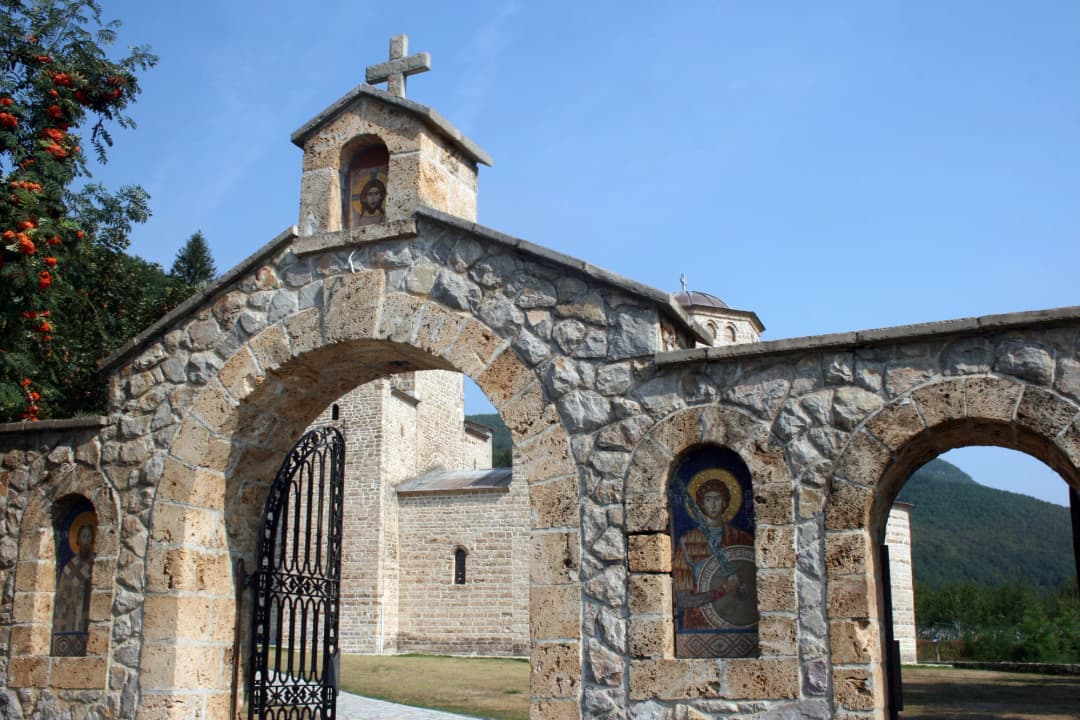
The local tourism organisation dates Đurđevi Stupovi to 1213, founded by Stefan Prvoslav, and places it about two kilometres from central Berane. Church histories connect it with the Budimlja episcopal seat created in 1219. Its twin towers, stone massing and position above the Lim valley explain why it dominates Berane’s heritage imagery.
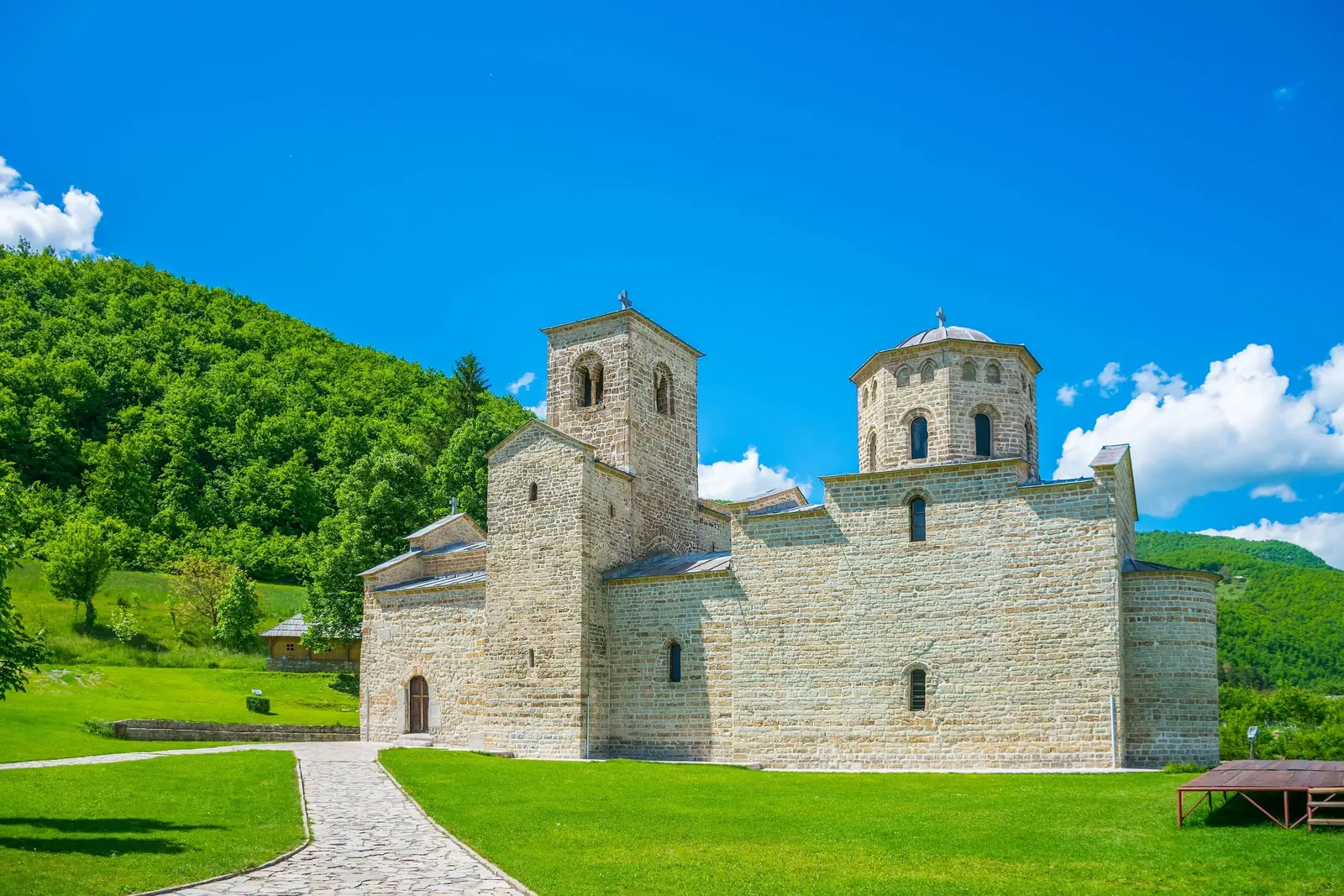
Đurđevi Stupovi near Berane, visually identified by its stone church and twin towers. The photograph does not establish current worship, opening or photography arrangements.
It is an active Orthodox monastery. Wear clothing that covers shoulders and knees, speak quietly, silence the phone and stop sightseeing when worship requires it. Ask before photographing interiors, icons, clergy or worshippers. Do not enter residential or closed areas, and do not treat an unlocked door as broad visitor permission.
No current official visitor page reviewed here establishes fixed tourist hours, a ticket price or step-free access to every desired space. Contact the monastery or local tourism organisation if timing or mobility is critical. A two-kilometre distance does not reveal gradient, pavement continuity, heat, snow or safe pedestrian separation from traffic; take a taxi when the walking route is uncertain.
Saint George’s feast can materially change the experience. A church report confirms that a procession passed from the monastery through Berane on 6 May 2026. That demonstrates a living annual tradition, not a reusable future schedule. If travelling around the feast, seek that year’s announcement and expect worship and local movement to take priority.
Jasikovac: important memorial, conditional visit
The Freedom Memorial on Jasikovac is not merely a viewpoint. The Polimski Museum says it was declared a cultural property of national significance and identifies architect Bogdan Bogdanović. Its account describes an 18-metre central monument surrounded by 40 granite blocks bearing ornament and roughly 10,000 inscribed letters. It commemorates local conflict and loss across several wars; approach it as a memorial landscape.
Current access descriptions conflict. The tourism organisation describes arranged walking paths, easy road access and parking. The municipality’s later 2025–2030 mobility plan says maintenance was inadequate, paths were inaccessible and the last major maintenance had been in 2015; it proposes rehabilitation, lighting, seating and signage over a three-year programme. The same plan describes Jasikovac as about a 15-minute uphill walk from the centre.
The conservative reading is clear: do not promise yourself or another traveller a 15-minute accessible walk. Go only in daylight and stable weather. Wear grip footwear, take water, and turn back at mud, ice, broken surfaces, poor lighting or unclear access. Do not climb on the monument or granite blocks. If step-free access is essential, obtain a current route description from the municipality or tourism office rather than relying on the words “easy access.”
Heritage facts are not access guarantees
Documented
Verify today
National cultural property
Path surface and maintenance
Bogdan Bogdanović design
Lighting and remaining daylight
18 m central monument
Parking and road access
40 granite blocks
Snow, mud, heat or storm
Memorial—not playground
Step-free route, if any
—
Uncertain conditions = choose the centre alternative
If Jasikovac does not fit, staying by the urban core is not a failed itinerary. The municipal plan identifies Lim Park as the largest park in Berane and places it near the pedestrian street. A short riverside pause can preserve energy and protect a bus connection while still giving the landscape context.
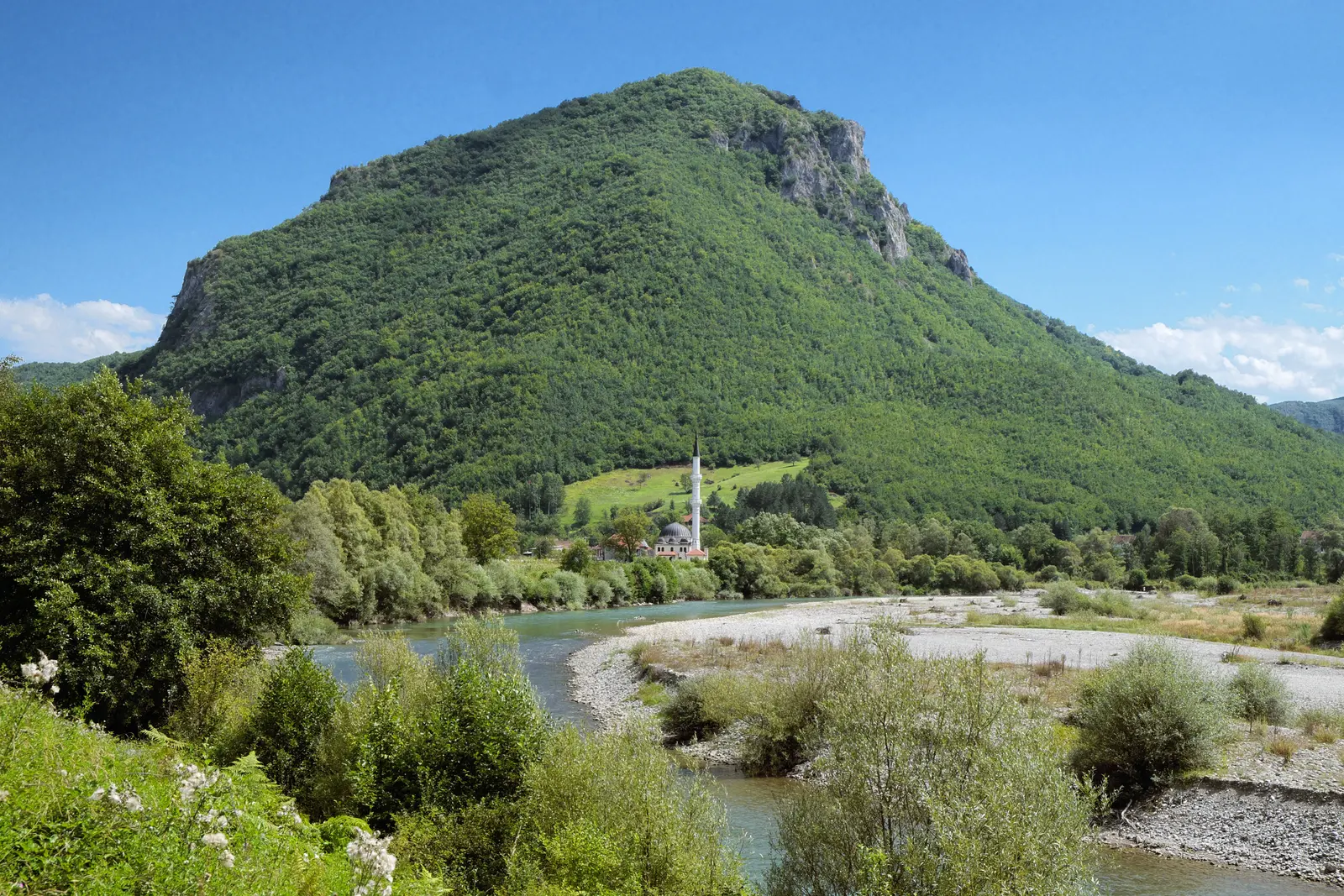
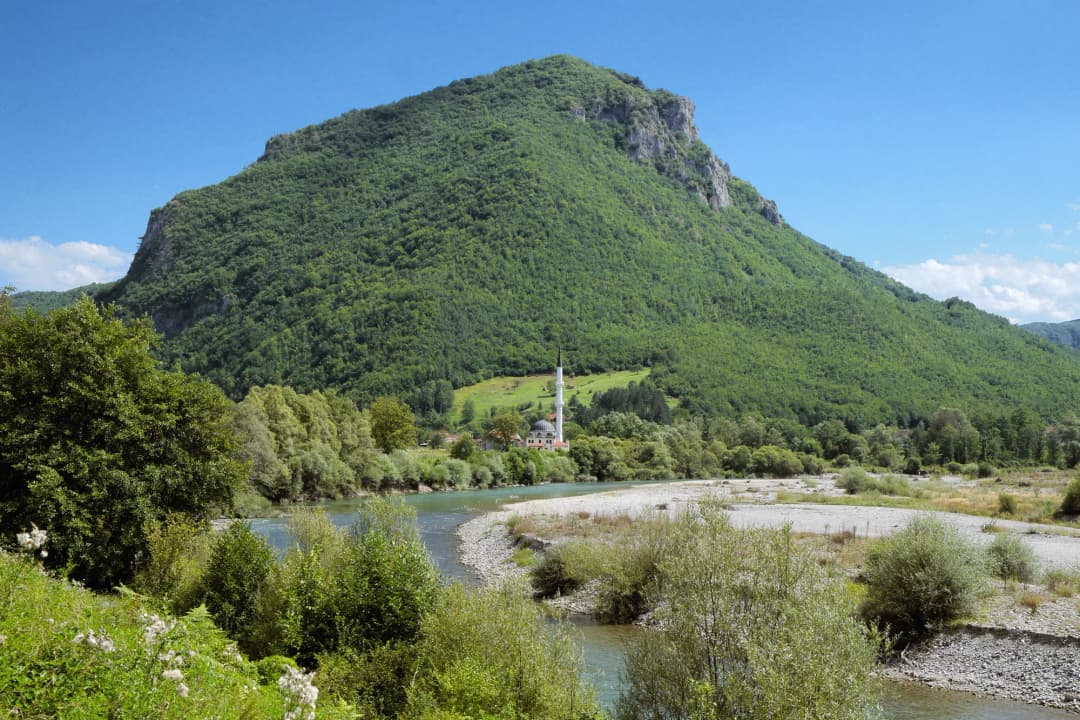
The Lim below a wooded hill in the Berane area. The exact viewpoint and hill name were not independently identified; river level and bank safety vary.
Do not infer safe swimming, rafting or bank access from a scenic photograph. River levels, current, erosion and works change. Remain on clear public paths, supervise children and keep away from unstable edges. Montenegro’s general emergency number is 112; save it, but prevention and a realistic route remain the first controls.
Why Jelovica and the glacial lakes are another day
The local tourism organisation lists Bjelasica, Mokra, Cmiljevica, Tifranska Gorge, the Lim and glacial lakes including Ursulovačko, Šiško and Pešića. These are genuine reasons to stay longer, but a destination list is not a same-day trail report. It does not establish road surface, trail marking, snow, water crossings, phone coverage, guide availability or rescue time.
Do not append a remote lake to the heritage route because the museum closed early. Plan a separate mountain day with current weather, route data, daylight margin and local advice. Tell the accommodation or guide the exact destination and return time. The same applies to winter skiing language around Jelovica: tourism potential does not prove operating lifts, patrol, avalanche control or equipment rental.
For an onward valley route, Andrijevica is a logical next base; Rožaje continues the northeastern story in another direction. Give either its own day rather than turning Berane into a hurried fuel stop.
Accessibility and family planning
“Walkable centre” describes proximity, not universal access. Ask the museum about the visitor entrance, lifts or steps, seating and accessible toilet. Ask the monastery about the route from vehicle drop-off to the spaces you hope to enter. For Jasikovac, treat the municipal warning about inaccessible paths as controlling until a current, route-specific source shows otherwise.
Families should keep the day compact. The museum plus monastery is enough for many children; choose Lim Park instead of a late hill climb when attention or daylight is fading. Bring water, weather layers and any essential medication. In winter, clear central streets do not prove that shaded slopes or steps are ice-free.
Budget for flexibility rather than a perfect free day. A taxi may be the correct link to Đurđevi Stupovi or the current bus stop, and a museum entrance or exhibition may have a charge even when no reliable price is published online. The Montenegro trip-cost guide provides national context; obtain local prices before committing.
History
Medieval Period: The Land of Budimlja
During the medieval period, the land of Berane was known as Budimlja, a region of great religious, political, and economic importance in the medieval Serbian state. Until 1455, when the Ottoman Turks conquered the city, Budimlja was part of the wider historical region of Raška within Medieval Serbia.
The area’s religious significance was established in 1213 when County Prefect Stefan Prvoslav, lord of the medieval Budimlja area and cousin of Stefan Nemanja, built the Đurđevi Stupovi Monastery on the left bank of the Lim River. Just six years later, in 1219, Saint Sava, the first Serbian archbishop, founded one of the first Serbian eparchies here at Đurđevi Stupovi Monastery, cementing the region’s importance to Serbian Orthodoxy.
Ottoman Era (1455-1912)
The Ottoman conquest in 1455 brought dramatic changes to the region. Berane as a modern town was officially founded in 1862 by order of Turkish general Husein Pasha, who established it in the vast Tifran valley, known for its fertile lands and natural mountain defenses.
During the Ottoman period, the region’s Orthodox monasteries faced repeated destruction. The Đurđevi Stupovi Monastery was burned by the Turks several times—in 1738, 1825, 1862, and 1875. In a remarkable act of resistance, when the Turks attempted to destroy it again in 1898, the local population stood against them, determined either to defend the monastery or to be burned within it. The monastery was preserved.
Berane was finally liberated in 1912 after the First Balkan War, becoming part of Montenegro and ending nearly five centuries of Ottoman rule.
The Ivangrad Period (1949-1992)
In July 1949, just a few years after World War II ended, the city of Berane changed its name to Ivangrad to honor Ivan Milutinović (1901-1944), an accomplished Partisan commander of Montenegro and Yugoslav Partisan general. By February 1944, Partisans had retaken Berane, at which point the town hosted a Grand National Assembly of Montenegrin Partisan leaders.
Ivan Milutinović died on October 23, 1944, when a small boat transporting him to Belgrade hit a naval mine in the Danube. He was decorated with the Order of the People’s Hero and proclaimed Hero of the People by Albania in 1947.
As Ivangrad, the town experienced prosperity and population growth during the 1960s and 1970s, developing as one of Yugoslavia’s important industrial centers. However, its original name was restored in March 1992, and the town’s economy didn’t recover due to the sanctions imposed on Yugoslavia in the 1990s.
Modern Challenges
Today, Berane faces significant economic challenges. The municipality is one of the poorest in Montenegro, with very low levels of industrial production since many companies stopped working in the past 15 years. The total number of employed in the municipality is approximately 3,000. However, there has been recent growth in small private companies, mostly in commerce and catering.
Quick answers
When is the best time to visit Berane?+
For budget travelers : June through August offers generally the lowest hotel prices. For hiking : Late spring through early autumn (May to September) offers mild temperatures and stable weather with minimal rainfall, ideal for mountain activities.
Berane is located in northeastern Montenegro, close to the border with Serbia to the north and Kosovo to the east, at the confluence of the Lim River and Lješnica River.
Berane serves as an excellent base for exploring some of Montenegro’s most spectacular mountain ranges. Bjelasica Mountain Bjelasica is known as the greenest mountain in Montenegro, spanning over 630 km² and renowned as one of the country’s most picturesque and verdant ranges.
Berane offers approximately 103 hotels, guesthouses, and rural farm stays catering to diverse traveler needs, from welcoming hotels to charming countryside accommodations. Hotel Berane : Located 25 miles from Plav Lake, providing accommodations with a garden, free private parking, a private beach area, and a shared lounge, with a restaurant, room service, and 24-hour front desk, plus free WiFi.
Pavle Obradović is from Herceg Novi. He was Manager of Montenegro.com, then Director of the Herceg Novi Tourism Organization, and is now Coordinator for Investment and Development Projects at the Municipality of Herceg Novi. He holds a BSc in International Hospitality and Service Management from the Rochester Institute of Technology (RIT).
···
Updated · Originally published
Montenegro Travel Newsletter
Get weekly stories, guides, and insider tips about Montenegro delivered to your inbox.