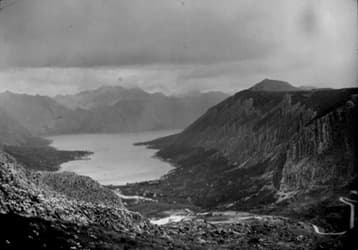
Montenegro.com's old gallery arrived with a one-word title—“Antiquity”—and sixteen tiny black-and-white files. The pictures are not ancient. They belong to the photographic era and concentrate on Kotor, the Bay of Kotor, Perast's islands, mountain roads and people whose names were not preserved in the article. This reconstruction does not manufacture a date or photographer. It turns an under-documented gallery into something more useful: an evidence-led lesson in how to look at a historic photograph without mistaking a plausible story for a fact.
What the archive can and cannot prove
A photograph is evidence of light reaching a camera at a particular place and time; it is not automatically reliable evidence of every caption later attached to it. A building may establish location. A shop sign can narrow language and commercial context. Clothing, road engineering, vegetation or photographic process can support an approximate range. None of those clues alone proves the photographer, year, identity, ethnicity, profession or purpose of the people shown.
The Library of Congress warns that historical captions can contain mixed-up places and dates. Its cataloguing practice distinguishes a transcribed date from an estimated one and records the basis of an estimate. ICOM-CIDOC documentation principles likewise treat documentation as a system of accountable information about an object. Applied here, those principles produce three labels: observed for what pixels show, identified for a place matched to reliable external evidence, and unknown where the archive cannot support a conclusion.
| Level | Acceptable statement | Evidence needed | What we avoid |
|---|---|---|---|
| Observed | “People stand beside baskets or produce.” | Visible detail in the scan | Inventing the event or conversation |
| Identified | “This is Saint Tryphon Cathedral.” | Distinctive architecture plus authoritative place record | Assigning an exact year from appearance |
| Attributed | “Possibly made by…” | Repository note, signature, verso mark or matched original | Publishing a famous photographer's name by resemblance |
| Unknown | “Creator and date not recorded.” | Transparent absence in available metadata | Hiding uncertainty behind “circa 1900” |
Frame 1: the bay is a cultural landscape
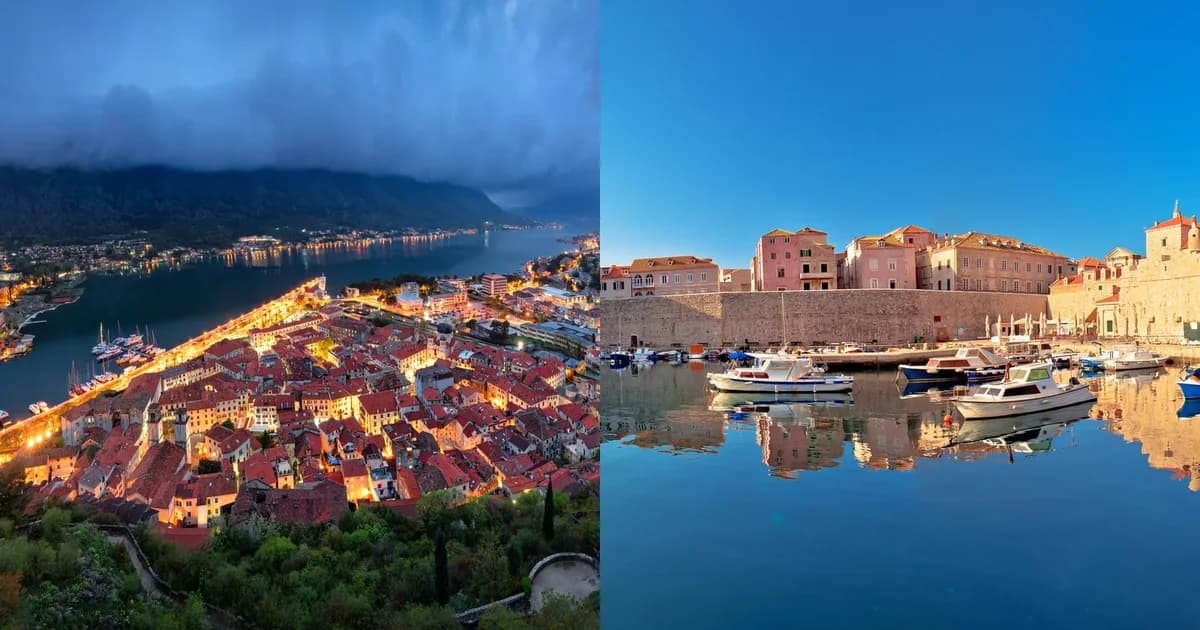
The first panorama matters because it defeats a common division between “natural view” and “historic town.” The UNESCO World Heritage record defines the Kotor region through the relationship among fortified and open settlements, cultivated terraces, coastline, paths, roads and mountain walls. The current property covers 14,600 hectares with a 36,491-hectare buffer zone. Those numbers describe World Heritage boundaries, not the whole Bay of Kotor.
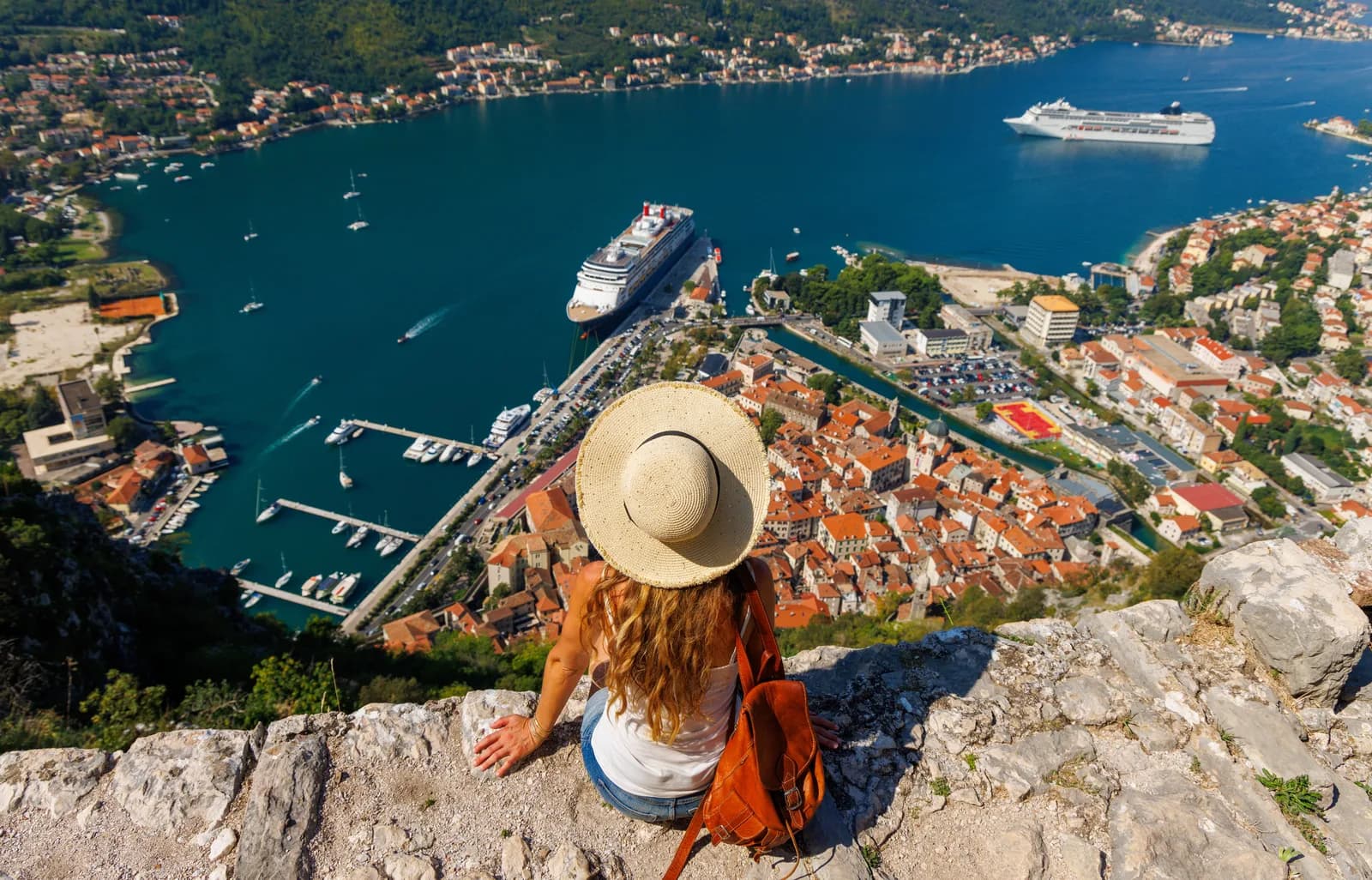
The road in the foreground is part of the story. From elevation, the bay reads as a chain of connected settlements rather than one postcard town. Roads and sea lanes shaped what people could carry, sell and see. For present geography before historical interpretation, use our Bay of Kotor guide; it explains the bay's parts without using the archive as proof of current conditions.
Frame 2: resist the confident place-name
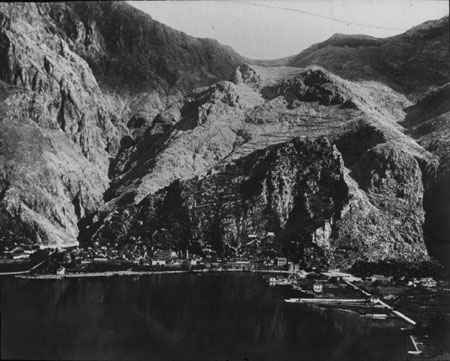
This frame tempts an instant answer. The mountain rises sharply; a waterfront and clustered buildings appear below. Several inner-bay settlements can produce that visual grammar. Without a legible church profile, street sign, repository caption or matched original, naming one would turn pattern recognition into false precision.
A useful investigation would compare historical shoreline plans, church towers, cadastral maps and photographs held by local institutions. Kotor's municipal museums preserve archaeological, artistic and documentary collections; Perast Museum holds maritime, ethnographic, historical-art, photographic and archival material. Montenegro's National Library says its Digital Library includes photographs, postcards, newspapers, maps and plans. Those are research routes, not retroactive proof that the image belongs to any one collection.
The modern traveller can compare the settlement sequence through our Risan, Perast and Kotor day guide or the quieter Muo guide. Do not use a visit to overwrite the archive: shorelines, vegetation, buildings and road cuts can change.
Frame 5: daily life is not decorative background
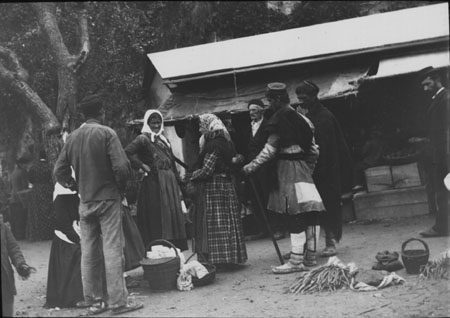
The legacy caption wondered what the group had gathered and discussed. Curiosity is valid; invented dialogue is not. Visible baskets, produce and an awning support the cautious phrase “market scene.” Dress varies within the group, but clothing cannot by itself establish each person's hometown, ethnicity, wealth or occupation.
This is where tourist nostalgia can do damage. A black-and-white street photograph is often flattened into “timeless tradition,” erasing work, gender, trade and the possibility that people deliberately dressed for town. Museum collections can help identify garment construction and use. For example, Museums of Kotor catalogues a men's ćemer from the early twentieth century as part of the Boka Navy uniform and describes its materials and placement. That record teaches specificity; it does not license us to label every belt or jacket in this photograph.
The right research question is not “What costume are these Montenegrins wearing?” but “Which visible garment features can a qualified curator compare with documented objects?” That shift protects the people in the image from becoming anonymous folklore.
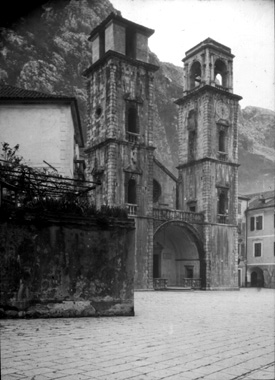
Frame 6: one building, multiple historical moments
What the sources say
Saint Tryphon Cathedral provides the gallery's strongest architectural anchor. Yet even here, identification is not dating. Historic buildings are repaired, altered, damaged and restored. UNESCO records that Kotor's monuments, including Romanesque churches and town walls, suffered serious damage in the 1979 earthquake. The site was placed on the World Heritage List and the List in Danger in 1979, then removed from the danger list in 2003 after professional restoration mitigated the earthquake threat.
That sequence changes how the photograph should be read. A façade seen today may include conservation choices made after the exposure. Conversely, a visible difference in an old image may reflect an earlier repair rather than the original medieval design. The photograph is a source for architectural comparison only when it can be tied to a date and restoration history.
For visiting logistics rather than archival claims, the Kotor cruise-port guide builds a time-limited walking plan, while our day trips from Kotor article places the old town in a wider itinerary. Check cathedral access and worship times locally; a heritage landmark remains an active religious space.
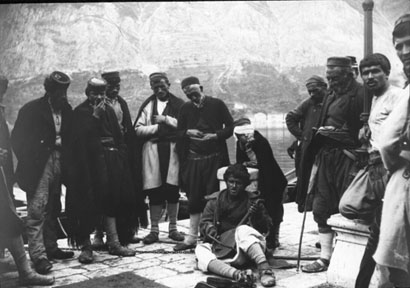
Frame 7: caption people with dignity
A seated musician holds a bowed string instrument while a mixed group faces the camera. The legacy text calls him a guslar on a mule, but the low-resolution scan does not establish every part of that sentence. The animal or seat is obscured; the precise instrument and performance context deserve specialist confirmation. A responsible caption says what is visible and records the inherited claim separately.
Weapons or long objects appear beside some figures. That does not make the group a military unit. Clothing ranges from garments associated with regional dress to shirts and jackets that read as more broadly urban. The image could involve performance, gathering, tourism, documentation or staged portraiture. Without provenance, those remain hypotheses.
Language also shifts over time. If a caption, shop sign or postcard inscription is found, preserve the original spelling in transcription, then explain it in current English rather than silently modernising the source. Our Montenegro language guide helps readers recognise contemporary scripts and usage, but it is not a palaeography manual.
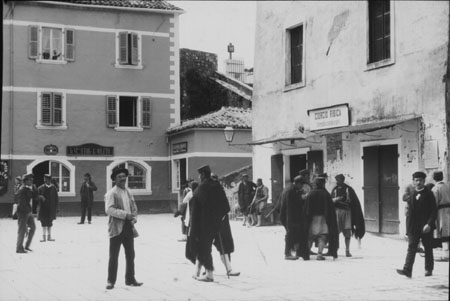
Frame 8: the missing information lives at the edges
Researchers often look first at faces. The more diagnostic evidence may sit behind them: a business name, street plate, paving pattern, window arrangement, church edge or shadow direction. Here, a small wall sign and façades invite comparison, but enlargement cannot create detail that the 450-pixel file never captured. Artificial sharpening may improve legibility at the margin; it cannot turn interpolation into evidence.
The original negative or a first-generation print could contain far more information. A verso might carry a photographer's stamp, postcard publisher, handwritten place or postal date. A sequence number could link neighboring frames to an album. The US National Archives recommends identifying photographs on their enclosures and protecting the image surface from damaging marks and materials. For this digital derivative, the analogous rule is to keep the untouched master and store interpretations in metadata, not bake guesses into the pixels.
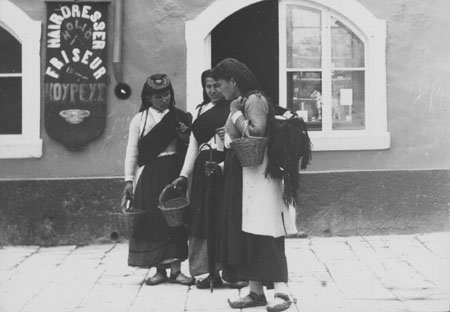
Frame 9: a sign is evidence, not a punchline
The legacy caption jokes about women shopping and notices a multilingual hairdresser sign. The sign is the stronger historical lead; the gender stereotype is not. Commercial language can reflect customers, administration, tourism, imperial networks or a proprietor's marketing. Each explanation requires evidence beyond the existence of several words.
A rigorous workflow would photograph or scan the sign at higher resolution, transcribe every visible character without “fixing” spelling, identify the scripts, compare historical directories and search period newspapers. Montenegro's National Library reports digitised runs of old periodicals and explicitly includes photographs, postcards, maps and plans among its digital categories. A business advertisement or address could establish a narrower date range more reliably than dress alone.
When families contribute identification, record who supplied it, their relationship to the subject, the date of the statement and whether another source corroborates it. Oral knowledge is valuable evidence; undocumented certainty is fragile.
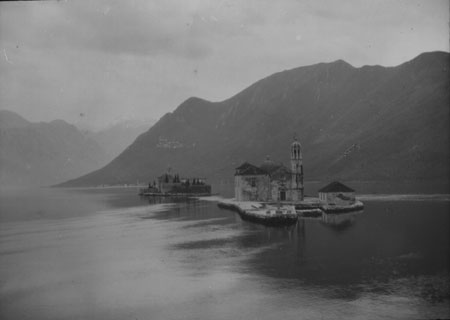
Frame 14: the maritime archive around Perast
The island silhouette is one of the archive's safest geographic identifications. Official tourism material distinguishes natural Saint George from the artificial Our Lady of the Rocks. Perast Museum provides the deeper human record: maritime objects, navigational instruments, charts, weapons, portraits, family archives and art that connect a small waterfront town to Adriatic and wider seafaring networks.
The museum says its holdings grew substantially through donations from Perast residents and family heirs in the late nineteenth and early twentieth centuries. That provenance matters. Old photographs often survive not as isolated art objects but inside family papers, municipal archives, school records or collections built around seafaring careers. A matched copy with a donor record could answer questions the Montenegro.com files cannot.
Readers following Montenegro's overseas networks can compare our independently researched archive pieces on Montenegrins in General Madariaga and Montenegrin cemeteries in Montana. Those connections should be built from names and records, never from assumed resemblance.
The archive's hidden technical story
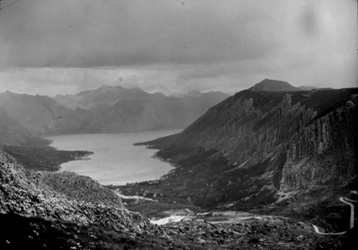
The sixteen files range from only 244 to 478 pixels wide. Several names begin “slide,” suggesting that at least one prior owner organised the images as a presentation, but a filename is not original provenance. Two files reproduce the same mountain-bay view. Compression, cropping and absent embedded metadata indicate derivatives rather than preservation masters.
The practical consequence is a ceiling on interpretation. We can describe composition, recognise a major landmark and flag text for future work. We cannot inspect grain, paper, plate marks, retouching, verso inscriptions or a photographer's emboss. Nor can apparent monochrome alone distinguish an original black-and-white photograph from a later reproduction of a postcard.
| Stage | Focus | Note |
|---|---|---|
| 1 Observe | visible details | Separate observation from inference |
| 2 Metadata | file and object | |
| 3 Compare | trusted records | |
| 4 Qualify | confidence and gaps | Preserve the uncertainty |
| 5 Publish | with source | Preserve the route back to evidence |
| Revision | New evidence can revise the catalogue without altering the master | Never collapse observation, inheritance and inference into one confident sentence |
ICOM-CIDOC documentation principles; Library of Congress cataloguing guidance
Practical research plan for your own photograph
- Preserve first. Do not write on the image face, clean it aggressively or discard its envelope. Scan front and back separately at preservation quality and keep an untouched master.
- Record the object. Note dimensions, medium if known, damage, inscriptions, stamps, album position, file history and who currently holds it.
- Separate transcription from interpretation. Copy visible words exactly, including uncertain letters. Put guesses in brackets or notes.
- Build a comparison set. Use dated maps, directories, newspapers, museum catalogues and photographs of the same façade or shoreline.
- Ask people carefully. Interview relatives or residents independently, record consent and preserve conflicting memories instead of forcing agreement.
- Contact the right institution. For Boka material, begin with Museums of Kotor, Perast Museum, the National Library and the relevant state or municipal archive. Send the full image and metadata, not a cropped screenshot.
- Assess rights separately. Apparent age does not prove public-domain status. Record creator, publication history, ownership and the basis for any reuse decision.
If you visit to compare a scene, photograph from a legal, safe public position and record coordinates, direction, date and lens. Do not climb private terraces or block roads to imitate an old viewpoint. The goal is repeatable evidence, not a dramatic before-and-after at any cost. For a broader visual route, Montenegro from a different perspective can help structure the journey.
Frequently asked questions
When were these photographs taken?
The available Montenegro.com files do not establish a year or decade. Architecture and dress may support future estimates, but those should remain bracketed and sourced until a repository record, publication or marked original is found.
Who was the photographer?
Unknown. No creator credit, stamp, signature or collection reference accompanies the files. Resemblance to another photographer's work is not attribution.
Are all the images from Kotor?
No such conclusion is justified. Several show Kotor or the wider bay; the islands near Perast are identifiable. Other settlement and mountain scenes need source-level matching.
Does “old” mean copyright-free?
No. Rights depend on creator, publication, jurisdiction, term and ownership of the reproduction. This article uses existing Montenegro.com legacy assets; it does not declare them public domain for third-party reuse.
Can AI identify the people?
It should not be trusted to name people from resemblance, especially from tiny derivatives. Documentary records, family testimony and repository provenance are required, and privacy or dignity concerns still apply.
Why not enhance the images?
Basic tonal adjustment can aid viewing, but generative restoration may invent faces, text and architecture. Any enhanced derivative must be labeled and kept separate from the unaltered master.
Where should I research Boka photographs?
Start with the National Library's Digital Library, Museums of Kotor and Perast Museum, then relevant archives, period newspapers and family collections. Provide filenames and the uncropped scans when asking for help.