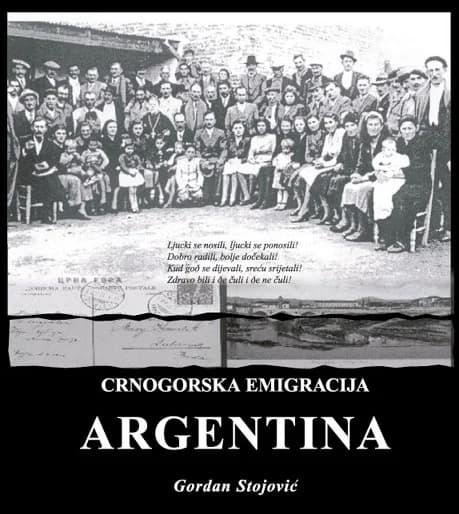
This page preserves the 2002 announcement of Gordan Stojović’s book Crnogorska emigracija: Argentina—Montenegrin Emigration: Argentina—and turns it into a research guide. It is an archive, not a current shop listing. The old price and ordering invitation have expired, and no present stock, seller or digital edition has been verified.
The announcement matters even with incomplete catalogue data. It records an early attempt by Montenegro.com and diaspora collaborators to bring family papers, personal testimony and community history into one publication. It also sits inside a longer body of work by Stojović on Montenegrins across the Americas. Readers should use it as a signpost: first identify the exact edition, then test individual names and journeys against archives.
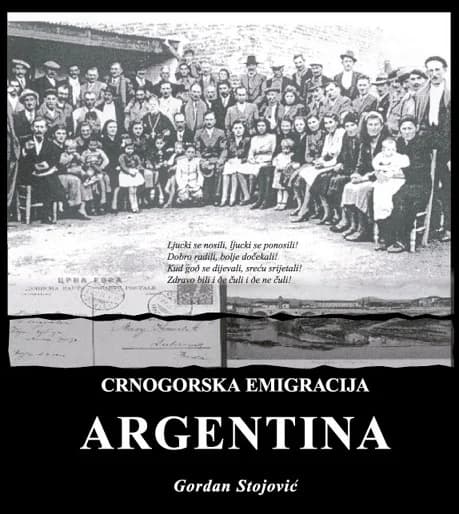
What the 2002 announcement actually says
The archived notice identifies Stojović as author and describes the publication as a joint effort between the Montenegrin homeland and diaspora. It says the book surveys the history and then-current condition of Montenegrin emigrants and their descendants in Argentina. Its most specific content claim concerns a first-person account attributed to Timoti Jokanov, describing a journey from Trsa in the Piva region to Buenos Aires in 1904.
Those details are useful leads, but an announcement is not a neutral catalogue. Phrases such as “most complete” belong to promotional copy and cannot be independently scored today. The testimony should be cited as appearing in the book until a researcher compares the text with a passenger register, manuscript, oral-history recording or family archive. This source discipline protects the witness’s story from being expanded beyond the surviving evidence.
The article’s creation date and a companion archival notice place this title in 2002. However, the currently accessible record does not supply an ISBN, pagination, printer, edition statement or holding library. Anyone citing the book academically should inspect a physical copy’s title page and colophon instead of copying a web headline into a bibliography.
Do not confuse the related editions
An independently documented earlier title is Crnogorci u Argentini. The Library of the Parliament of Montenegro catalogues that book under Gordan Stojović, published by Grafo Gost in Danilovgrad in 2000, with 255 pages. That is not automatically the same text as Crnogorska emigracija: Argentina from 2002.
A third milestone arrived a decade later. COBISS records reviews and presentations of Crnogorci u Južnoj Americi, associated with Stojović and Marijan Miljić and published by Montenegro’s Centre for Emigrants around 2012. That later volume broadens the frame beyond Argentina. A reliable citation must therefore distinguish at least the 2000 Argentina book, the 2002 title archived here, and the later South America study.
| Date | Title or record | What is verified online | Citation caution |
|---|---|---|---|
| 2000 | Crnogorci u Argentini | Author, publisher, place and 255 pages in Parliament Library catalogue | Do not assign its pagination to the 2002 book |
| 2002 | Crnogorska emigracija: Argentina | Cover and original publication announcement | Inspect a copy for full imprint and ISBN status |
| c. 2012 | Crnogorci u Južnoj Americi | Reviews and presentations in COBISS; broader regional scope | Do not back-project later findings into the earlier editions |
| Year | Title |
|---|---|
| 2000 | Crnogorci u Argentini |
| 2002 | Crnogorska emigracija |
| c. 2012 | Crnogorci u Južnoj Americi |
Source: api.skupstina.me, plus-legacy.cobiss.net
A longer research trail
Matica Crnogorska’s bibliography gives independent evidence of sustained scholarship. It lists Stojović’s 2000 article “Crnogorci u Argentini,” a 2006 study of Montenegrin colonies in Wyoming and Alaska, a 2009 study of the diaspora in Argentina and neighbouring countries, a 2010 Argentina directory, and a 2013 article about Pavle Popović and emigration to Bolivia. That sequence shows how the research widened and became more specific over time.
Our own historical collection provides first-party context rather than independent proof. The South American diaspora archive overview explains how this reporting was preserved. Separate dispatches introduce the human setting in Argentina, record meetings with descendants in General Madariaga, and continue in the third Argentina report. Read them as authored field records whose names and dates should still be cross-checked.

Why passenger records can hide Montenegrins
Migration databases reproduce the categories written by officials at the time. A traveller from present-day Montenegro might appear under a state, empire, port, language group or spelling that changed across documents. Surnames were heard and transcribed into Spanish; diacritics could disappear; a patronymic might shift; and a return voyage might create a second record. Searching only the modern nationality “Montenegrin” is therefore too narrow.
Argentina’s National Archives now provides a public search for maritime arrivals at the port of Buenos Aires between 1882 and 1937. Search fields include passenger name, surname, ship and arrival range. The archive says a matching result can provide a downloadable record and, where digitized, the relevant passenger-book image. Its separate request service covers inspection documents into the mid-twentieth century.
The National Directorate of Migration points researchers to historical records covering 1882–1950 and to CEMLA. FamilySearch’s collection of Argentina passenger lists covers 1901–1922 and says its records originate in the Argentine National Archives; it currently describes more than one million indexed people and tens of thousands of images. These ranges overlap the 1904 journey described in the book, but a name match alone is not identity proof.

Practical research workflow
1. Start with the copy in front of you. Photograph the title page, copyright page, contents and any handwritten ownership marks. Record dimensions and pagination. If the 2002 volume has no ISBN, say so only after inspecting it; never infer absence from an incomplete web record.
2. Build a name-variant sheet. Include spellings with and without diacritics, likely Spanish phonetic forms, given-name translations and the surname of a spouse or travelling relative. Add a date window rather than a single year. For the book’s Timoti Jokanov lead, the starting fields would be the printed spelling, Trsa/Piva origin, Buenos Aires destination and approximately 1904—not a claim that every field is already verified.
3. Search in layers. Try the Argentine National Archives first, then the migration service, CEMLA and FamilySearch. Save the query used even when it returns nothing. An empty result can mean spelling variation, an uncovered year, arrival at another port, land entry, missing pages or a person travelling under a different political nationality.
4. Correlate at least two records. Compare age, occupation, relatives, origin, ship and later residence. Civil registration, church registers, cemetery inscriptions, association minutes, newspapers and family letters can distinguish two people with similar names. A directory proves that a name was listed; it does not by itself prove kinship.
5. Cite the record, not just the database. Capture collection title, archive, book or image number, page, arrival date and access date. Keep the original scan alongside your transcription. If you publish living people’s details, obtain consent and avoid exposing addresses or identity documents.
| Step | What to use |
|---|---|
| Clue | book · letter |
| Variants | names · dates |
| Search | AGN · CEMLA |
| Correlate | 2+ records |
| Cite | image · page |
Source: argentina.gob.ar, familysearch.org, cemla.com
Community history is more than a passenger list
Arrival records answer only the first question. Community history also asks where families settled, how associations formed, which languages survived and how descendants interpreted their origin. Montenegro’s government documented research cooperation with CEMLA in 2019 and a 2016 Buenos Aires round table about identity among future generations. These are dated institutional records, not proof that every programme continues unchanged.
A 2025 foreign-ministry report on the opening of new embassy premises in Buenos Aires described descendants attending from the capital, Chaco, Córdoba and other areas. It demonstrates an active relationship across generations without resolving population size. Large estimates for “Montenegrins” in Argentina often mix immigrants, descendants, self-identification and ancestry; unless a method and census category are supplied, quote the estimate to its issuer rather than presenting it as a settled count.
Comparison can sharpen the questions. Our record of Montenegrin emigrants in Alaska concerns a different destination and evidence base, yet it illustrates the same need to separate family memory, organizational history and administrative records. The source-led account of Sabbatai Zevi and Ulcinj poses a related historical problem: later identity traditions must be tested against records created in very different political systems. Diaspora archives are strongest when they retain narrative, institutional context and documentary evidence together.

How to find or cite the book
Begin with Montenegro’s national and parliamentary catalogues, university libraries, Matica Crnogorska, diaspora collections and second-hand catalogues. Ask for the exact 2002 title and author, and request a photograph of the title and copyright pages before assuming that a similarly named 2000 volume is the same edition. This article does not confirm that copies are currently for sale.
A provisional citation may identify Gordan Stojović, the title and 2002, followed by a bracketed note that publisher, place and pagination await inspection. Replace that note as soon as a physical or authoritative catalogue record supplies the data. For a quotation, add the page number from the copy actually consulted.
Frequently asked questions
Can I order the book from the old Montenegro.com announcement?
No current ordering channel has been verified. The old prices and sales language belong to 2002 and should not be treated as an offer.
Is this the same book as Crnogorci u Argentini?
Do not assume so. The Parliament Library catalogues a 255-page 2000 book under that title. The cover archived here has the different title Crnogorska emigracija: Argentina and is associated with 2002.
Does the book prove that Timoti Jokanov arrived in 1904?
It reportedly contains his testimony. Treat that as a primary narrative lead, then seek a passenger entry and corroborating family, civil, church or association records.
Where should I search for an ancestor arriving in Buenos Aires?
Start with Argentina’s National Archives passenger search, then check the migration service, CEMLA and FamilySearch using several spelling and date variants.
Why might a Montenegrin ancestor appear under another nationality?
Officials recorded the political and administrative categories available at the time. Borders, passports, languages and spellings changed, so origin and recorded nationality may differ.
Can I copy a family tree result without seeing the record?
No. Save the underlying image and citation, compare it with another source, and distinguish a possible match from a confirmed identity.