Montenegro’s artistic and archaeological heritage is not one collection and it is not one period. Connect objects in Cetinje’s national museums with excavated places such as Risan and Crvena Stijena, then read the buildings and landscapes of the Bay of Kotor as part of the same story. Museum displays, managed visitor sites and controlled research locations require different plans.
What the sources say
The National Museum of Montenegro has four museum units spread across several buildings. Kotor Museums publishes visitor information for the Roman mosaics in Risan. UNESCO defines the protected Kotor region as a cultural landscape rather than only an old town, while Crvena Stijena had archaeological work funded in 2025. Together, these places span museum collections, managed ruins, living towns and a controlled research site.
| Place | What it shows | Planning rule |
|---|---|---|
| Cetinje | Collections in context | Check each unit’s hours and display |
| Risan | Roman villa and Hypnos mosaic | Use the current local-language schedule |
| Inner Boka | A connected cultural landscape | Check access monument by monument |
| Crvena Stijena | Deep prehistoric sequence | Do not assume walk-in access in 2026 |
| Lipci | Rock art in its landscape | Check lawful access; chronology is uncertain |
Start in Cetinje, where the collections are connected
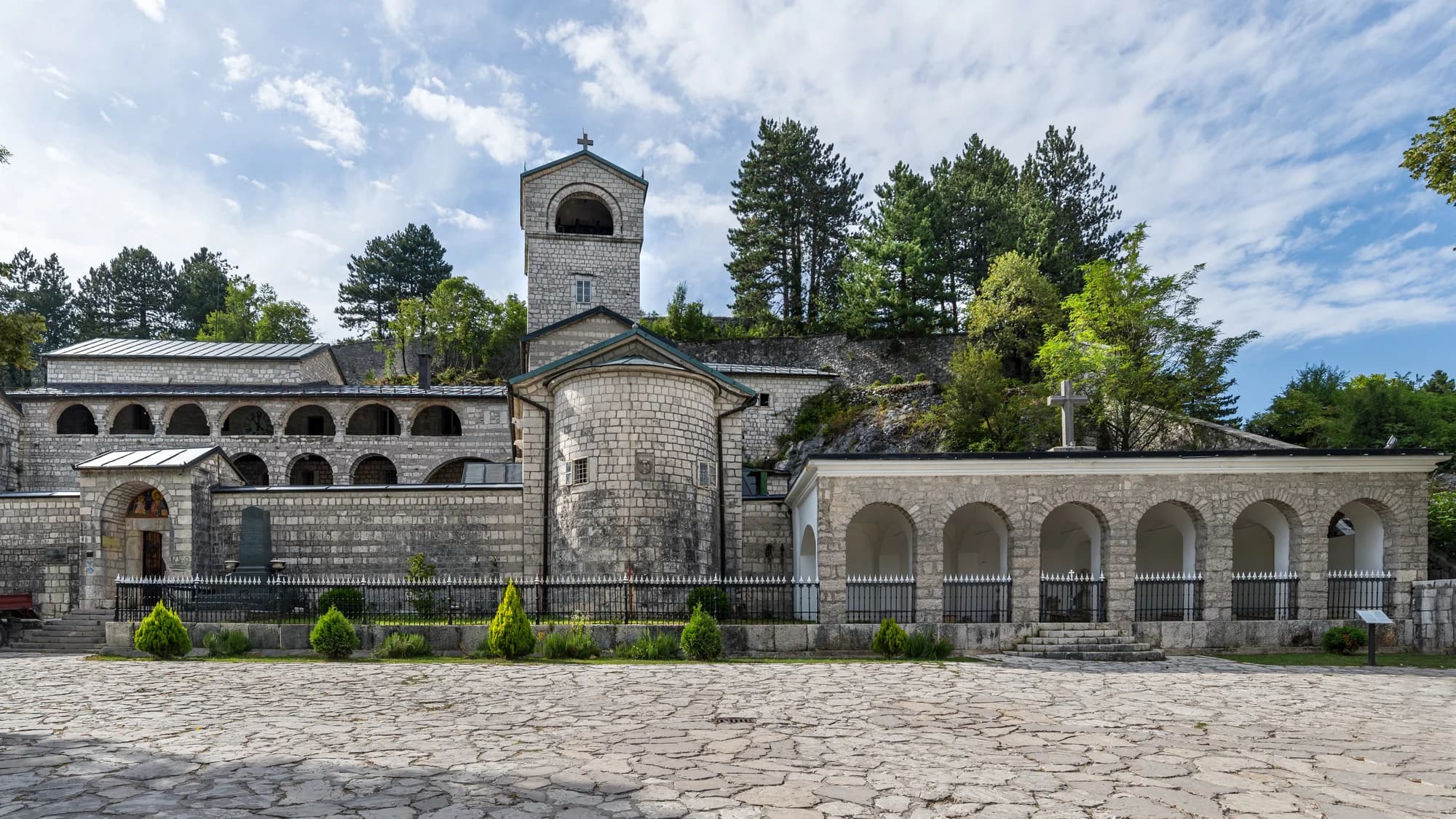
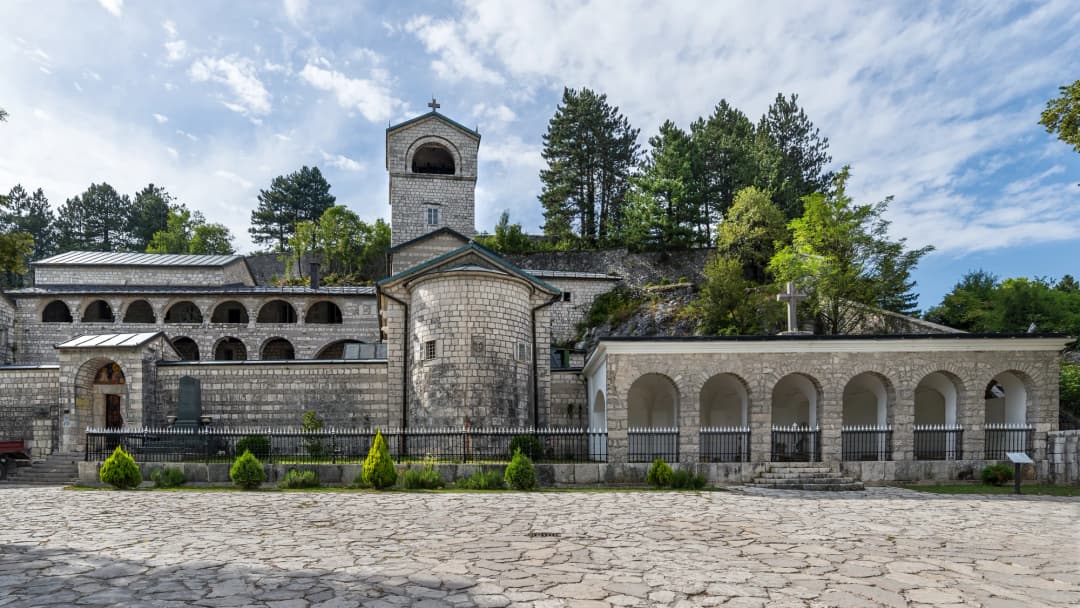
The National Museum is a complex institution rather than a single palace. Its official structure places the Historical Museum, Art Museum, Archaeological Museum and Ethnographic Museum in multiple buildings, with the central Cetinje units close together. The Government House, built in 1910, contains permanent History and Art Museum displays; the Archaeological Museum includes a lapidarium; the Ethnographic Museum occupies the former Serbian legation; and Njegoš’s Billiarda has its own historical and literary role.
The official National Museum history also resolves an institutional-date problem. It distinguishes the 1896 law establishing a princely library and museum from the State Museum founded in 1926 and the National Museum organization created in 1992. A single “founded” date without context compresses three different milestones.
In 2026 the museum marked both the 130th anniversary of the 1896 foundation and the centenary of the 1926 restoration. Its jubilee programme brought archaeology, ethnography, history, art, archives and library material together in Threads of Continuity, announced through 11 October 2026, while The Museum Through Time in the Billiarda was announced for 2026 and 2027. These are time-limited exhibitions: check the institution’s news page before building a trip around them.
| Year | Institution | What it established |
|---|---|---|
| 1896 | Princely law | library + museum |
| 1926 | State Museum | royal palace collection |
| 1992 | National Museum | current institutional form |
| 2026 jubilee | Two anniversaries marked | 130 years from 1896 · 100 years from 1926 |
Source: en.narodnimuzej.me
What the Archaeological Museum actually presents
The Archaeological Museum is the youngest National Museum unit. Its official page says the “Paths of Continuity” project investigated prehistoric sites, ancient sites, and early medieval and medieval fortifications from the sixth to the fifteenth centuries. Material from that research supports the museum collection and permanent exhibition. The lapidarium in the Billiarda courtyard currently displays eleven stećci—medieval tombstones—from the Nikšić and Pljevlja municipalities.
Archaeology depends on provenance, stratigraphy and documentation. A stone tool in a case, a tombstone moved to a lapidarium and a layer still under excavation each tells a different part of the story. The museum interprets material from many sites, but not every famous find is necessarily on view. Ask staff about temporary closures and the objects currently displayed.
The official Archaeological Museum page publishes seasonal hours: 09:00–17:00 daily from 11 April to 15 November, and 09:00–15:00 Monday to Friday from 16 November to 10 April. Recheck on the day, because temporary closures and exhibition changes are normal museum operations.
| Stage | What it covers |
|---|---|
| 1 · Research | layer + location; associated material; methods + uncertainty |
| 2 · Preserve | conserve; catalogue; compare |
| 3 · Interpret | selected display; labels + chronology; not every holding shown |
| Visitor takeaway | Ask what is displayed now, not only what the institution owns |
Source: en.narodnimuzej.me
Art in Cetinje: collections, icons and a live programme
The Art Museum’s official collection description is unusually useful. It names Montenegrin, Yugoslav and foreign-art collections, the Vukmanović collection, gifts to Njegoš from artists of Yugoslavia, applied and naïve art, fresco copies and icons. The permanent display includes part of the icon collection, while the Blue Chapel presents the icon of the Virgin of Philermos.
This is where a broad “art through the ages” article should slow down. The collections combine religious images, courtly and national narratives, Yugoslav art and modern Montenegrin practice. They do not form one uninterrupted national style. The institution’s categories reflect how objects were collected and reorganized over time.
The Art Museum visitor page lists 09:00–17:00 daily from 11 April to 15 November and 09:00–15:00 Monday to Friday from 16 November to 10 April. A July 2026 technical-maintenance notice closed the permanent display only from July 10 until regular hours resumed July 14; it should not be repeated as a continuing closure.
For a focused contemporary extension, compare the national collection with our guide to Atelier DADO. For the literary and political context of Petar II Petrović Njegoš, continue with Njegoš and Andrić in Topla.
| Collection strand | What it reflects |
|---|---|
| Icons + fresco copies | religious image traditions |
| Montenegrin + Yugoslav | changing artistic frameworks |
| Foreign authors | collection history + exchange |
| Contemporary programme | temporary exhibitions + dialogue |
| Reading tip | Read labels for provenance, date and collection—not just the artist name |
Source: en.narodnimuzej.me
Crvena Stijena: research site, not origin myth
Crvena Stijena, near Petrovići in the Nikšić municipality, is one of southeastern Europe’s major Palaeolithic and Mesolithic rock-shelter sequences. A University of Montenegro-hosted scholarly study reports more than thirty cultural horizons investigated through roughly twenty metres of deposit, with phases from the Middle Palaeolithic to the Middle Neolithic. It also explains the limitations of the early excavations and unresolved questions about the attribution of some layers.
Crvena Stijena documents repeated human activity over a long prehistoric sequence in this region; it is not a record of the beginning of life on Earth. Published object totals vary with the excavation period, catalogue and counting method, so focus on the depth and continuity of the sequence rather than one headline number.
Research was active in 2025. The Ministry announced that the Cultural Properties Administration had authorized systematic archaeological work through 9 August 2025. A separate 2025 funding decision allocated €20,000 for excavation at Crvena Stijena and also funded projects at Carine in Risan, Brskovo, Medun and Duklja. These dated records establish recent scientific and conservation work; they do not prove that excavation continued in 2026 or establish opening hours, a visitor centre or unsupervised access.
Use the University-hosted archaeological study for the sequence, the Ministry’s 2025 authorization notice for the dated field season, and the funding decision for the allocation. If access matters, ask the Nikšić museum or municipality; do not enter excavation areas, cross private land or collect stone, pottery or bone.
| Aspect | Detail |
|---|---|
| Archaeology | more than 30 investigated horizons |
| Archaeology | long prehistoric cultural sequence |
| Archaeology | some layer attributions unresolved |
| Archaeology | research authorized in 2025 |
| Archaeology | €20,000 allocated in 2025 |
| Visitor rules | treat it as a research site |
| Visitor rules | confirm permission before travel |
| Visitor rules | never enter a closed area |
| Visitor rules | never touch or collect material |
| Visitor rules | follow local instructions |
| Bottom line | Scientific importance does not imply public access |
Source: ucg.ac.me, gov.me
Lipci: preserve uncertainty around the rock art
The rock drawings above Lipci near Risan are commonly described as a hunting scene with deer and geometric or solar-looking signs. Their exact date remains uncertain, so treat precise century claims cautiously. The setting and imagery are significant without forcing the drawings into a chronology that specialists have not securely settled.
For a focused orientation, use our Lipci rock-art and village guide, then verify lawful access locally. Rock art is vulnerable to touch, chalking, water, smoke and casual “cleaning.” Photograph without contact, do not trace the lines, and never add markings to make a faded figure more visible.
The distinction matters: an image can be visibly ancient in character while its exact production date remains debated. A responsible guide can explain what is depicted, where the uncertainties sit and how to avoid damage without inventing precision.
| Access level | Site | Conditions |
|---|---|---|
| Managed visit | Risan | ticket + hours; museum rules |
| Verify locally | Lipci | lawful route; no touching |
| Research record | Crvena Stijena | authorized in 2025; 2026 status unproven |
| Rule | All | Never infer permission from an article, map pin or funding notice |
Source: ucg.ac.me, gov.me, muzejikotor.me
Risan: the clearest visitor-ready archaeological stop
The Roman Mosaics in Risan offer a different experience: a managed archaeological site with published admission. Kotor Museums describes a second-century Roman villa complex of 790 square metres. Its best-known mosaic depicts Hypnos, the god of sleep, in a central medallion; other floors use geometric and floral decoration.
The official Kotor Museums profile makes a useful institutional distinction: it manages the Roman Mosaics, Perast City Museum, the Lapidarium, Solidarity Gallery and the Church of St Paul. Those collections range from prehistoric and Roman material to Perast family holdings and art donated after the 1979 earthquake.
For practical planning, use the newer Montenegrin ticket and hours page, which says its prices apply from 1 January 2025. It lists the Roman Mosaics at €6 for an individual adult visit; 10:00–16:00 Tuesday–Sunday from 15 October to 15 April, and 08:00–20:00 Tuesday–Sunday from 15 April to 15 October. It also lists closure every Monday, throughout January, on Orthodox Easter, May 1, and November 13–14. The site’s older English page still shows 2024 wording and less consistent hours, so recheck the local page or contact the museum rather than choosing the translation you prefer.
Continue with our guide to the Risan Roman Mosaics or plan the broader Risan–Perast–Kotor route.
| Element | Fact | Detail |
|---|---|---|
| The site | 2nd c. | Roman villa; 790 m² complex |
| The image | Hypnos | central medallion; geometric + floral floors |
| The visit | €6 | adult individual; closed Mondays + January |
| Seasonal hours | 15 Apr–15 Oct | 08:00–20:00 |
| Seasonal hours | 15 Oct–15 Apr | 10:00–16:00 |
Source: muzejikotor.me
Kotor’s artistic value is a relationship, not a checklist
What the sources say
UNESCO’s Natural and Culturo-Historical Region of Kotor covers 14,600 hectares of the inner bay. Its statement emphasizes the relationship among fortified towns, maritime setting, architecture and visual axes. It also identifies Kotor as a medieval artistic and commercial centre with schools of masonry and iconography, and records the severe damage caused by the 1979 earthquake and subsequent restoration.
This means the World Heritage value is larger than Kotor’s walls. Risan, Perast, Prčanj, churches, palaces, waterfronts and the steep mountain enclosure work together. A fast old-town checklist can miss the very relationship UNESCO protects. Use our Perast guide for its Baroque urban fabric, but treat churches and sacred interiors according to their own opening and worship rules.
The World Heritage label also does not guarantee step-free routes, photography permission or admission to every church. It is a conservation status for a property and buffer zone. Respect barriers, avoid leaning equipment against old stone, and do not use drones without checking national, municipal and site-specific rules.
| Component | What it contributes |
|---|---|
| Inner Boka | 14,600 ha |
| Fortified towns | urban form |
| Masonry + icons | artistic schools |
| Maritime life | harbour + exchange |
| Mountain frame | visual integrity |
Source: whc.unesco.org
Other museum anchors worth adding
Bar’s municipal page identifies the Local Museum in King Nikola’s 1885 summer palace at Topolica. The complex includes the large palace, small palace, chapel, winter garden and park. Its institutional role is to collect, research, protect and present cultural material. The same page lists the Velimir A. Leković Gallery, founded in 1976, with two contemporary exhibition spaces and its own art fund.
Because the Municipality of Bar page publishes contact numbers but not dependable day-of hours, call before a special trip. For context on the palace itself, use our guide to King Nikola’s Palace in Bar.
Herceg Novi’s town museum and galleries, Nikšić’s local museum and northern municipal collections are valuable, but a national overview should not imply that every holding is permanently installed. Temporary exhibitions, conservation work, staffing and seasonal hours can change what is visible. The best question is not “does the museum own it?” but “is it on display on my date?”
| Institution | Origin | Character | Before you go |
|---|---|---|---|
| Local Museum | 1885 summer palace | historical + architectural complex; research · protect · present | call for day-of hours |
| Velimir A. Leković Gallery | founded 1976 | two exhibition spaces; contemporary programme + fund | check the current exhibition |
| Takeaway | — | One municipal system, two different reasons to visit | — |
Source: bar.me
Practical two-day heritage route
Day 1: Cetinje collections
Begin with the Archaeological Museum and lapidarium, then move to the Government House and the Art or History Museum display that best fits your interest. Add the Ethnographic Museum or Billiarda only after confirming current hours and temporary exhibitions. The buildings are close, but collection density makes a rushed “all units” ticket poor value if you do not leave time for labels.
Photograph only where museum rules allow. Religious icons, manuscripts and conservation-sensitive works may have tighter rules than building exteriors. If mobility, seating or lift access matters, contact the museum before arrival; proximity on a map does not guarantee step-free circulation through historic buildings.
Day 2: Risan, Perast and Kotor
Visit Risan’s mosaics during the published seasonal window, then continue to Perast and Kotor for the relationship between objects, architecture and bay landscape. Monday is a bad default for this route because the Roman Mosaics are closed. In January they are closed throughout the month under the current official schedule.
Do not add Crvena Stijena as a casual detour. It lies in a different region and is an archaeological research site rather than a dependable walk-in museum stop. Treat Lipci similarly: check access, stay on lawful paths and never touch or enhance the drawings.
| Day | Stops |
|---|---|
| Day 1 · Cetinje | Archaeology; Art / History; Ethnography / Billiarda |
| Day 2 · Inner Boka | Risan mosaics; Perast; Kotor |
| Note | Arrange access to research sites separately |
Source: en.narodnimuzej.me, muzejikotor.me, whc.unesco.org
| Check | What to confirm |
|---|---|
| 1 · Opening | season · weekday · closure |
| 2 · Display | what is actually installed |
| 3 · Access | steps · seating · assistance |
| 4 · Conduct | photo · bag · sacred-site rules |
| Source to use | Use the institution's latest visitor notice |
Source: en.narodnimuzej.me, muzejikotor.me, bar.me
Frequently asked questions
What is the best single place for Montenegro’s art and archaeology?
Cetinje offers the strongest concentration because the National Museum’s Archaeological, Art, History and Ethnographic units are nearby. It is still a multi-building visit, not one universal gallery.
Can I visit Crvena Stijena independently?
Do not assume public access. Ask the responsible local museum or municipality whether visits are permitted, and respect every closure, private boundary and excavation limit.
Are the Lipci drawings definitely from the eighth century BCE?
No securely established date supports treating the eighth century BCE as certain. The drawings remain important, but describe their chronology as uncertain.
Where can I see a Roman mosaic?
At the managed Roman Mosaics site in Risan. Kotor Museums describes a second-century villa complex and publishes admission, seasonal hours and closure days.
Is every museum open year-round?
No. National Museum units switch to shorter weekday winter hours, while some outlying sites close in winter. Risan’s mosaics close every Monday and throughout January under the current schedule. Temporary maintenance and exhibition changes also occur.
Does UNESCO list all of Montenegro’s archaeology?
No. UNESCO’s Kotor listing protects a defined natural and cultural region of the inner bay. It does not function as a national inventory of objects, excavations or museums.
Bottom line
Montenegro’s heritage becomes clearer when each place is understood on its own terms. Cetinje explains collections and institutions; Risan provides a managed archaeological site; Kotor shows how art, architecture and landscape interact; Crvena Stijena preserves a deep prehistoric sequence; and Lipci pairs evocative imagery with uncertain chronology. Confirm what is open and leave every research site undisturbed.