Tiho Vujović's paintings are easy to encounter online and surprisingly difficult to describe responsibly. A 2004 Montenegro.com studio visit left a useful photographic record, but its accompanying text mixed observation with extravagant promotion. This update keeps the archive, rebuilds the biography from identifiable sources, and separates what a visitor can see from what no source can prove.
The result is both an artist profile and a practical Cetinje art guide. It explains the recurring figures, veils and compressed spaces that the Montenegrin Academy's art lexicon identifies in Vujović's work, while directing visitors to public museums whose access can actually be checked. It does not turn a private house project into a walk-in attraction or present artistic metaphor as medical evidence.
Tiho Vujović at a glance
| Question | Best available evidence | Responsible conclusion |
|---|---|---|
| Who is he? | CANU and UDG identify a Cetinje-born painter and multimedia artist, born in 1961 | The institutions disagree on the exact July day, so July 1961 is the safest formulation |
| Where did he train? | Both profiles record graduation from Cetinje's Faculty of Fine Arts; CANU records a 2014 master's degree | Academic formation and later theory study are well supported |
| What recurs in the work? | CANU's critical entry centres the idealised female figure, veil-like surfaces and themes of distance and autonomy | This is a documented critical reading, not the only possible interpretation |
| Is he still teaching? | UDG lists him among four engaged lecturers for Art (Umjetnost) when checked in August 2026 | Current course listings support an active teaching role; staffing can change |
| Can I visit his gallery? | A 2024 interview describes a private house-museum project; 2026 reporting records an official visit to a gallery space | No reviewed source publishes regular walk-in hours, so contact and explicit confirmation are essential |
| Where can I reliably see art? | The National Museum publishes visitor information for the Art Museum and Atelje DADO | Use those public institutions as the dependable route, after checking same-day notices |
A biography with one unresolved date
The Montenegrin Academy of Sciences and Arts lexicon identifies Tihomir “Tiho” Vujović as a painter and multimedia artist born in Cetinje in 1961. The Academy gives 20 July. The University of Donja Gorica's institutional biography gives 29 July. Both cannot be the exact day, and neither reviewed page explains the discrepancy. Reporting only “July 1961” is more accurate than silently choosing one.
The sources agree on the larger educational outline. Vujović studied at the Faculty of Fine Arts in Cetinje and graduated in 1993. The UDG biography adds that he entered in 1988 and completed his degree with a high academic average. CANU records study periods in Italy, the United States and Paris, followed by a master's degree in modern and contemporary art theory in 2014.
His practice was never confined neatly to an easel. UDG describes earlier work in Cetinje radio and the multidisciplinary Art-kok initiative, which brought painting together with theatre, music and dance. That history helps explain why “multimedia artist” is not ornamental language in the Academy entry. It points to a career shaped by presentation, performance, teaching and cultural organisation as well as paintings.
The university's Art (Umjetnost) course page listed Vujović as one of four engaged lecturers when checked on 29 August 2026. A current course page supports a teaching assignment, not a fixed lifetime post or sole responsibility, but it does place the artist inside a continuing conversation with students rather than only in an early-2000s archive.
How critics read the paintings
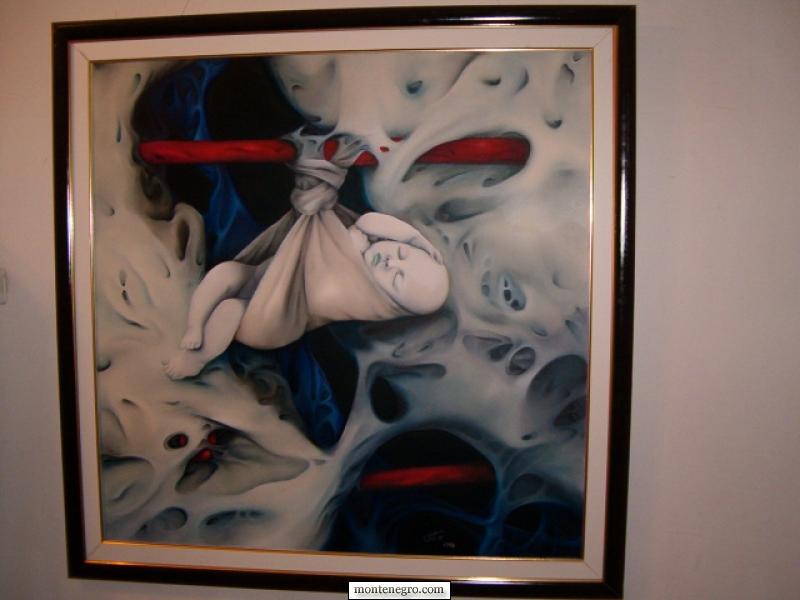
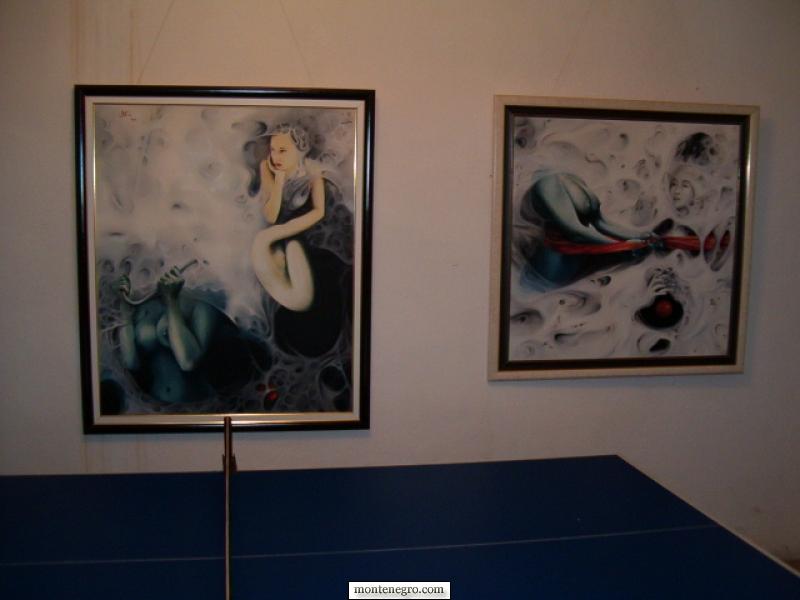
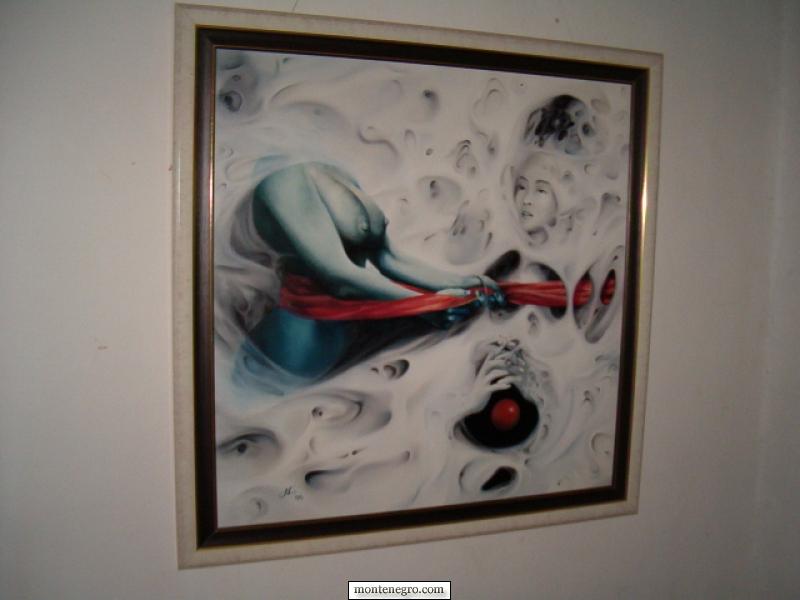
CANU's lexicon offers the most useful independent critical framework found for this profile. It describes woman as a central image in Vujović's painting: not simply a portrait subject, but a carrier of ideas about love, beauty and perfection. Bodies are idealised and presented with a cinematic sharpness, while web-like or veil-like layers create distance. The entry reads that separation through ideas of untouchability, alienation and self-sufficiency.
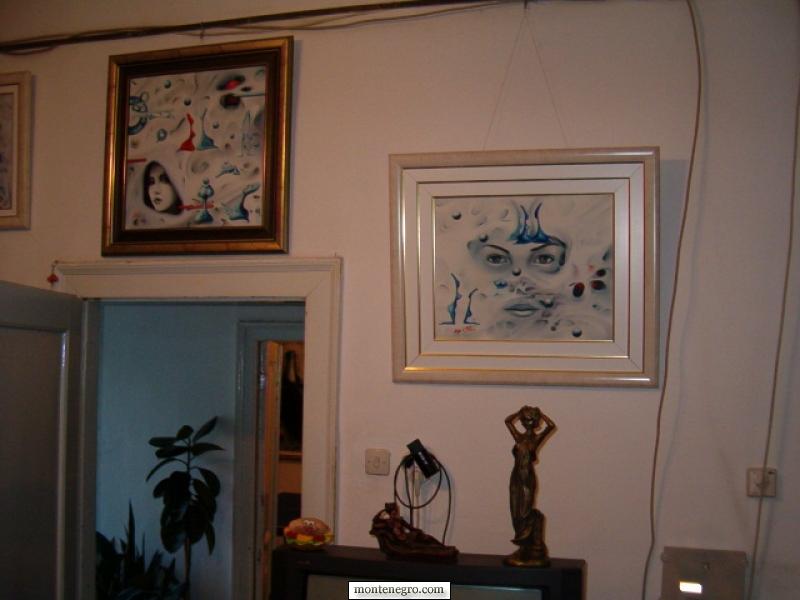
That interpretation helps a viewer ask better questions without pretending there is a single answer. Is the figure enclosed or protected? Does the pale surface behave like mist, membrane, water or polished glass? Do bright red bars connect the body to the surrounding field, or hold it in place? Where a face appears in fragments, does the painting suggest emergence or erasure?
The Academy entry also discusses the emphatic treatment of the breast as a civilisational symbol. That is the lexicon author's critical proposition; it is not a licence to reduce each work to one anatomical motif. Look at posture, negative space, scale, repeated colours and the relation between human and abstract form. The old studio photographs are most valuable when they slow down looking, not when they are forced to confirm a ready-made slogan.
For a wider frame, the companion guide to Montenegrin painters and Cetinje's museum collections introduces Petar Lubarda, Milo Milunović and other artists represented in the national collection. Vujović belongs to a later environment, but comparison reveals how Montenegrin artists repeatedly negotiate body, landscape, monumentality and belonging without producing one national style.
What the 2004 archive can—and cannot—tell us
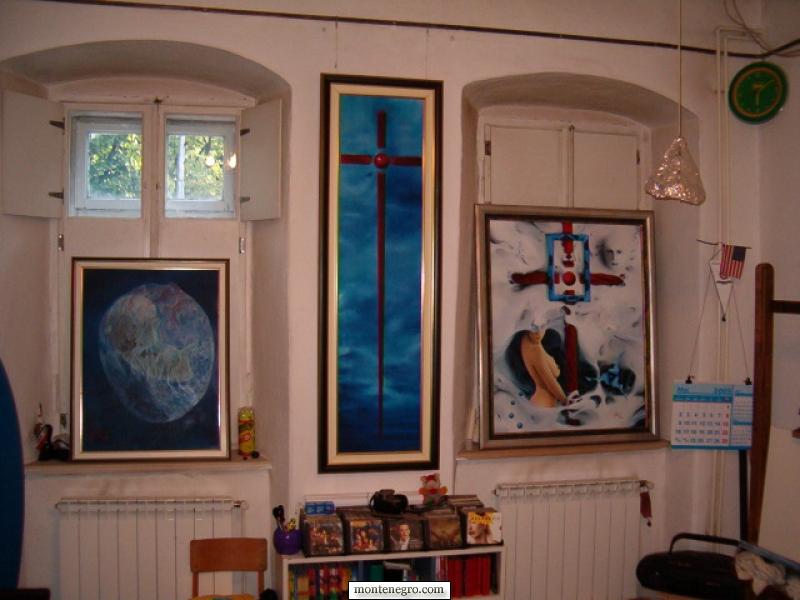
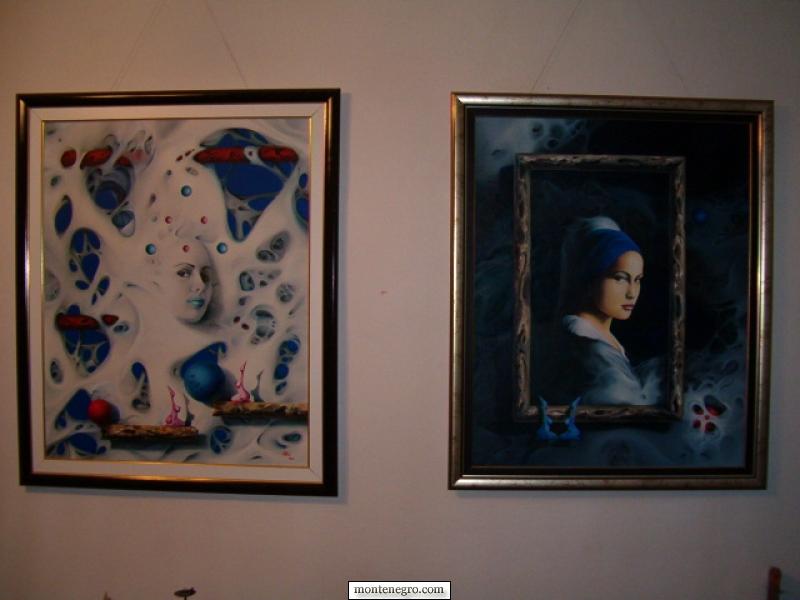
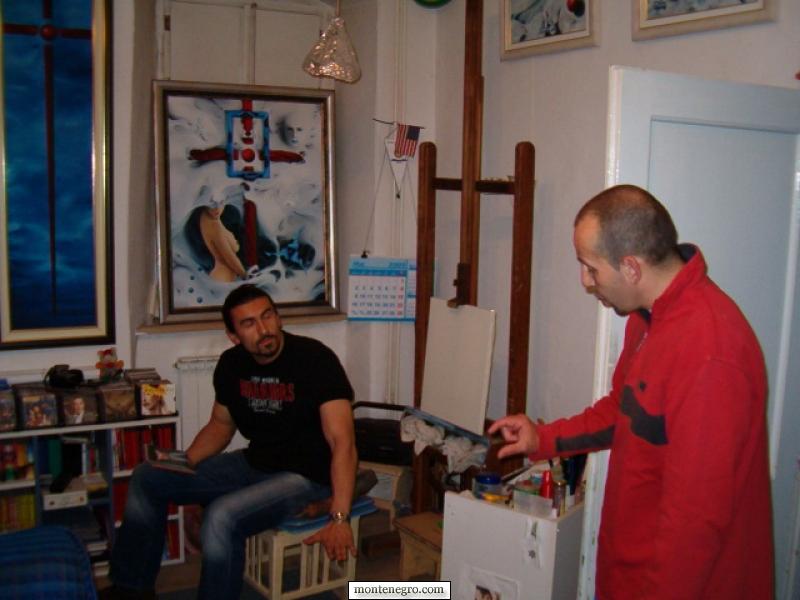
These seven retained photographs came from the page's original studio visit. They document framed paintings on domestic walls, an easel, visitors and the physical closeness of making, storage and display. That makes them primary visual evidence for one room at one time. They are not a catalogue raisonné, a conservation report or proof of present ownership.
No legible labels accompany the photographed works, so this update does not invent titles. The exact identities of two people in one frame are also left open. A filename is not an attribution record, and familiarity is not verification. The captions therefore describe visible form and context only.
The old text stated that Vujović had painted exactly 103 pictures, but it supplied no dated, complete catalogue. A selection displayed online does not necessarily represent every work, a chronological sequence or a current total. The responsible conclusion is simply that the inherited fixed count cannot establish the artist's full output.
| Layer | What it carries | How to use it |
|---|---|---|
| 2004 archive | Visible works, room arrangement | Not titles, meanings or current access |
| CANU + UDG | Training, roles, critical context | Record conflicts; must stay visible |
| Artist voice | Intent, projects, personal claims | Attribute; do not turn promotion into proof |
| Visitor check | Museum notice, hours and programme | Verify on the day before travelling |
| All layers | No single layer proves artwork title, medical effect, institutional endorsement or public access | Combine observation, named source and explicit limit |
Source: leks.canu.ac.me, fist.udg.edu.me, rtcg.me, en.narodnimuzej.me
A claims audit: admiration is not verification
The inherited profile said that Vujović's paintings heal viewers and create experimentally proven positive energy. No clinical study, named research team, journal article, trial design or medical institution was cited, and none was identified in this review. Art can prompt pleasure, reflection or a personal sense of wellbeing. Those experiences should not be recast as treatment, prevention or an experimentally demonstrated health effect.
It also described a relationship with Louvre documentation, enormous exhibition attendance, an unofficial record and a technique superior to Renaissance oil painting because it could not crack. Variants of some claims appear on the artist's own site and in a promotional university biography, but no relevant Louvre catalogue, Guinness record or independent conservation assessment was found. They are not used here as endorsements or facts.
Thin paint layers can influence how an oil painting ages, but cracking depends on support, ground, binders, pigment, layer structure, environment, handling and conservation history. A photograph cannot prove permanent material stability. It would be particularly misleading to turn an artist's technical self-description into a universal conservation guarantee.
This does not diminish the paintings. It gives them room to stand without borrowed authority. The work can be discussed through composition, colour, recurring bodies and critical reception. A visitor can decide whether it is moving, unsettling, decorative or intellectually productive without being told that a museum, record body or psychologist has settled the judgement.
Current work, teaching and the private gallery question
Vujović remains visible in Cetinje's cultural life. Beyond his UDG teaching, local reporting in 2026 recorded a mayoral visit to his gallery space and described projects associated with the NGO “Ljubav i prijateljstvo.” A 2025 municipal funding decision independently lists that NGO, names Tihomir Vujović as responsible person and records a project application. These documents support current civic activity; they do not establish a permanent public museum.
That distinction matters because a 2024 RTCG interview reported construction of a museum inside his Cetinje house. Vujović explicitly framed it as a project made for himself. Later use of the word “gallery” does not automatically transform a private or appointment-based space into an institution with ticketing, staffing and regular opening hours.
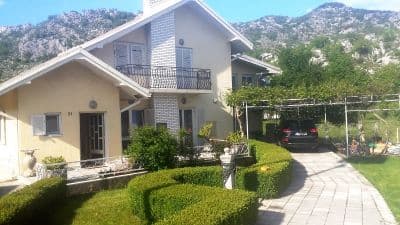
Do not arrive at a private address found in an old directory or map listing. No reviewed primary visitor page publishes standard hours, admission, accessibility details or walk-in rules. If an event is publicly announced by the artist, municipality or a named organiser, confirm its date, location and access terms through that current announcement. Otherwise treat the studio photographs as an archive, not an invitation.
For another example of Montenegrin contemporary practice outside the capital, read the profile of a Montenegrin artist working in the Arctic Circle. The contrast is useful: place can shape artistic identity without confining artists to a single local circuit.
Practical Cetinje art route
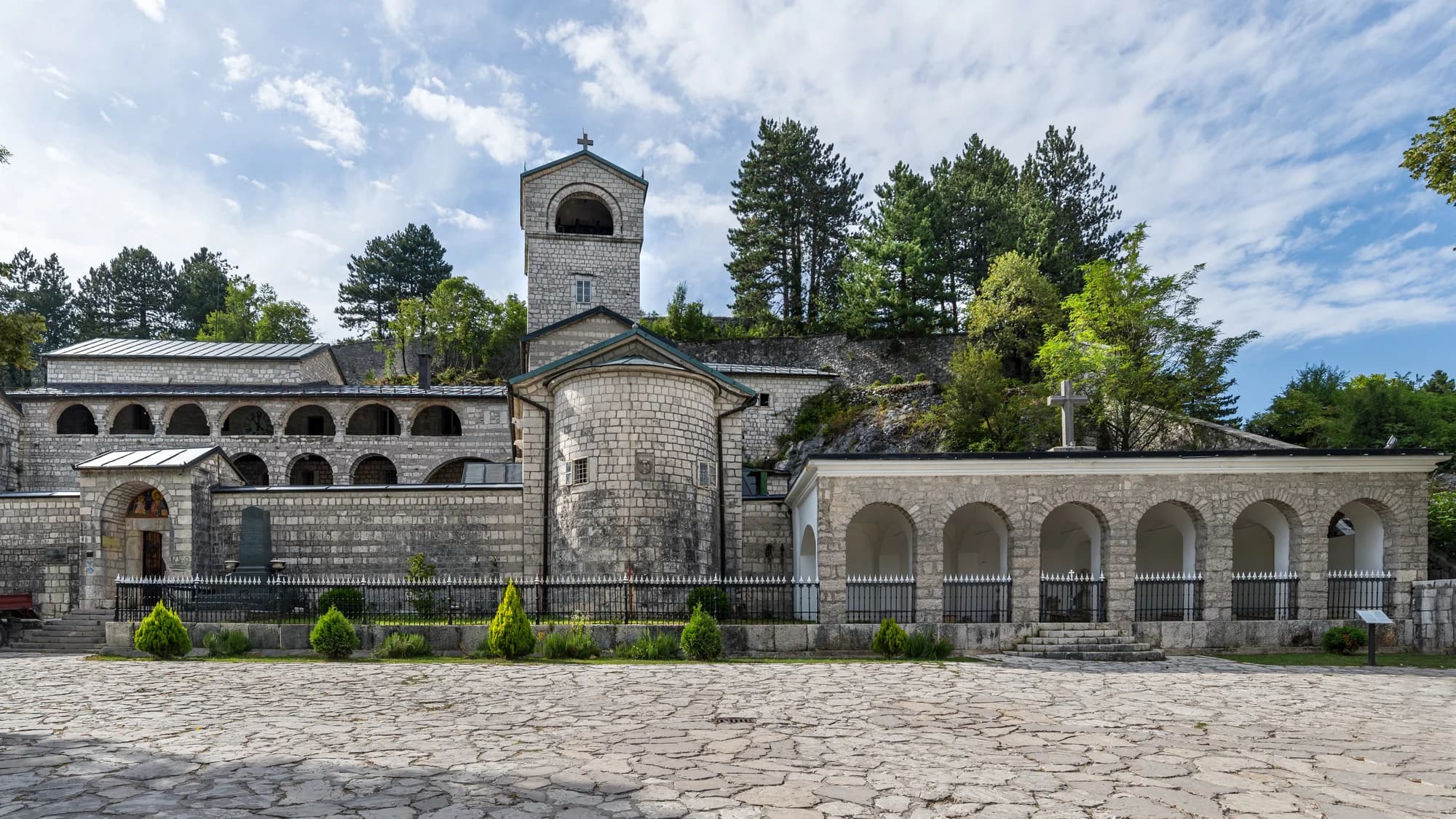
The dependable way to encounter Montenegrin art in Cetinje begins with public institutions. The National Museum's Art Museum occupies the former Government House at Novice Cerovića bb. Its visitor page describes a collection of more than 4,000 works and a permanent display extending from the late nineteenth to the twenty-first century, with memorial rooms devoted to Milo Milunović, Petar Lubarda, Branko Filipović Filo and Miodrag Dado Đurić.
When checked on 29 August 2026, the museum published two operating seasons: daily from 09:00 to 17:00 between 11 April and 15 November, then Monday to Friday from 09:00 to 15:00 between 16 November and 10 April. It listed an adult ticket at €5, a pupil or student ticket at €2.50, and a €20 combined ticket. These are planning figures, not a promise. Temporary closures occur; the museum posted a short technical closure and reopening notice in July 2026. Check the current Art Museum visitor page on the day.
Allow at least 90 minutes if you want comparison rather than a checklist. Start with the memorial rooms and note how each artist handles the human figure or landscape. Then move into later work and ask where Vujović's smooth, pale, cinematic imagery might sit in relation to those older modernisms. The goal is not to force a family tree, but to make formal differences visible.
Continue to Atelje DADO if its current programme is open. The National Museum describes the space as a venue for contemporary, alternative and new-media forms. That makes it a particularly useful counterpart to a painter whose institutional description includes multimedia practice. Check the exhibition notice first: a venue profile does not guarantee that a show is installed every day.
A compact plan is Art Museum at opening, coffee or lunch in the historic centre, then Atelje DADO according to its programme. Cetinje's central museums are close enough for a walking day, but stone thresholds, stairs, weather and temporary room closures can alter accessibility. Contact the museum before travel if step-free entry, seating, an accessible toilet or assistance is essential.
Broader trip logistics belong in the Montenegro first-time visitor guide. If Cetinje is one stop in a longer loop, the seven-day Montenegro itinerary helps prevent a museum morning from being squeezed between unrealistic mountain and coastal drives.
How to look without turning taste into fact
Spend one uninterrupted minute with a work before reading a label. Track the largest shape, the brightest accent and the direction in which the eye moves. Identify what is materially visible—edge, colour, texture, scale—and keep it separate from what you infer. “A red band crosses the composition” is observation. “The band represents oppression” is interpretation and needs an argument.
Then test the CANU reading. Does the figure appear idealised? Is a veil or translucent field separating it from the viewer? Does distance create vulnerability, control, isolation or serenity? Another viewer may make a different case. The value lies in connecting an interpretation to visible choices, not in guessing the artist's private intention.
Compare two works rather than trying to decode one. Note which elements recur and which change: blue-white atmosphere, red linear accents, fragmented faces, suspended bodies, open fields or crowded clusters. Repetition may establish a visual vocabulary, but it does not make every image a duplicate message.
Finally, check provenance before repeating a dramatic story. Museum labels, collection catalogues, Academy entries and dated institutional programmes carry different authority from an artist biography, a newspaper interview or an old tourism article. Attribution makes each useful. Blending them together makes all of them weaker.
Montenegro's art geography is larger than Cetinje. The Herceg Novi museum overview opens a coastal comparison, while the Bijelo Polje cultural walk connects visual culture with religious architecture and literary memory. For the literary strand mentioned in the inherited profile, use the documented Njegoš and Andrić route in Topla and the city's Trg od knjige festival history rather than attaching famous names loosely to an artist biography.
Responsible photography and contact
Public museum rules govern photography, flash, tripods and reproduction. Ask staff before photographing and respect any room-specific sign. A ticket usually grants entry, not commercial reproduction rights. Keep enough distance from paintings and frames, do not touch surfaces, and avoid blocking circulation while composing an image.
A private studio requires explicit permission for both entry and photography. An invitation to one event does not create standing access, and a publicly visible social profile does not waive privacy. If requesting an appointment, identify the purpose, number of visitors, preferred date and whether photographs or publication are intended. Accept a refusal or no response without attempting the address.
The same care applies to claims. If a current exhibition provides titles, dates, dimensions and media, record them from the label. If not, describe what is visible and name the source of any interpretation. This makes future correction possible and prevents a 2004 caption from becoming false certainty in 2030.
Frequently asked questions
Who is Tiho Vujović?
He is a Cetinje-born Montenegrin painter, multimedia artist and university lecturer. Institutional sources agree that he was born in 1961, trained at the Faculty of Fine Arts in Cetinje and later completed a master's degree in modern and contemporary art theory.
What is the exact date of his birth?
The reviewed institutional sources conflict. CANU gives 20 July 1961; UDG gives 29 July 1961. Without a stronger civil or artist-confirmed record resolving the difference, this guide reports July 1961 and preserves both published dates in its methodology.
Can I visit Tiho Vujović's museum or studio?
Do not assume walk-in access. A 2024 interview described a museum project inside his home as private, while later reporting referred to a gallery space without publishing standard visitor hours. Visit only through a current public event or an explicitly confirmed appointment.
Are the claims about the Louvre and healing paintings verified?
Not to the standard required here. Promotional biographies repeat versions of the Louvre claim, but no relevant Louvre public catalogue or independent institutional confirmation was identified. No clinical evidence supports a claim that the paintings heal or deliver a proven medical effect.
Where can I reliably see Montenegrin art in Cetinje?
Start with the National Museum's Art Museum in the former Government House. Add Atelje DADO when a current programme is open. Check official notices on the day because exhibitions, rooms, prices and operating hours can change or pause for technical reasons.
How much time should I allow?
Allow at least 90 minutes for the Art Museum, more if you compare memorial rooms carefully. A half day can include the museum, a break in central Cetinje and Atelje DADO, provided its current exhibition and hours are confirmed.
.jpg&w=2048&q=75)