Cetinje, Montenegro's old royal capital at 670 m under Lovćen: the monastery and its relics, King Nikola's palace, old embassies, a day trip from Kotor.
1485first recorded
38 kmto the airport
Jul–Augthe busy months
Updated Originally published 63 min readby Pavle Obradović
Cetinje – The Old Royal Capital of Montenegro
Montenegro’s capital from 1482 to 1946, and its Old Royal Capital ever since: five museum houses under one ticket, a monastery holding the right hand of John the Baptist, a street of embassies that are now faculties and libraries, and 14,494 people.
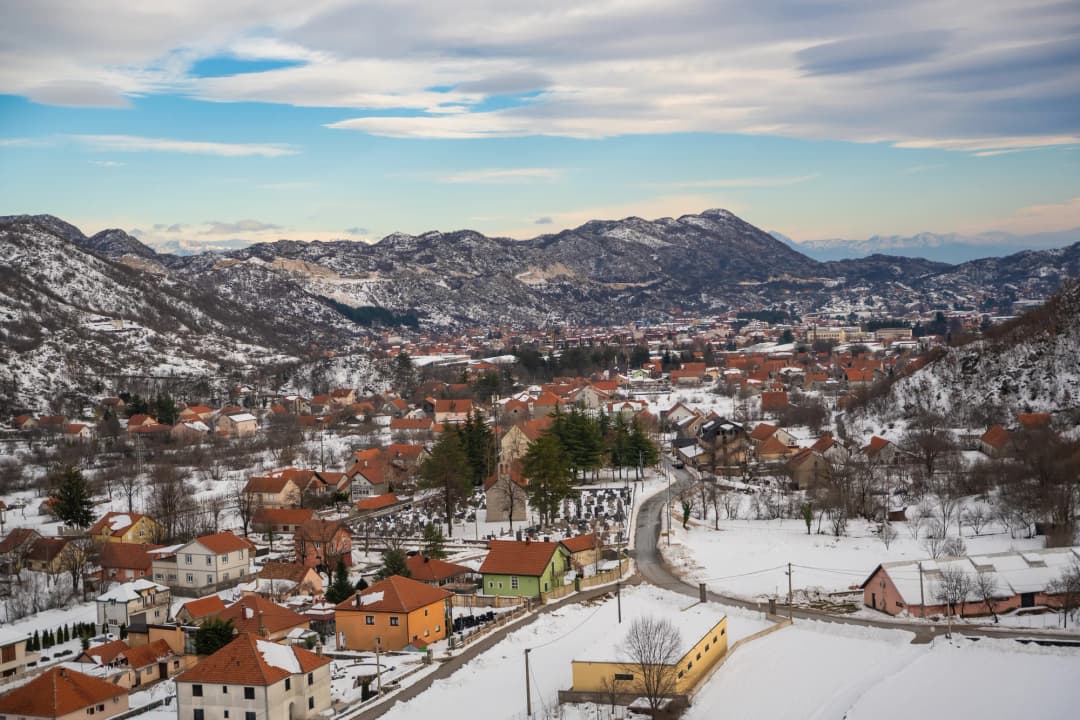
Cetinje sits in a small karst field at 670 m, forty minutes above the sea and three-quarters of an hour below the capital, and it is the one Montenegrin town that has nothing to sell you. What it has instead is an unusual concentration of institutions: five houses of the National Museum, a monastery that has been the seat of the Montenegrin church since 1485, and a street of embassies built by six great powers for a capital of a few thousand people. The town was the capital from 1482 until 1946. Its population has fallen by 29% since 1991, to 14,494 at the 2023 census, while 71,167 tourist overnights were recorded in the municipality in 2025 — one seventieth of Budva’s, forty minutes down the hill.
Overview
Cetinje stands at 670 m on the floor of Cetinjsko polje, under the eastern wall of Lovćen. It is a mountain town, not a coastal one, and the practical consequence is rain: 3,305 mm a year, against 1,390 mm at Kotor on the far side of the mountain [35]. The municipality had 14,494 residents at the 2023 census, down from 16,657 in 2011 and 18,482 in 2003 [49]. Cetinje holds the constitutional title of Old Royal Capital (Prijestonica), which no other Montenegrin town has; Podgorica is the seat of government. The president’s official residence is here all the same.
The National Museum of Montenegro runs five houses in Cetinje plus the mausoleum on Lovćen and Njegoš’s birth house at Njeguši, and one €20 collective ticket covers the lot — €10 for pupils and students, free under twelve [37]. Around the museums stand the former legations of six great powers, built between 1878 and 1910. The historic core is on the UNESCO World Heritage Tentative List, which is a nomination and not an inscription [1][2].
Cetinje is also where the first printing house in southeastern Europe worked. The Crnojević press ran from 1493 to 1496 and printed five liturgical books in Cyrillic, the first of them the Oktoih prvoglasnik [45]. Copies of its output are in the palace museum’s library [9].
What a day here costs, in one line: €20 for every museum, nothing at the monastery, €3 a person a day for Lovćen National Park and €8 more for the mausoleum, €16.90 for Lipa Cave, and about €1.20 for the coffee you drink between them. Every one of those figures is set out, with its source, in the tables below.
Day trips
How far a day reaches
22 min
25 min
34 min
39 min
Geography and landscape
The municipality covers 910 km², 6.6% of Montenegro [51], and borders six others: Kotor to the west, Budva and Bar to the south, Podgorica to the south-east, Danilovgrad to the east and Nikšić to the north. It runs from the wall above the Bay of Kotor in the west to the reed beds of Skadar Lake in the east. Three roads carry almost all of the traffic — up from Podgorica, up from Budva, and over the mountain from Kotor — and a fourth leaves north through the Katun plateau towards Grahovo. The town sits where they meet.
Measured by road with OSRM on 11 September 2026, Podgorica airport is 38 km and about 49 minutes from the palace square, and Tivat airport 47 km and about 62 minutes [43]. The municipality’s own figures, which are straight-line or older-road distances, give Golubovci 58 km, Tivat 57 km and Ćilipi near Dubrovnik 115 km.
The ground is karst almost everywhere, with glacial, river and lake forms cutting across it. The municipality divides into three: the Katun plateau, the Lovćen massif, and the western edge of the Skadar basin. Each gets its own section below, seated beside the thing you would drive there to see.
The Katun karst surface
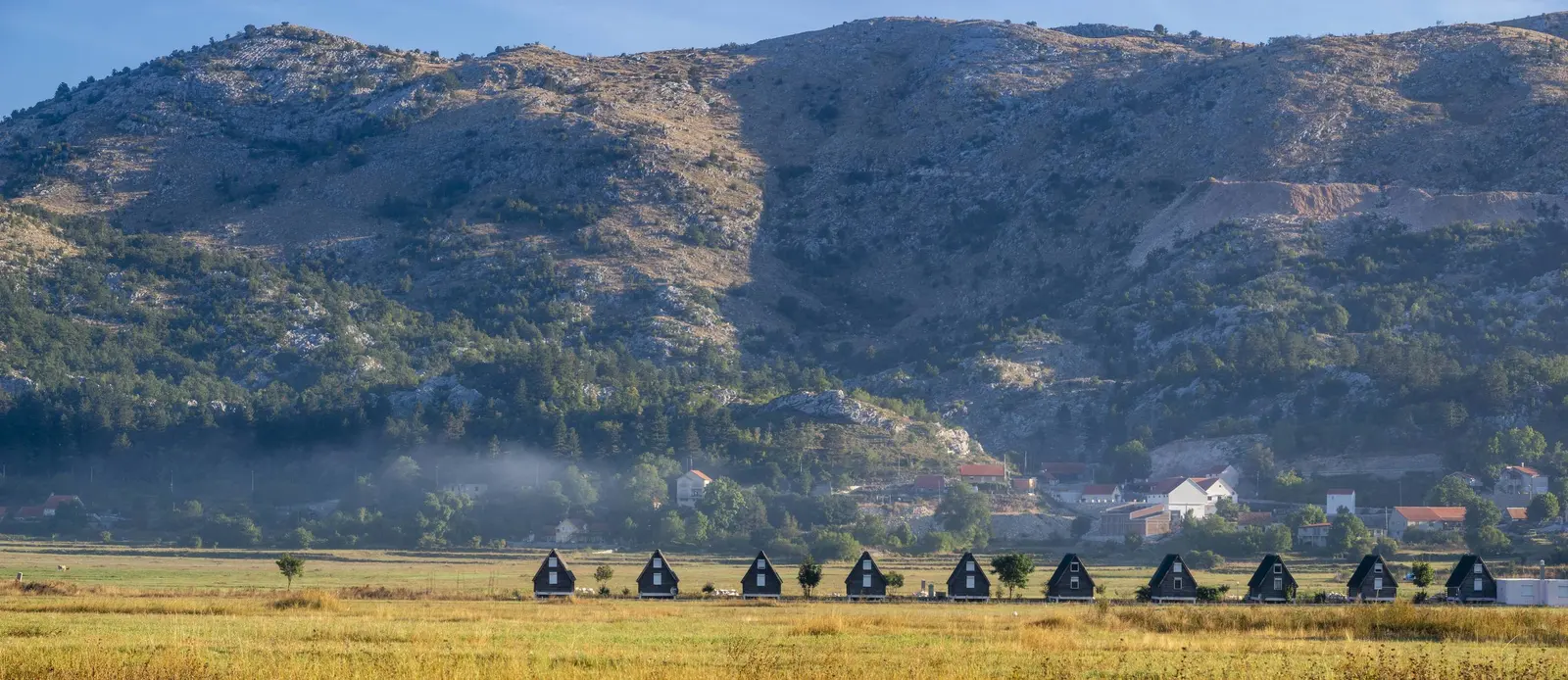
The Katun plateau averages 700–1,000 m and looks, from any ridge on it, like a sea that stopped moving: swells of bare limestone with sinkholes between them. Montenegrins call it the stone sea, and the name is descriptive rather than poetic. Under it the rock is hollow: the deepest of its pits is Duboki do at Njeguši, for which no measured depth is published anywhere we could find. The caves that matter to a visitor are Lipska, 5 km east of town, the Manastirska cave beside the monastery, and Obodska at Rijeka Crnojevića, out of which the river comes at full volume.
The one flat thing in all of it is Cetinjsko polje, and it is small: six kilometres long, about 800 m wide, and between 660 and 760 m above the sea. Its area is given as about 5 km² in one reference work and nearer 7 km² in another. That field is the entire reason a capital stands here. There was nowhere else within a day of Lovćen to put one.
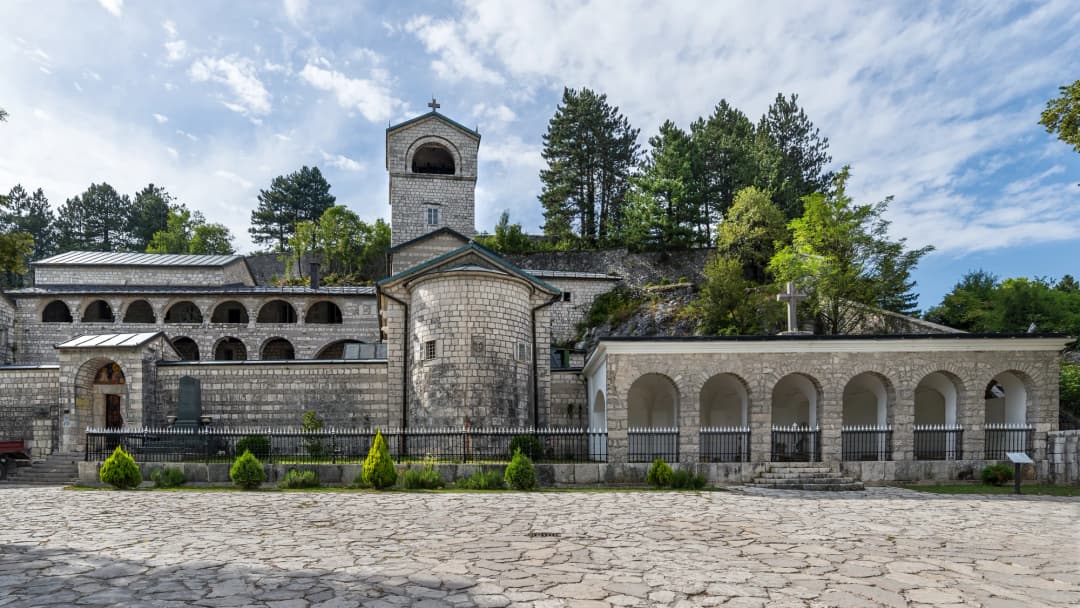
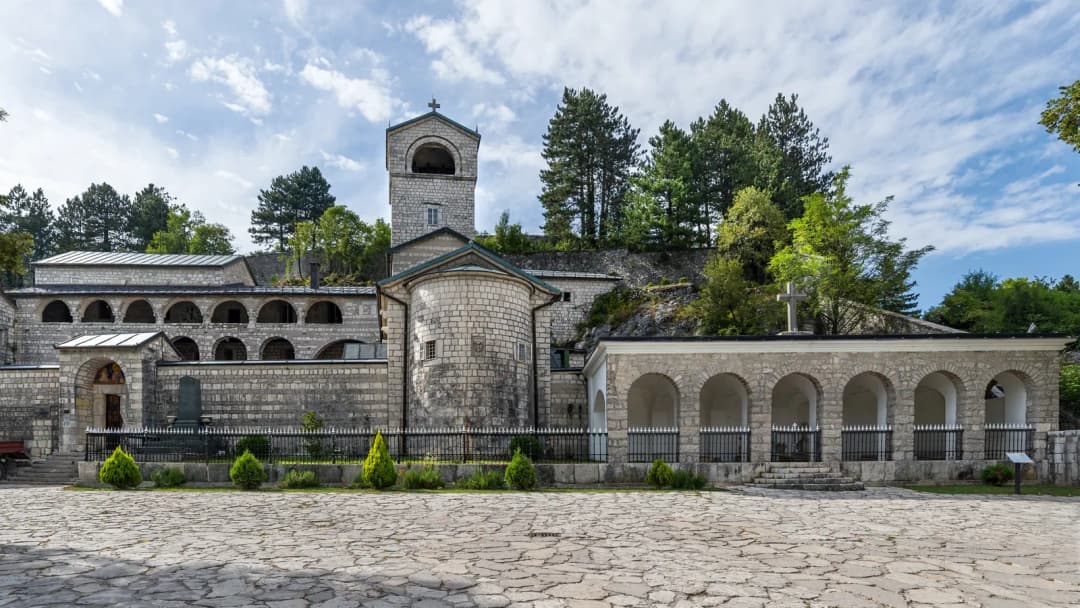
Cetinje Monastery
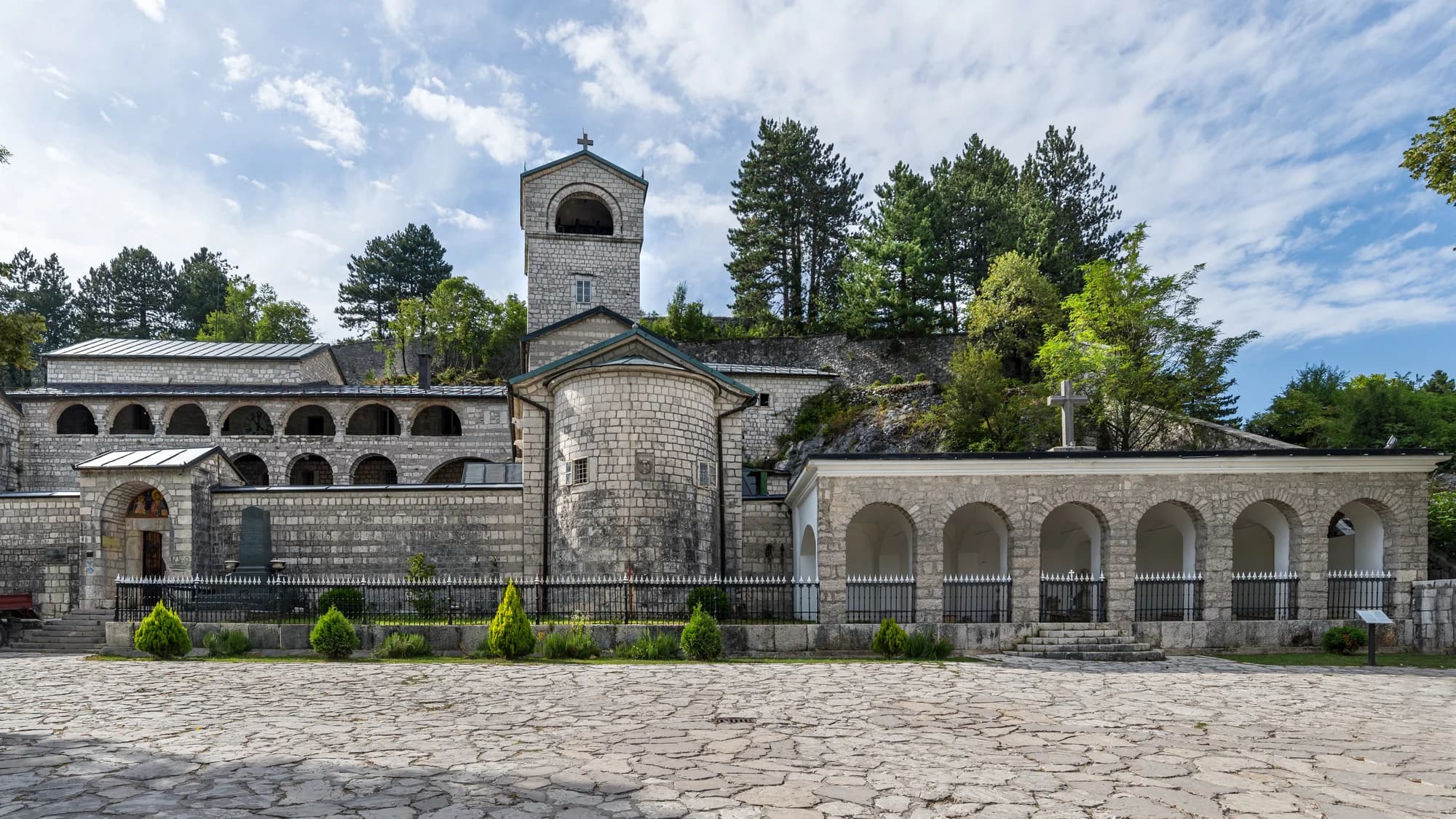
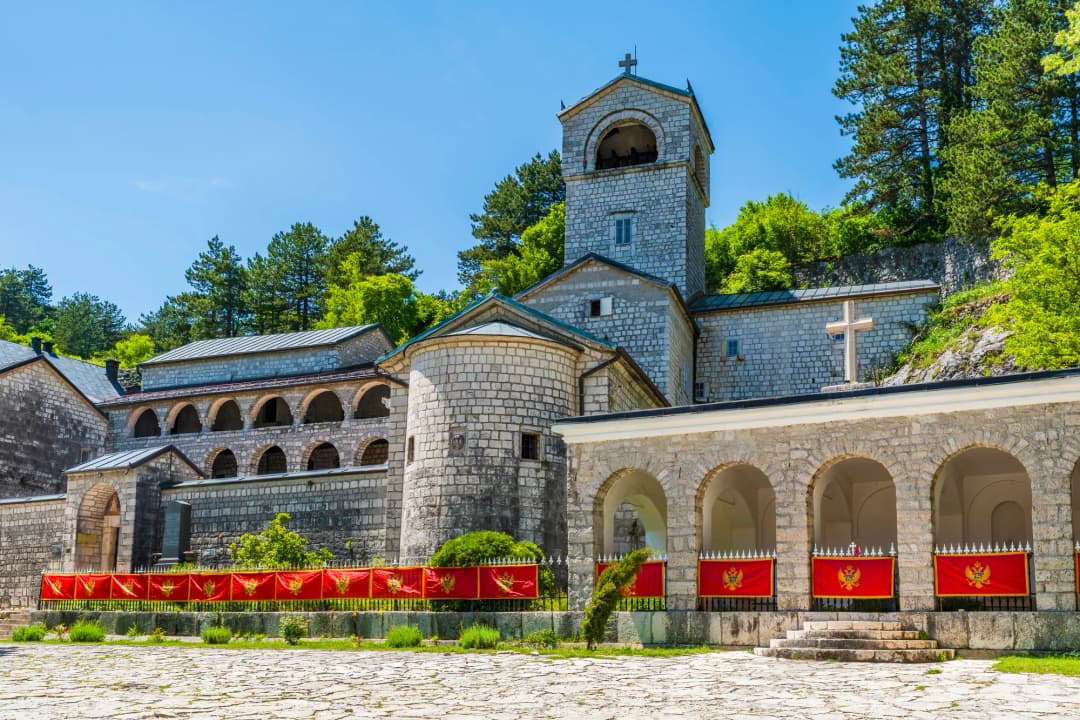
The Cetinje Monastery (Cetinjski manastir) is the seat of the Metropolitanate of Montenegro and the Littoral and, for most visitors, the reason the town is on an itinerary at all. Ivan Crnojević founded it in 1485 at Ćipur, beside his court. Venetian forces mined that building with a delayed charge as they pulled back during the Morean War in 1692; Wikipedia’s article dates the present monastery to a rebuilding by Metropolitan Danilo Petrović-Njegoš in 1701 or 1704, and says it burnt and was reconstructed again around 1743 under Metropolitan Sava; other accounts credit the fabric you see to Petar I after 1785. Nothing we could find settles which of those is the building standing today, so all of them are set down here [16][17].
The relics. The monastery treasury holds three objects that draw pilgrims from across the Orthodox world:
The Right Hand of Saint John the Baptist – held to be the hand that baptised Christ in the Jordan. Its provenance runs from Jerusalem to Constantinople, through Byzantine emperors and Ottoman sultans, to the Knights Hospitaller on Malta, who handed it to the Russian emperor Paul I [17][18]. How it reached Montenegro is often told wrongly. The Dowager Empress Maria Fyodorovna saved it from the Bolshevik Revolution; in 1932 the Metropolitan of Kiev gave it to King Alexander Karađorđević, and after the bombing of Belgrade King Peter II took it to Ostrog, not to Cetinje. A police raid took it from the Church in 1952; the state held it until 1978, and Metropolitan Amfilohije brought it back into the light in 1993 [52]. In 2006 it spent forty-two days in Russia, Belarus and Ukraine, where 2,165,000 people came to venerate it, and then returned here [53].
A Fragment of the True Cross (the Holy Cross on which Jesus was crucified).
The remains of Saint Peter of Cetinje (Metropolitan Petar I Petrović-Njegoš, canonised in 1834).
The monastery also preserves the Bishop’s Crown of Saint Peter of Cetinje and a collection of historical manuscripts [16]. The icon of Our Lady of Philermos, traditionally attributed to Saint Luke, is often said to be here too. It is not: the National Museum shows it in the Blue Chapel of the Art Museum, ten minutes away in Vladin dom. It remains an active monastery and a place of pilgrimage [16][17].
Visiting: entry is free and the monastery is open daily, usually 08.00–20.00 [26]. Cover shoulders and knees; women are asked for a headscarf and a long skirt or wrap, and both are lent at the door. Photography is not permitted inside. The relics are not on permanent open display — a monk brings them out, and the treasury proper is generally shown to booked groups rather than to individuals arriving off the street. No tariff for the treasury is published anywhere we could find, and no opening hours for it either; several guides mention “a small fee” without naming it. If the treasury is the reason you are coming, ring the monastery first. This is a working religious house before it is anything else.
Ćipur and the civic centre
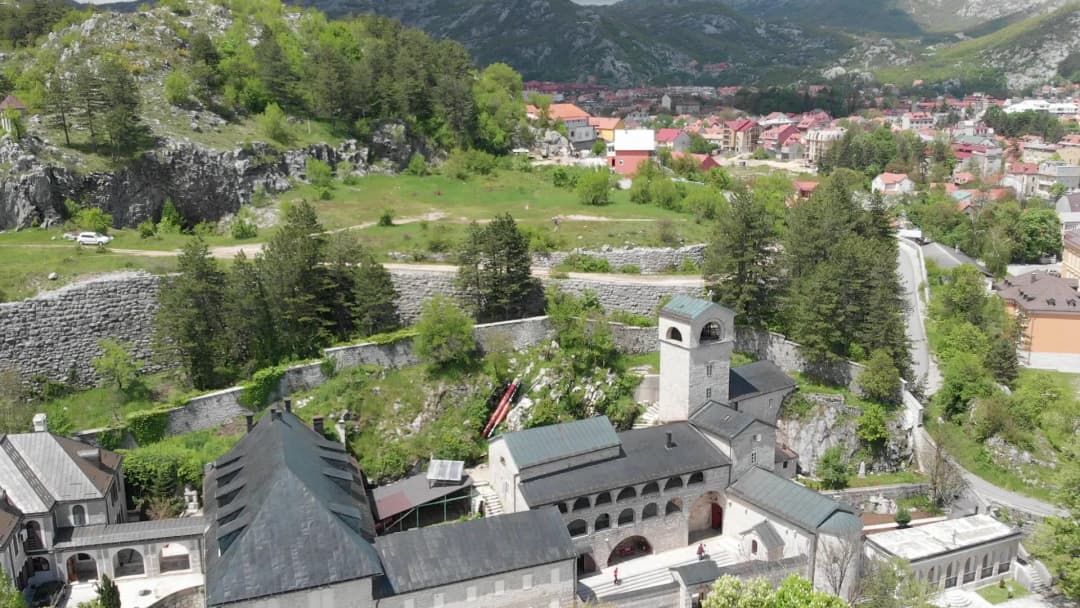
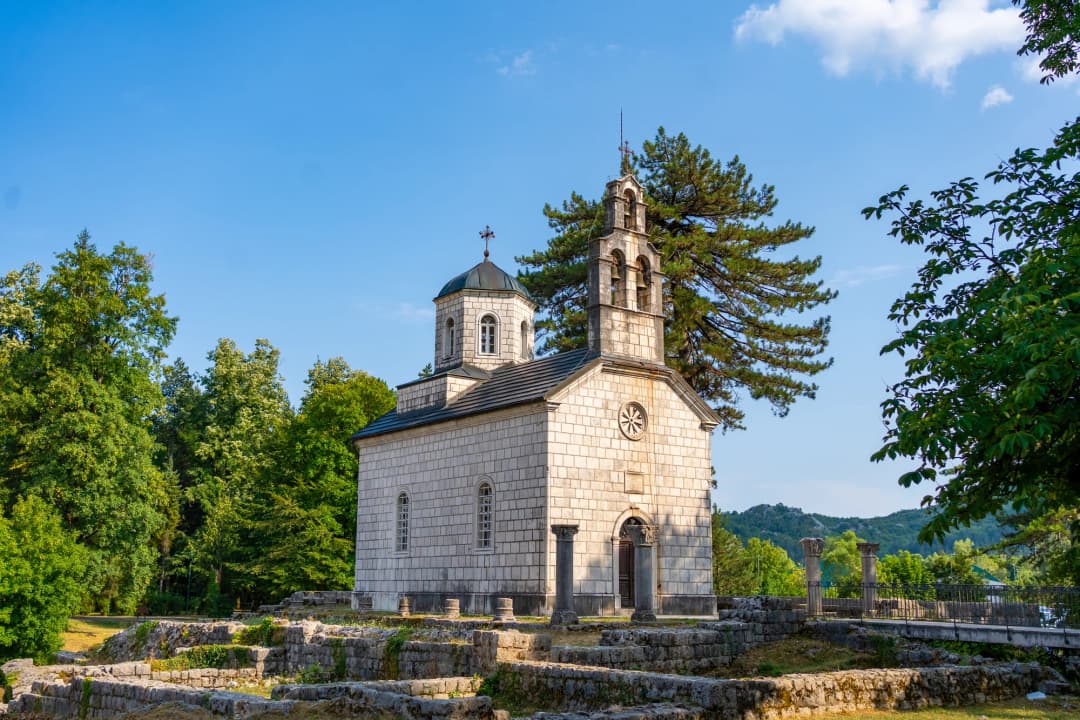
A hundred metres from the monastery is Ćipur, the Court Church, standing on the footprint of Ivan Crnojević’s first foundation of 1485 — the one the Venetians blew up in 1692. King Nikola and Queen Milena are buried in it. From there the whole of official Montenegro is inside a five-minute walk: the palace across the square, Vladin dom — Government House, built for the machinery and the ceremony of a state, and now holding the Art Museum — and the legations on the street beyond. The scale is the point. Court, church, government and the ambassadors of six great powers all fitted into one small field, and you can walk between any two of them before a coffee goes cold.
Religious, dynastic and civic sites share the same compact historic landscape.
The National Museum of Montenegro
The National Museum of Montenegro is not a building. It is five houses, all of them within a few minutes of the monastery — the palace of King Nikola, the Biljarda, the Art Museum and the Historical Museum in Vladin dom, and the Ethnographic Museum in the former Serbian legation — plus the Njegoš Mausoleum on Lovćen and Njegoš’s birth house at Njeguši. They share a tariff and a seasonal calendar, and one of them is shut. Deciding which doors you are going through, before you buy anything, is the whole of planning a day in Cetinje.
Everything below is from the museum’s own price and working-hours pages, read on 11 September 2026 [37][38]. Summer runs 11 April to 15 November — every house open daily, 09.00 to 17.00. Winter runs 16 November to 10 April — 09.00 to 15.00, Monday to Friday only, and the mausoleum and the birth house are shut altogether. The last group is admitted thirty minutes before closing.
The National Museum of Montenegro’s own tariff and calendar, read off en.narodnimuzej.me on 11 September 2026 [37][38]. Summer is 11 April to 15 November; winter is 16 November to 10 April.
11 April–15 November, 09.00–17.00 daily. Closed in winter.
Montenegrin Art Gallery “Miodrag Dado Đurić”
—
—
7 April–15 November 09.00–17.00 Tue–Sat; 16 November–31 December 10.00–16.00 Tue–Sat; closed 1 January–6 April
Collective ticket — every unit, mausoleum included
€20.00
€10.00
Worth it from four houses, or from three houses plus the mausoleum
Children under twelve go free, and so do residents of Cetinje, ICOM members and organised school groups from Montenegrin schools. Opening a house outside its hours costs €200 plus the individual tickets, by arrangement [37].
King Nikola’s Palace Museum — €8
Across the square from the monastery stands the palace of Nikola I Petrović-Njegoš, the last ruler of an independent Montenegro. It was built between 1863 and 1867 for Darinka, the widow of Prince Danilo, and their infant daughter Olga; when Darinka left the country the ruling family moved in, and it was the royal seat for more than fifty years, until the Austro-Hungarian occupation of January 1916. It was extended and redecorated for the proclamation of the kingdom in 1910 [9][12].
Since 1926, the palace has functioned as a museum and is now a department of the National Museum of Montenegro. Its rooms and collections trace the development of the Montenegrin state through 1918, including court life, diplomacy, military history and the ruler’s public image. The ground floor holds the royal furniture, the personal effects and the reception rooms. The entrance hall displays the Montenegrin Crown Jewels – the most popular exhibition in the entire National Museum system [9][12].
The arms fill the upper rooms — swords, long guns, pistols and edged weapons gathered over three centuries of fighting — and the library holds copies of the books printed by the Crnojević press, the Oktoih among them [9]. The museum’s own Montenegrin-language page adds two figures the English one leaves out: 44 Ottoman battle flags taken on the battlefield, and a library and archive of more than 10,000 items, now part of the display [50].
It is the strongest first stop for a visitor who knows little about the country: the building connects objects to the political story rather than presenting the royal family as decoration. If this theme interests you, compare Cetinje’s inland court with King Nikola’s seaside palace in Bar.
Hours and admission:09.00–17.00 daily from 11 April to 15 November, 09.00–15.00 Monday to Friday from 16 November to 10 April. Adults €8, pupils and students €4, or included in the €20 collective ticket [37][38].
Cetinje’s ceremonial buildings are close enough to connect on a single walking route.
Biljarda, the Njegoš Museum — €5
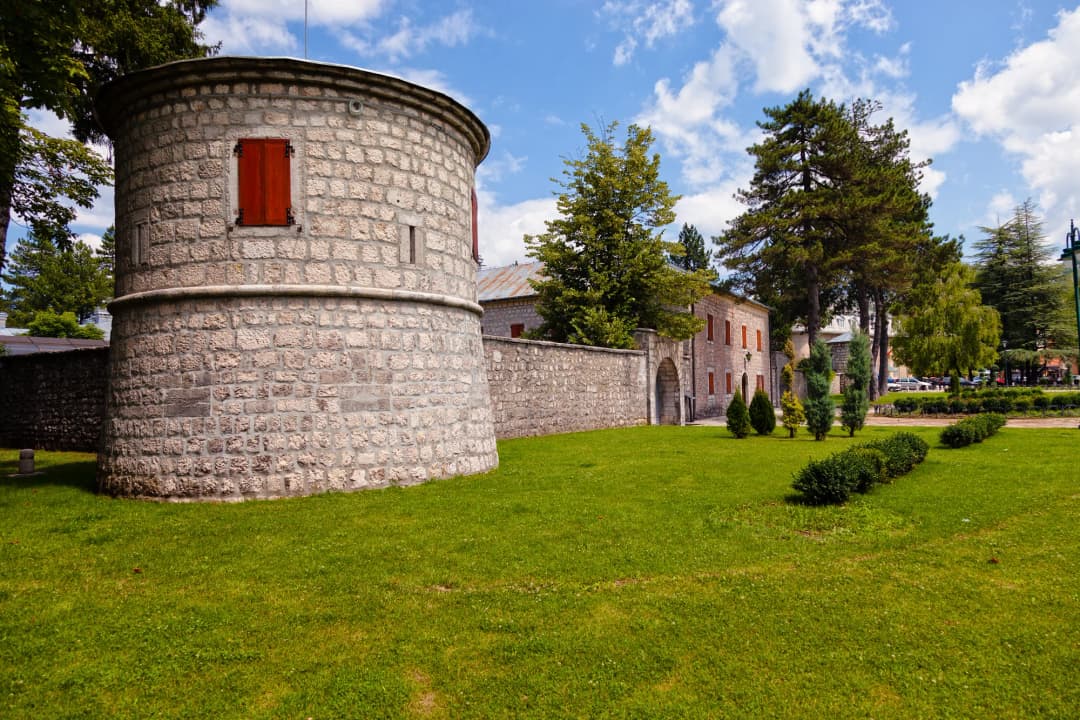
Just steps from the monastery, the Biljarda is a low fortified residence built in 1838 for prince-bishop Petar II Petrović-Njegoš. The building was constructed with significant financial help from Russia, and its thick walls and corner towers give it the appearance of a small fortress rather than a palace — fitting for a ruler who governed a land perpetually at war. The restrained stone building is valuable precisely because it conveys how small and exposed the governing centre remained [7][19].
The name comes from the billiard table Njegoš played on — the only one in the country at the time. Accounts of where it came from differ: Vienna in 1839 in one, Italy in another. However it arrived, it arrived before there was a road — the cart road over the mountain from Kotor was not finished until 1884. The table is still in the room.
Founded as a museum in 1951, the Biljarda shows Njegoš as ruler, bishop and writer at once: manuscripts and editions — the museum’s own page names the original manuscript of The Mountain Wreath — portraits, coins, weapons, his bishop’s cross and vestments, papers, the furniture of the house, and the table [7][19].
The relief map. In a glass pavilion beside the main building is a three-dimensional relief of Montenegro built by the Austro-Hungarian army during the occupation, to plan its own movements. The museum sells it as a separate unit at €3, or included with the Biljarda ticket at €5 [37]. Its area, its scale and its exact years are given differently in different places — around 180 m² at 1:10,000 horizontally and 1:15,000 vertically, dated either to the occupation of 1916–17 or more loosely to Austrian cartographers in the nineteenth century — and the museum’s own page states none of them. Stand over it for five minutes and the point of the country’s history becomes obvious in a way no flat map manages [7][19].
Njegoš also connects Cetinje to other parts of the country. Our guide to literary Topla in Herceg Novi follows his early education, while the route through Njeguši leads to his mausoleum on Lovćen.
Hours and admission: same seasons as the palace — 09.00–17.00 daily, 11 April to 15 November; 09.00–15.00 Monday to Friday, 16 November to 10 April. Adults €5 including the relief of Montenegro, pupils and students €2.50; the relief on its own is €3 and €1.50. The €3 adult price still printed in older guides is the relief-only ticket, not the museum [37][38].
Stone façades and mature trees define much of the central museum district.
The Art Museum, in Vladin dom — €5 with the Historical Museum
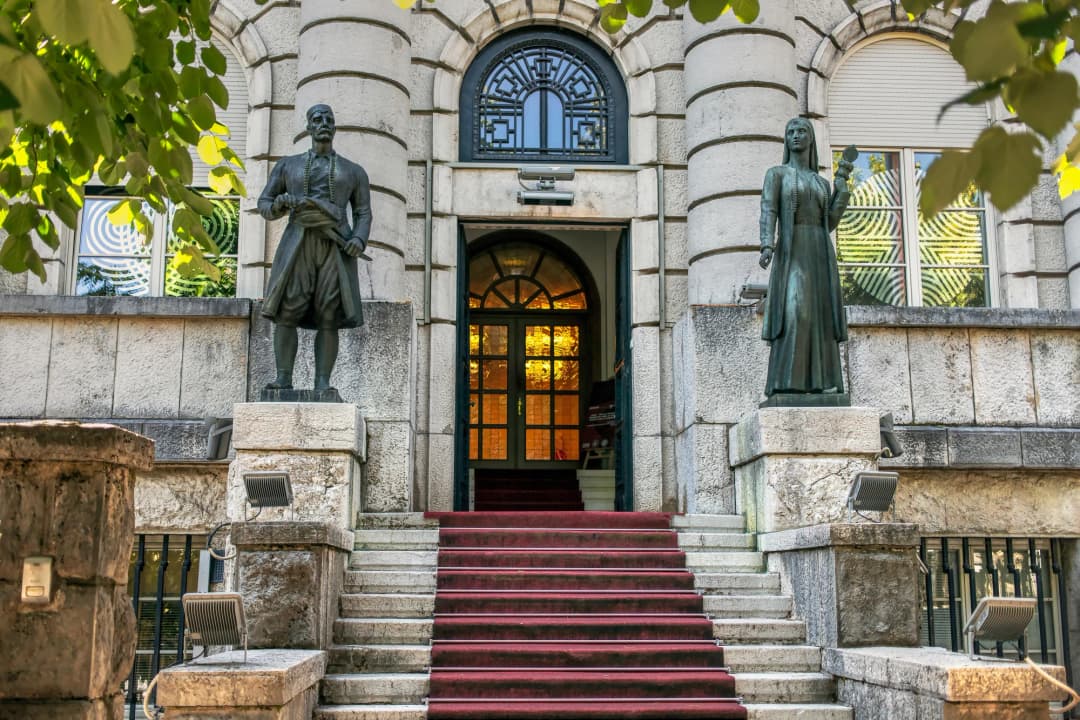
Founded in 1950 with 240 works, the Art Museum of Montenegro (Umjetnički muzej Crne Gore) is one of the oldest cultural institutions in the country and, by its own account, now holds more than four thousand. It is in the Vladin dom, Government House [23][24].
The collection divides into Montenegrin fine art, Yugoslav fine art, foreign artists, the Vukmanović bequest, the “Artists of Yugoslavia to Njegoš” collection, copies of medieval frescoes, and icons [23][24].
The Icon of Our Lady of Philermos (Filermosa), traditionally attributed to Saint Luke and dated by art historians to the eleventh or twelfth century, is displayed here — in the museum’s Blue Chapel, not in the monastery, which is where most guides put it. It came to Montenegro with the hand of John the Baptist and the particle of the True Cross [1][16].
The Historical and Ethnographic museums — €5 and €4
The National History Museum holds period weaponry, artefacts from Roman and prehistoric sites, and materials documenting Montenegro’s long struggle for independence and its political and social history. The Ethnographic Museum, housed in the former Serbian Embassy, is considered one of the best-curated ethnographic collections in Montenegro, displaying traditional costumes, tools, household items, musical instruments and crafts from the mountain villages that surrounded and fed Cetinje [12][24].
The two are the specialist end of the circuit and repay a visit after the royal and Njegoš collections rather than before. The National Museum’s working-hours page lists the Historical Museum as closed. Do not build an itinerary around that gallery until the museum confirms reopening. A collective ticket can still be useful, but ask staff which sites and rooms are operating that day.
Which ticket, and in what order
Do the arithmetic before the first counter. The four houses are €8, €5, €5 and €4, so any two come to €9–13, any three to €14–18, and all four to €22. The collective ticket is €20. Up to three houses the single tickets are cheaper; at four, or at three plus the mausoleum on Lovćen — which is €8 on its own — the collective wins. Guides published before 2025 quote a €10 combined ticket; that price is gone, and €20 is what the museum’s own page says today [37].
Order matters more than the money. Start at the palace museum while your attention is fresh — it is the one that makes the rest legible — then the Biljarda, then one specialist collection rather than both. The Historical Museum is listed as closed, so do not plan around it, and ask at the first desk which rooms are actually open that day. The monastery is free and is not part of any of this [9][12][19][37].
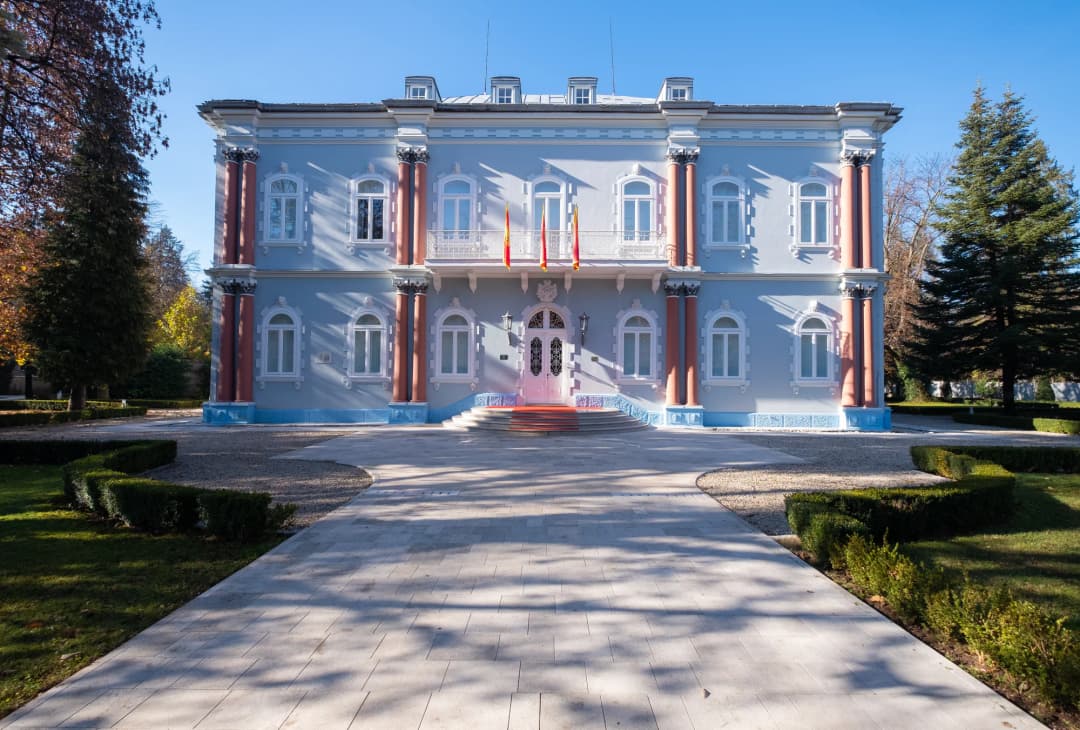
Blue Palace: the president’s residence
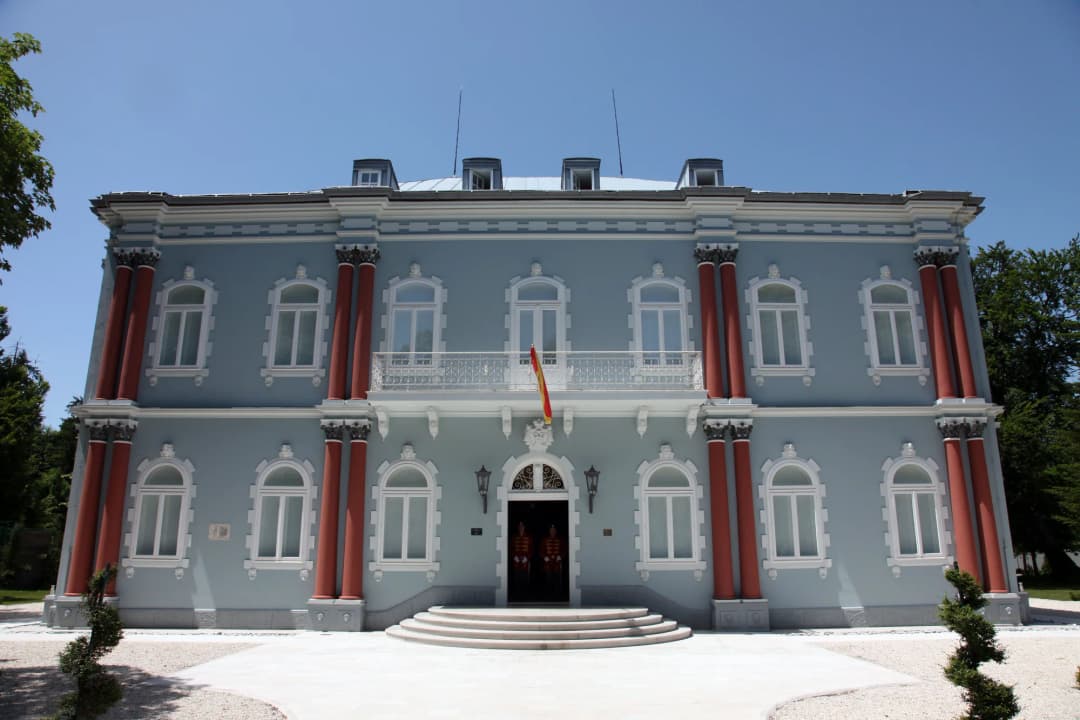
The Blue Palace was built in 1894-1895 in late Empire style as the residence of Crown Prince Danilo, heir to the Montenegrin throne. Who designed it is not recorded. The Montenegrin Academy’s heritage lexicon enters the architect as anonymous; other accounts credit unnamed Italian and Montenegrin master builders [15][20].
Crown Prince Danilo and his wife lived in the palace until 1916. During the interwar Kingdom of Yugoslavia period, it housed the Cetinje Gymnasium. Under socialist Yugoslavia it was converted into a gallery and museum, and it was adapted for the President’s Office in 2006. Since 2010 it has been the official residence of the President of Montenegro [15][20].
It is not open to the public, and there is no ticket, no tour and no interior to see. What you can do is walk the grounds and look at the front, which takes five minutes and is worth them: it is the only late-Empire building in the town and it is painted the blue it is named for. Do not photograph the guard post.
Vlach Church (Vlaška crkva)
The Vlach Church (Vlaska crkva), dedicated to the Nativity of the Virgin Mary, is the oldest surviving building in Cetinje, predating the city’s official founding. Built around 1450, some thirty years before Ivan Crnojević brought his court here, it stands on the site of a Bogomil necropolis that once contained around 150 stecak tombstones (the ornate monumental medieval gravestones characteristic of the western Balkans). Most were built into the church’s foundations during its restoration; only two stecci have been preserved, still lying at the entrance to the churchyard [21][22].
It is named for the Vlachs, the shepherds who grazed Ivan Crnojević’s cattle on this ground. Originally constructed from sticks, switches, and mud, it was rebuilt three times: first in dry stone, then stone with lime mortar, and finally receiving its current form in 1864 (one account dates that restoration to 1866). Inside, it is modest — simple icons and a quiet atmosphere [21][22].
The rifle-barrel fence. The churchyard is enclosed by a railing built in 1897 out of captured Ottoman rifle barrels, stood on end — 1,550 of them by one count, about 1,544 by another. Which battle they came from is disputed. Wikipedia’s article on the church and Montenegro Pulse’s local guide both say they were taken at the Battle of Grahovac in 1858. Other accounts give the Montenegrin–Ottoman war of 1876–78 instead, and nothing we could find supports that date, so 1858 is the attribution used here [21][22][26]. Either way, the memorial is not a statue. It is a fence.
Embassy Row: the diplomatic quarter
After 1878 the great powers had to put their ministers somewhere, and each built in the style that advertised itself. The result is a street of embassies for a capital of a few thousand people. Every one of these buildings now does something else — university faculties, the national library, a music academy — so this is a walk past façades, not a set of museums. Allow about forty minutes for all of them; they are within ten minutes of each other [10][11]:
Austro-Hungarian Embassy (1899) – designed by Josip Šilović Slade, the Trogir engineer who also laid out the Kotor road, this spacious building features ground floor and attic levels, with a Roman Catholic chapel along the north side. German legation buildings are also present in the quarter.
Russian Embassy (1903) – Designed by the Italian architect Corradini, Baroque with some Renaissance detail, the decoration executed in stucco. It burnt in 2012; accounts of what it holds now differ, the Faculty of Fine Arts in some and the foreign ministry in others.
French Embassy (1910) – Finished for the proclamation of the Kingdom: rough stone at the base, rustic concrete above and coloured ceramic tiles across the façade, in the Art Nouveau of the day. It stands on the main street, Njegoševa, and is now part of the Central National Library.
Italian Embassy (1910) – Also built for the Kingdom proclamation year; today the Central National Library “Đurđe Crnojević”.
British Embassy – Now houses the University of Montenegro Music Academy.
Turkish (Ottoman) Embassy – Now the Faculty of Drama.
Serbian Embassy – The building now contains the Ethnographic Museum.
United States – never built anything. The legation worked out of the town’s hotel, the Lokanda, later the Grand; the American minister to Montenegro and his successors lived in Athens and came up to Cetinje once a year. The Lokanda did not survive the 1979 earthquake.
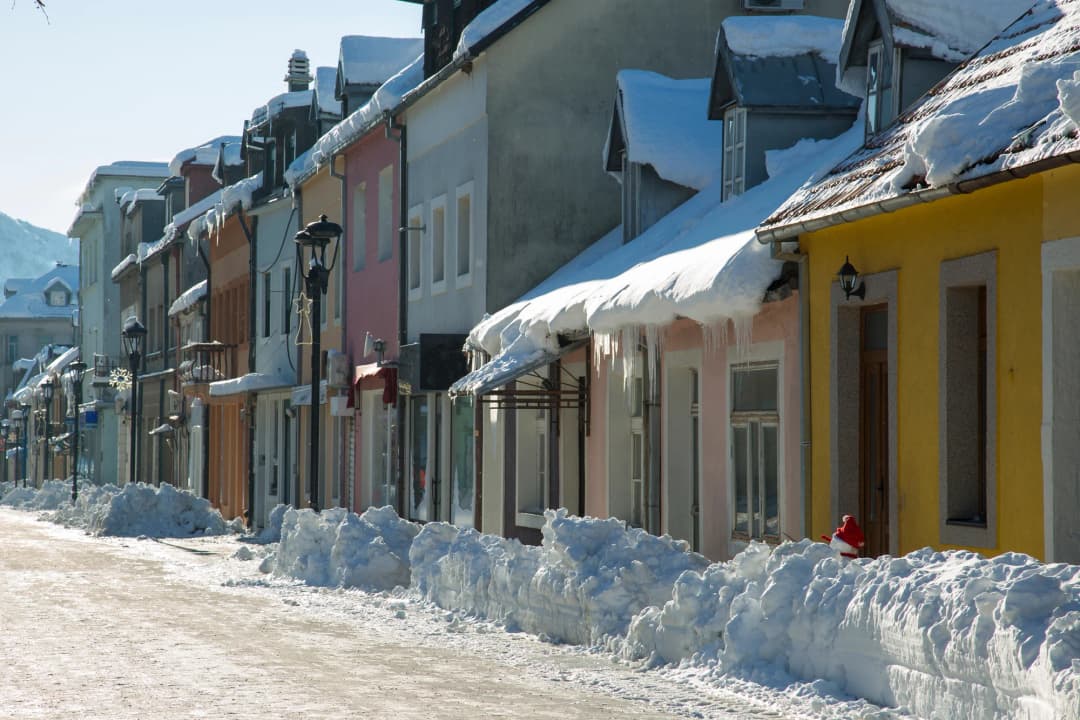
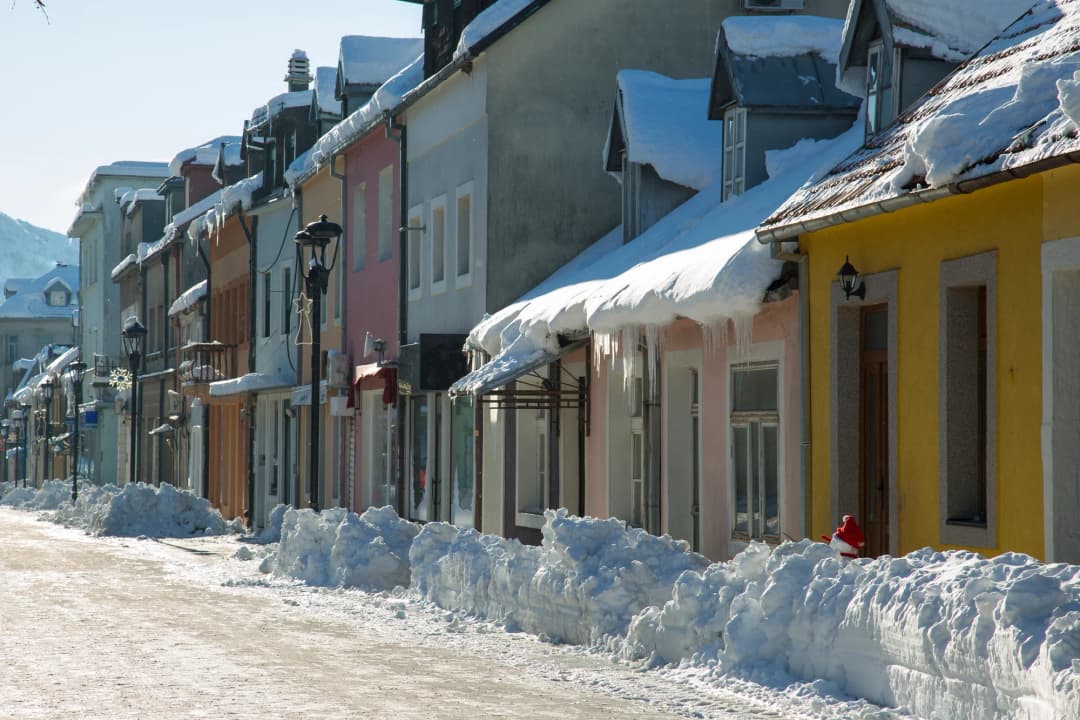
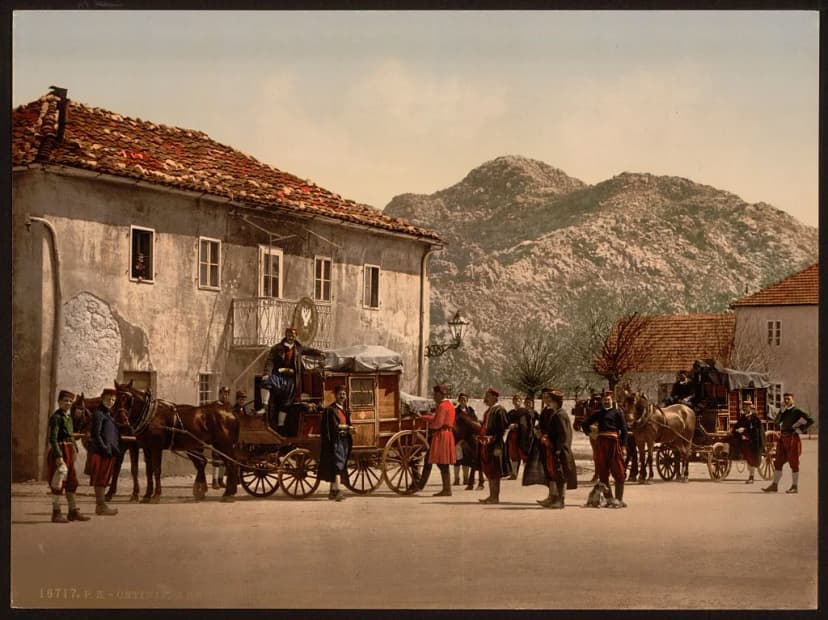
The concentration is the point. In most capitals the legations are scattered over miles; here you pass six or seven of them inside ten minutes, along one boulevard of linden trees and pastel houses. The main street, Njegoševa, is partly pedestrianised and looks nothing like the Venetian coast an hour away — this is a nineteenth-century administrative town, built to be walked in by people in uniform.
A useful walk links the central museums with the former Russian, French, Italian and British diplomatic buildings, then continues through residential streets. The walk works best as context after the King Nikola Museum: the court’s international relationships become physically visible. Note that some former legations now have institutional uses — universities, libraries, galleries and cultural facilities — and are not conventional visitor attractions. Appreciate exteriors from public streets, respect signs and never assume that an open gate means public access. Exact occupancy changes over time, so treat a current city map or visitor-office advice as more reliable than an old list [10][11].
Former legations give Cetinje an unusually varied diplomatic streetscape.
Culture and events
Cetinje lost the government in 1946 and kept everything else. The National Museum, the Central National Library, the state archives, the Faculty of Fine Arts and the Faculty of Drama are all here, in a town of 14,494 people, mostly in buildings put up as embassies. That is why the place reads as part museum and part university town, and why the pace on the main street at six in the evening is a promenade rather than a rush.
It is also why the fabric looks the way it does. Njegoševa, the main street, is partly pedestrianised and lined with pastel single-storey houses under arching lindens — plaster and shutters, not Venetian stone. Several buildings are visibly tired. The municipality took 71,167 tourist overnights in 2025 against Budva’s 4,970,193 [49], and it shows on the façades.
Njegoš, and why the whole country is named after him
Petar II Petrović-Njegoš was born at Njeguši on 13 November 1813, learned to read from the monks at Cetinje Monastery, and became prince-bishop at sixteen, on 30 October 1830. He ruled for twenty-one years and died at Cetinje on 31 October 1851; his remains were carried up to Lovćen in 1855. The Mountain Wreath (Gorski vijenac) was written at Cetinje in 1846 and published in Vienna in 1847 — a verse drama set in the eighteenth century, about his own ancestor Danilo I trying to hold the tribes together against the Ottomans [7][8].
Montenegro keeps Njegoš Day on 13 November, his birthday, as a state holiday, with 14 November also a non-working day [46]. It falls two days before the museums drop to their winter hours, which is worth knowing if you are planning a November visit [38].
He was ruler, bishop, poet and builder at once. He put up the Biljarda in 1838 as a residence, organised a senate, courts and a tax, and opened schools; the epic he wrote in that building is the national poem of both Montenegro and Serbia, which is part of why he is still argued over [7][8].
His nephew Danilo I renounced the ecclesiastical office in March 1852 and made Montenegro a secular principality; Nikola I followed in 1860 and was proclaimed King on 28 August 1910. The dynasty that began with a bishop in 1697 ended with a king in exile in 1918 [5][9].
The summer festival, and the Biennial
The Cetinje Biennial (Cetinjsko bijenale) opened on 8 June 1991 and put international contemporary art into the town’s galleries and empty legations. It ran five times — 1991, 1994, 1996, 2002 and 2004 — and has not been held since; what exists now is an archive of it, and periodic talk of a revival. Guidebooks that describe it in the present tense are out of date, so do not plan a trip around it [25].
What does run is Ljeto u Prijestonici — Summer at the Old Royal Capital — from mid-June to about 20 September, outdoors and free at the door. It is the one stretch of the year when the town is busy after dark. Recurring strands include Espressivo, the Music Academy’s classical festival; Cučka jeka, a traditional festival in the hamlet of Kobilji Do; Riječka noć at Rijeka Crnojevića; Njeguško ljeto on Lovćen and at Njeguši; a folklore festival; and a jazz programme whose billing changes from year to year. Alongside them run readings, book launches, exhibitions and open-air film. Check the municipality’s own programme for the current year rather than an old list [25][26].
Lovćen: the park and Njegoš’s mausoleum
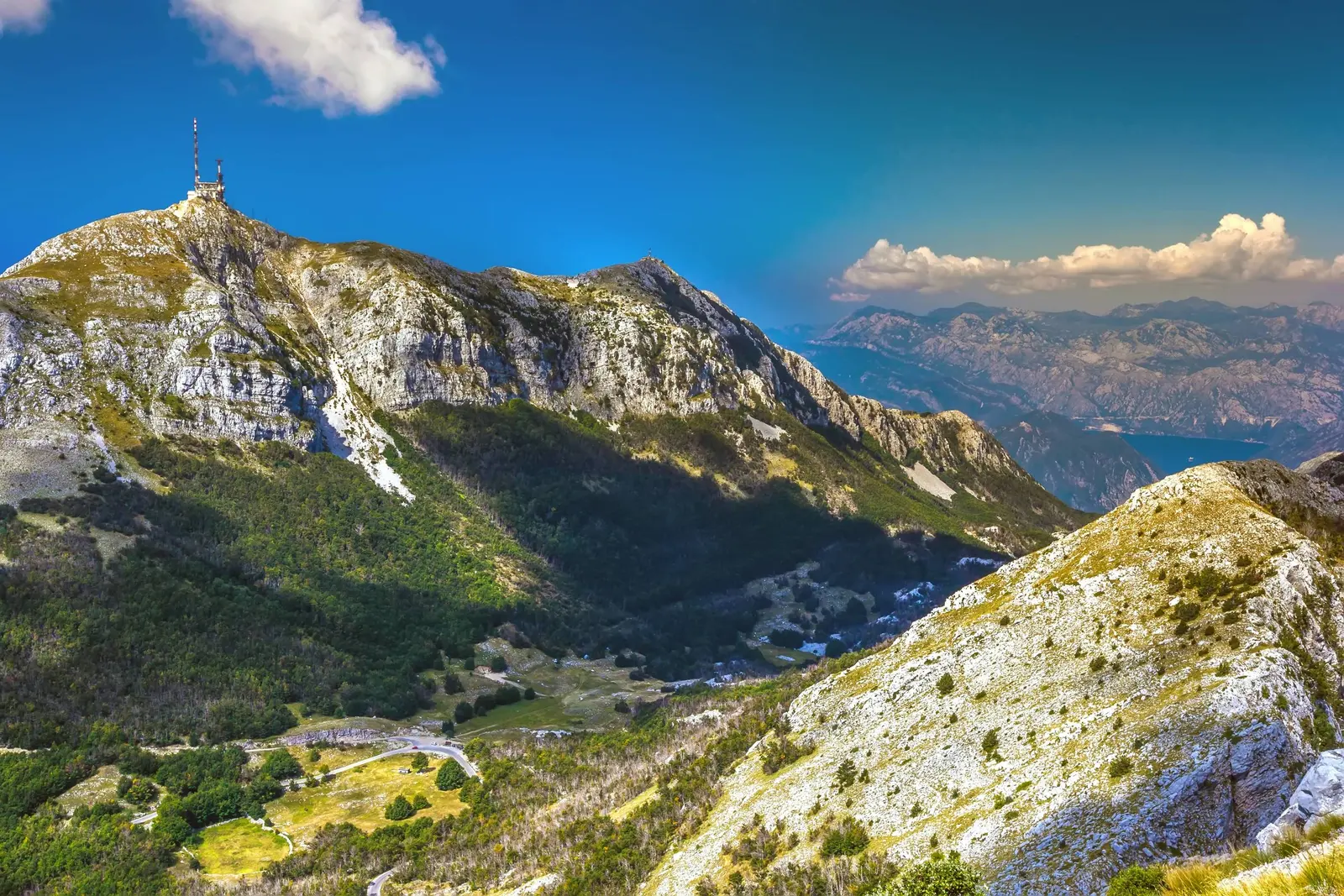
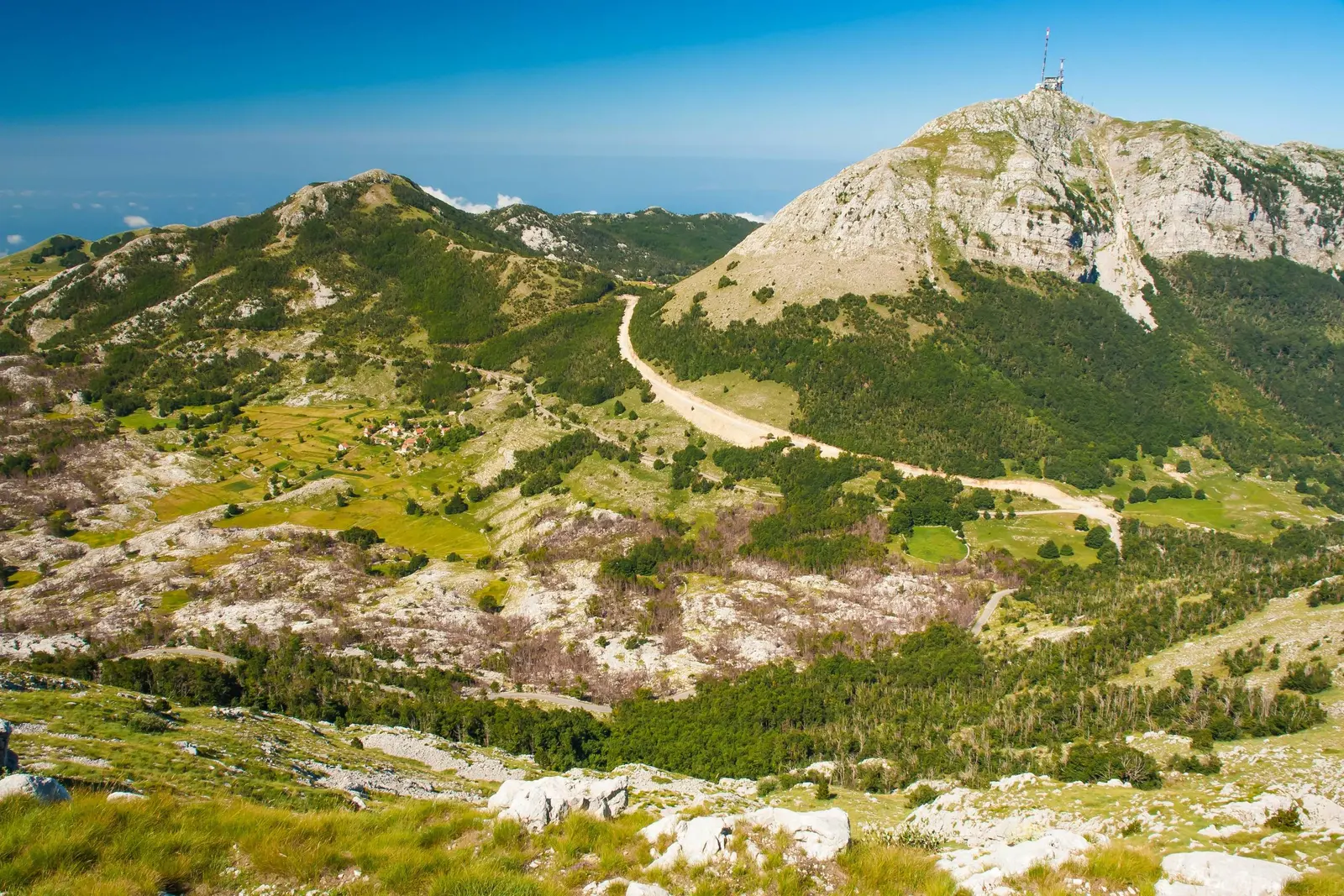
Lovćen National Park begins a few minutes outside town and lies almost entirely inside the municipality of Cetinje. It was proclaimed in 1952 and covers 62.20 km²; its high points are Štirovnik at 1,749 m and Jezerski vrh at 1,657 m, and it is the mountain whose name — Crna Gora, black mountain — the country carries [48]. Entry is €3 per person per day, which includes the visitor centre and the educational trails; parking inside is €1 an hour for a car, €0.50 for a motorcycle, €2 for a four-wheel-drive, €3 for a van and €5 for a bus. An annual pass to all five Montenegrin national parks cost €13.50 for 2026 [39][40].
The mausoleum car park is 20 km and about 34 minutes from the palace square, measured on 11 September 2026, and the road climbs the whole way through beech and pine [43].
The Njegoš Mausoleum stands on Jezerski vrh, the mountain’s second summit at 1,657 m — the National Museum gives the structure’s own platform as 1,660 m [44][48]. It was designed by Ivan Meštrović, on a government decision of 1951, and opened in 1974, when Njegoš’s remains were brought back up; Wikipedia’s article says the structure itself was finished by 1971, so the widely repeated “built 1970 to 1974” is at best loose [28][44]. You reach it up 461 steps through a tunnel driven into the rock, which is lit and cold and comes out on the platform [44]. It is a steady climb rather than a hard one, but it is 461 steps at 1,650 m and there is no lift.
Inside, two stone caryatids weighing 7.5 tonnes stand at the entrance, and under a gold mosaic canopy sits a 28-tonne seated figure of Petar II Petrović-Njegoš, an open book in his lap and an eagle at his shoulder. In the crypt below, a white marble sarcophagus holds his remains, with 18 kg of gold laid into the walls as some 27,000 tesserae [29]. The figure of 200,000 mosaic tiles that circulates elsewhere is not stated by any source we could find.
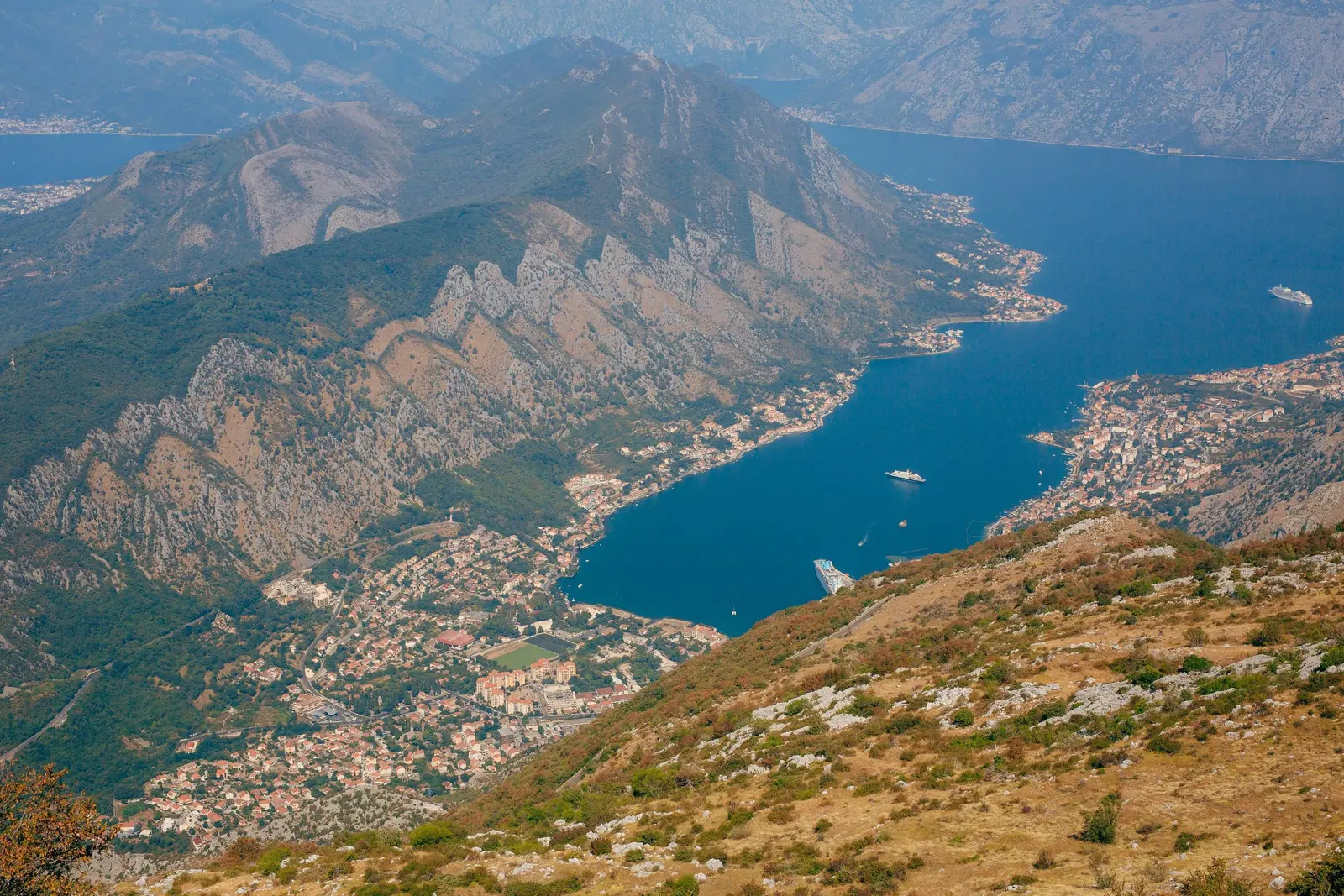
But it is the view that most visitors remember. On a clear day, the panorama from the mausoleum platform encompasses half of Montenegro: the Adriatic Sea, the Bay of Kotor, Lake Skadar, the mountains of Durmitor in the north, parts of Albania and Croatia, and on exceptionally clear days even the coasts of Italy across the Adriatic [28][29].
What it costs, and when it is shut. Two tickets, not one: the park charges €3 a person a day at the barrier, and the mausoleum — run by the National Museum, not the park — charges €8 for adults and €4 for pupils and students, which also admits you to Njegoš’s birth house at Njeguši on the way [37][39]. So the mountain is €11 a head before parking. The mausoleum is open 09.00–18.00 daily from 11 April to 15 November and closed from 16 November to 10 April; the birth house keeps the same season and closes at 17.00 [38]. The €20 collective museum ticket covers the mausoleum, which is what usually tips a three-museum day into buying it.
The massif itself
Lovćen fills the western third of the municipality. On its seaward side it drops almost vertically to the Bay of Kotor and the Budva coast; on its landward side it eases into the Katun plateau and Cetinjsko polje, which is why the approach from Cetinje is a drive and the approach from Kotor is twenty-five hairpins. Between the peaks are deep closed depressions — Kuk, Bizaljevac, Vuči Do, Veliki and Mali Boštur — some of them 200 m deep. Two are broad and shallow instead: Dolovi, and Ivanova Korita at about 1,250 m, which is where the park’s visitor centre, its bungalows, its sports pitches and the only hotel inside the boundary all are.
The municipal geography description in wide circulation gives the peaks as Štirovnik 1,679 m and Jezerski vrh 1,166 m. Both are wrong. Štirovnik is 1,749 m and Jezerski vrh 1,657 m; the second figure is out by 491 metres [48].
Njeguši: pršut, cheese and the house Njegoš was born in
Njeguši is 19 km and about 25 minutes from Cetinje, on the way over the mountain to Kotor [43]. Njegoš was born here on 13 November 1813, in the hamlet of Erakovići, in a house his uncle Petar I built in 1779; it has been a memorial museum since 1973 and is a unit of the National Museum — €3 on its own, or free with the €8 mausoleum ticket, open 09.00–17.00 daily from 11 April to 15 November and shut in winter [37][38].
The village is better known for its ham. Njeguški pršut is a registered protected geographical indication: a bone-in pork leg with the skin and fat on, dry-salted with sea salt, smoked over slowly burning dry beech, and matured for at least nine months. The designation applies only to the Njeguši territory — Dugi Do, Erakovići, Raićevići, Kopito, Vrba, Mali and Velji Zalazi, Žanjev Do, Mirac, Majstori and the hamlets around them — so ham sold as Njeguški elsewhere in the country may or may not be [47]. Half a dozen family konobe along the road serve it with the local cheese.
Walking and cycling on the mountain
Ivanova Korita, at about 1,250 m, is where the walking starts: a visitor centre with trail maps, a restaurant, picnic ground and the park’s own bungalows at €30 a night, with tent pitches at €3 a day and a serviced camping place at €20 [39]. The walk from there up to the mausoleum climbs a little over 400 m and takes an hour and a half to two hours one way. The park hires bicycles at €3 an hour or €8 a day, snowshoes at €4 and poles at €3, and a guide is €40 for four hours or €80 for eight [39]. Other routes [34]:
Marked trails in the park: moderate loops by Škrka lake, the climb to Jezerski vrh, and longer ridge walks. Much of it is shaded, which matters in July.
Mountain biking: steep off-road climbs from Cetinje to the high ground of Lovćen, and the descents back off it.
The long descent to Kotor: from the mausoleum at 1,657 m to the quay at sea level — a drop of more than 1,650 metres in one ride.
The Kotor serpentine road, and when you are allowed on it
The old road from Cetinje to Kotor, now the R-1, was the first cart road built in Montenegro. Josip Šilović Slade, an engineer from Trogir, laid it out and it was built between 1878 and 1884: 36.3 km end to end, five metres wide for most of its length, climbing from sea level to nearly a thousand metres on twenty-five sharp bends, none of them steeper than 8%. The hairpins are the descent from the Krstac saddle — 927 m — down to Kotor. The Cetinje–Njeguši half was rebuilt in 2018, shortened from 19.5 km to 16 km and widened to nearly seven metres, so the five-metre road is now the Njeguši–Kotor side. Adriatic Ways, which drives it as a route rather than measuring it as a road, gives the same twenty-five hairpins over about 25 km and more than 1,000 m of climb [30].
Before it, the only way between Kotor and the capital was a mule track. The Njeguši–Kotor side is still five metres of road with a wall on one side and nothing on the other, and it is worth driving once.
But check the hours before you set off. Under the government order of 25 May 2026, in force from 25 May to 15 October 2026, the R-1 between Krstac and Trojica is one-way by clock for every category of vehicle: Njeguši down to Kotor is prohibited from 08.00 to 15.00, and Kotor up to Njeguši is prohibited from 14.00 to 19.00 [42]. In practice that means a summer day trip from Cetinje either goes down before eight in the morning and comes back before two, or goes down after three and comes back after seven — and between 14.00 and 15.00 the section is shut in both directions. If those hours do not fit, take the Budva road: 48 km and about 65 minutes, against 41 km and about 57 minutes over the mountain, and it is open all day [43]. Neither is a road to drive in fog.
Lipa Cave: Montenegro’s show cave
Lipa Cave is 5.3 km and about 12 minutes from the palace square, on the edge of the Dobrsko-gornjoceklin depression, and it is the only outing from Cetinje that is completely indifferent to the weather [43]. It is one of the largest cave systems in the country, with about 2.5 km of passages and halls, of which the standard tour walks roughly 400 metres of the main tunnel and the big chamber, after a ride in on the small open train from the car park [31][32].
Tickets and times, from the cave’s own booking page on 11 September 2026 [41]. The Cave Experience tour is €16.90 for adults, €8.90 for children aged 5 to 15, €2 under five, and €41.90 for a family of two adults and two or three children. The price covers parking, the train each way, the guided tour and basic accident insurance in the cave. It lasts 60 minutes including the train, and the cave holds 10–12 °C all year, so take a layer whatever the date.
The season runs April to November. From May to October tours leave at 10.00, 11.30, 13.00, 14.30 and 16.00; in April and November there are three, at 10.00, 12.00 and 14.00. There is no online booking and no reservation — turn up at the ticket point in the car park at least thirty minutes before the tour you want. The longer Adventure Tale tour, 100 minutes with equipment at €50 for adults, €25 for children and €125 for a family, was listed as cancelled until further notice in September 2026 [41].
The old road east from Cetinje drops to Skadar Lake, the largest lake in the Balkans, shared with Albania. On the way down is Pavlova strana, the lay-by over the horseshoe bend of the Crnojević river round a conical green hill, about four kilometres above the village. It is the one view of Skadar Lake that most visitors arrive already knowing [33].
Rijeka Crnojevića is 15 km and about 22 minutes from Cetinje [43]. Its two-arched limestone bridge, 43 m long, was ordered by Prince Danilo in 1853 in memory of his father Stanko and replaced Petar II’s wooden one. The village was the capital’s port — everything that came up to Cetinje came through here by boat — and the oldest surviving building in it, Petar I’s house of 1810–15, still stands above the bridge. Skadar Lake National Park charges €5 per person per day and hires a single kayak at €3 an hour; its visitor centres are at Vranjina and Virpazar [39].
For the boats and the pelicans, go on to Virpazar, 36 km and 54 minutes from Cetinje by road, where the trips onto the open water leave from [43].
This corner of the municipality is a different country from the mountain. It is lower, softer and far easier to drive: the largest of its depressions is the Dobrsko-gornjoceklin bay, with Lipa Cave on its rim, and beyond it the Crnojević river has cut a deep, winding valley down to the lake.
The wildlife of the municipality is concentrated here rather than on the karst. The municipal description counts over 150 species of birds on the Crnojević river and the lake — among them one of Europe’s last colonies of Dalmatian pelicans — and about thirty species of fish. Up on Lovćen the animal life is thin by comparison; the same description gives about 2,000 ha of that park as beech forest, out of the 62.20 km² it covers in total [48].
Where to eat in Cetinje
Cetinje is not a restaurant town, and the prices reflect it: an espresso runs about €1.00–1.50, a beer €2.50–3.00, and dinner for two in a konoba with local wine €25–35. The menus are written for people who live here, which is why they are short and there are no photographs on them.
Restaurant Kole, on Crnogorskih junaka a few hundred metres off the palace square, is the one most often named locally as the best food in town. The menu runs to Njeguški pršut (the dry-cured ham from the village up the mountain), Njeguški sir (its cheese), smoked meats, lamb boiled and roasted, and fresh carp from Skadar Lake cooked on volcanic lava stone. The ham and the cheese are the house’s own. There are international dishes on the menu; the Montenegrin ones are the reason to be there. Open daily, from seven in the morning to about eleven at night.
Beyond Kole, several kafanas and small restaurants around the main square serve reliable grilled meats, salads, freshwater fish and traditional stews. Cetinje is also a good place to try cicvara (a rich cornmeal and cheese dish) and kacamak (a similar preparation), both mountain staples that you will not often find on coastal menus. Local bakeries sell burek and other pastries for quick, inexpensive meals.
Coffee is the local institution. An hour on the boulevard with a domestic coffee, between five and seven in the evening when the whole town is walking up and down it, is the cheapest thing to do in Cetinje and the most characteristic.
Where to stay in Cetinje
Almost nobody sleeps here. The municipality recorded 71,167 tourist overnights in 2025 against Budva’s 4,970,193, which is the single most useful fact about accommodation in Cetinje: the supply is small, it is family-run, and it is cheap. Staying the night is also the only way to see the town without the coaches in it.
Two places to sleep in the Cetinje municipality are published on this site — one in the town, one on the mountain. Rates are shown live on each listing.
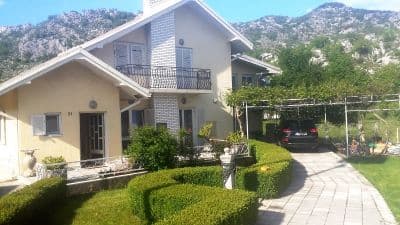
Stanković Apartmani — one apartment of 25 m² with its own separate entrance, a terrace and parking, four or five hundred metres out of the old centre and fifty metres from the two big supermarkets.
Hotel Ivanov Konak — four stars at Ivanova Korita, 1,250 m up on the southern edge of Lovćen National Park: five studio apartments and two double rooms, each with its own terrace, in a complex that also holds King Nikola’s summer house of 1896.
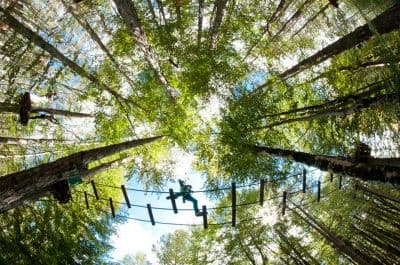
A third Cetinje listing on this site, Avanturistički park Lovćen, is not accommodation. It is the rope-course park on the same clearing at Ivanova Korita: seven aerial routes from one to fifteen metres up, rigged for ages five to seventy.
The Grand Hotel, not currently listed on this site, is the established three-star in the centre — indoor pool, sauna, breakfast, restaurant, free parking, and within walking distance of every door in this guide. It carries the name of the royal capital’s Lokanda, which housed the American legation, but not the building: that one came down after the 1979 earthquake and the present block is later.
Beyond it, the rest of the supply is small guesthouses, apartments and private rooms on the booking platforms: family-run, modestly furnished and cheap by Montenegrin standards.
For those with a car, staying in Cetinje and driving to the coast for day trips is a budget-friendly alternative to booking accommodation in Kotor or Budva during peak season. If you would rather base yourself elsewhere, compare bases in Budva or Kotor; from inland, the Podgorica accommodation guide helps with an early start.
Getting to Cetinje and getting around
Cetinje has no airport, no railway and no port, and never has had any of them. Everything arrives by road, from three directions, and the town is small enough that once you are in it you will not need a vehicle again until you leave.
Getting there
From Podgorica:35 km, about 44 minutes by car on a two-lane road that climbs the whole way. The older figures of 36 km and “30 minutes” are optimistic in summer traffic.
From Budva:27 km, about 39 minutes over the Brajići road — the shortest link to the sea.
From Kotor over the mountain:41 km, about 57 minutes by way of Njeguši and the twenty-five hairpins — but read the seasonal traffic order above before you rely on it. Via Budva it is 48 km and about 65 minutes, open all day.
Airports: Podgorica (TGD) is 38 km and about 49 minutes; Tivat (TIV) is 47 km and about 62 minutes. Podgorica takes almost all of the traffic.
Buses: direct services from Podgorica, Kotor, Budva, Herceg Novi and Ulcinj. CheckMyBus, read on 11 September 2026, lists 92 departures a day from Podgorica alone, run by 21 companies, the fastest scheduled at 30 minutes, with the cheapest ticket listed at €3.50 [46]. No operator and no bus station publishes a tariff of its own, so treat that as an aggregator’s number and buy at the counter. The bus station is a fifteen-minute walk from the centre.
Every road distance and driving time on this page was measured with OSRM on OpenStreetMap data on 11 September 2026, from the square in front of King Nikola’s palace [43].
Getting around
The historic centre is entirely walkable: every museum, the monastery, the legations and the restaurants are inside a fifteen-minute walk of one another, and there is no public transport within the town because none is needed. A car earns its keep only for Lovćen, Lipa Cave and the lake. Parking in the centre is charged: since 1 July 2024 the municipality has run a Zone I covering Studentski trg, the car park by the town hall, Šantićeva, Balšića pazar I and II, Ulica 13. novembra and the sports centre, at €0.30 for each started hour, paid by SMS to 14557, at a machine or by card [54].
Day trips from Cetinje
Cetinje sits between the coast, the mountain and the lake, which is what makes it a better base than its hotel count suggests. Every duration and distance below was measured with OSRM on OpenStreetMap data on 11 September 2026, from the square in front of King Nikola’s palace: duration first, then road distance [43].
Lipa Cave (12 minutes, 5 km) — the show cave on the old eastern road; an hour underground at a steady 10 to 12 degrees, and the one outing here that does not care what the sky is doing.
Rijeka Crnojevića (22 minutes, 15 km) — Danilo’s two-arched limestone bridge of 1853, 43 m of it, and the quay that was the capital’s port; the Pavlova strana lay-by is 4 km above the village.
Njeguši (25 minutes, 19 km) — the pršut village on the way over the mountain, and the house where Petar II was born in 1813, open 09.00 to 17.00 from 11 April to 15 November.
Lovćen and the Njegoš Mausoleum (34 minutes, 20 km) — 461 steps through a tunnel to the second summit at 1,657 m; a park ticket of €3 a person a day, and €8 more for the mausoleum itself.
Budva (39 minutes, 27 km) — the nearest sea, straight down the Brajići road: a walled town, a line of beaches and the loudest nightlife in the country.
Podgorica (44 minutes, 35 km) — the working capital, with its airport 49 minutes away at 38 km, and the buses and trains that go everywhere else in the region.
Sveti Stefan (48 minutes, 35 km) — the islet hotel, seen from the lay-by on the road above it, and the Miločer park walk below.
Virpazar and Skadar Lake (54 minutes, 36 km) — the boats onto the largest lake in the Balkans, and the national park’s own day ticket at €5 a head.
Kotor (57 minutes, 41 km) — the Budva road is 48 km and 65 minutes and never shuts; the twenty-five hairpins over Krstac are shorter, but in season the traffic order closes them for much of the day.
Tivat (65 minutes, 49 km) — Porto Montenegro and the second airport, 47 km and 62 minutes away.
What Cetinje costs, and what is open
Planning a National Museum visit in three steps
Step
Question to answer
1 · Building
Open today?
2 · Hours
Which season?
3 · Ticket
What is included?
Source: en.narodnimuzej.me
Cetinje is a town of paid doors, and almost every one of them is priced by an institution that publishes its tariff. Here is the lot, read off the official pages on 11 September 2026. The National Museum’s own houses are in the table further up; this one covers everything else.
What a day in and around Cetinje costs, September 2026. Sources given per row; a dash means the figure is not published anywhere we could find.
What
Price
Source
Cetinje Monastery, church and grounds
Free, daily about 08.00–20.00
Montenegro Pulse [26]
The monastery treasury
— no tariff and no hours published; generally shown to booked groups
unpublished
National Museum collective ticket — every house plus the mausoleum
€20.00 adult, €10.00 pupils and students; free under 12
narodnimuzej.me [37]
Njegoš Mausoleum, including Njegoš’s birth house
€8.00 adult, €4.00 pupils and students
narodnimuzej.me [37]
Lovćen National Park entry, with the visitor centre and the educational trails
€3.00 per person per day
nparkovi.me [39]
Parking inside Lovćen National Park
Car €1.00 an hour; motorcycle €0.50; four-wheel-drive €2.00; van €3.00; bus €5.00
nparkovi.me [39]
Annual pass, all five Montenegrin national parks, 2026
€13.50
nparkovi.me [40]
Lipa Cave, the 60-minute Cave Experience
€16.90 adult; €8.90 age 5–15; €2.00 under 5; €41.90 family of four or five
lipa-cave.me [41]
Skadar Lake National Park day ticket, for the lake below Rijeka Crnojevića
€5.00 per person per day; single kayak €3.00 an hour
nparkovi.me [39]
Bus, Podgorica to Cetinje
€3.50 cheapest listed; 92 departures a day, fastest 30 minutes. No operator or bus station publishes a tariff of its own
CheckMyBus [46]
Espresso · beer · dinner for two with wine
€1.00–1.50 · €2.50–3.00 · €25–35
indicative street prices, September 2026 — no published tariff
Parking in the centre, Zone I
€0.30 for each started hour, by SMS, machine or card
Prijestonica Cetinje [54]
A bungalow or a tent pitch inside Lovćen National Park
Bungalow €30.00 a day; tent space €3.00; serviced camping place €20.00
nparkovi.me [39]
Check the hours before the prices. The National Museum runs two calendars: 11 April to 15 November, every house open daily 09.00–17.00; and 16 November to 10 April, 09.00–15.00 Monday to Friday only, with the mausoleum and the Njeguši birth house closed altogether [38]. The Historical Museum is listed as closed for visiting with no reopening date. Public holidays, installations and maintenance override all of it, and 13 and 14 November are non-working days across the country [46].
Buy the right ticket. Up to three houses the single tickets are cheaper; at four, or at three plus the mausoleum on Lovćen, the €20 collective ticket wins. Ask at the first counter what is actually open that day before you commit to it.
Monastery dress code. Cover your shoulders and knees. Women should bring a headscarf and a long skirt or wrap. The monastery is a functioning religious site, not a museum, and dress requirements are taken seriously.
Expect mountain weather. Conditions can be cooler and wetter than the coast on the same day, and showers can begin abruptly. Bring a light layer and rain protection even when departing sunny Budva. The leafy centre offers shade, but not every route is sheltered.
Plan for mixed accessibility. Central distances are short, yet historic thresholds, steps, uneven paving and older interiors can create barriers. Ask the museum directly about the specific building, gallery and toilet facilities you need. Do not infer access at one museum from another.
Do not trust an old drive time. Guidebooks routinely say thirty minutes from Podgorica and thirty from Budva; measured on the road in September 2026 those are 44 and 39 minutes, and the Kotor serpentine route is 57, not 45. In July and August add to all of them.
Cetinje is quieter than the coast. That is the point. The town moves at its own rhythm — shops may close for long lunches, and not everything runs on a strict schedule.
Time needed. Half a day covers the main sights. To see the museums properly, take in the monastery and get up Lovćen as well, allow a full day, and preferably a night. Two nights buys an unhurried pace and a day trip to Kotor or the lake. The best order is the afternoon in the museums and the monastery, a night in the town, and the drive up to the mausoleum the next morning, when the air over the bay is clearest.
Language. English is less widely spoken here than on the coast, but younger residents and museum staff generally manage well. A few words of Montenegrin — dobar dan (good day), hvala (thank you), molim (please) — go a long way.
Cultural significance. Montenegrins view Cetinje with a reverence that is difficult to overstate. This is where their state was born, where their literature was printed, where their church has its seat, and where their independence was defended.
If one site is unexpectedly closed, use the time for the embassy walk rather than driving somewhere else to replace it.
Climate and when to visit
At 670 m, between the sea and the mountain, Cetinje is one of the wettest inhabited places in Europe: 3,305 mm of rain a year, from 65 mm in the driest month, July, to 500 mm in the wettest, November. July averages 20.2 °C and January 1.5 °C [35].
Summer (June-September): Warm and generally sunny, with average July temperatures around 20 degrees C. Afternoon thunderstorms possible, and mornings can be cool enough for a light jacket. This is the best time for hiking, cycling, and the cultural festival season.
Winter (December-February): Cold, with average January temperatures around 1.5 degrees C. There can be heavy snowfall at this altitude, and cold spells take the temperature to -15 °C or below; the record is -23 °C [35]. The mausoleum on Lovćen is closed to visitors from 16 November to 10 April in any case [38]. Accommodation is at its cheapest.
Best time to visit:May to September for the best combination of weather, open attractions (especially Lipa Cave from April), and cultural events. July-August are peak months.
Cetinje’s altitude makes layers and rain protection sensible even on a coastal day trip.
A realistic one-day Cetinje itinerary
A one-day Cetinje plan
Time of day
What to see
Morning
Palace + Biljarda
Midday
Monastery
Afternoon
One collection + walk
Source: en.narodnimuzej.me
09:00–10:30: King Nikola Museum. Start with the political framework while your attention is fresh. In winter, confirm weekday opening before leaving the coast or Podgorica.
10:30–11:15: palace square and Ćipur. Read the relationship between the palace, church and old dynastic centre rather than rushing between doors.
11:15–12:15: Biljarda. Focus on Njegoš’s combined literary and governing roles, and allow time for the relief map in the glass pavilion.
12:15–13:00: monastery area. Allow flexibility if a service is taking place; the sacred relics are the highlight for most visitors.
13:00–14:00: lunch. Pick from what is open and what the board says; menus and hours here change faster than any guide can follow.
14:00–15:30: one specialist collection. Choose Art or Ethnographic rather than exhausting both by default.
15:30 onward: embassy-quarter walk, taking in the Vlach Church and its rifle-barrel fence. Finish outside, where closing times matter less.
If you have a car and a longer day, swap the afternoon for the drive up to Lovćen and the Njegoš Mausoleum — two to three hours there and back — or for Lipa Cave, about an hour and a half, and finish at the Pavlova strana lay-by over Skadar Lake on the road towards Podgorica.
In the shorter winter schedule, reduce this to King Nikola Museum, Biljarda if open, the monastery exterior and a compact diplomatic walk. Visitors making a wider circuit can use the Grand Tour overview to place Cetinje between coast, mountains and the modern capital.
How to visit responsibly
Buy tickets from official desks, respect museum photography rules and avoid touching historic interiors. In religious spaces, the needs of worshippers come first. Former diplomatic buildings may be workplaces or institutions, so view them from public areas unless entry is explicitly offered. Finally, spread your time and spending beyond a rushed coach stop: a café break, specialist collection or guided walk adds more value than photographing the main façades in minutes.
What travellers say
Cetinje’s reviews are unusually consistent. These are the themes that recur across published guides and review pages, paraphrased rather than quoted [26][27][36].
The nineteenth century is still legible. The streetscape is largely intact, there is almost no modern commercial development, and the pace is slow.
The collections outweigh the displays. Several are hung as they were decades ago and would repay a rehang; the concentration of nationally significant material in one small area is what people come away with.
It does not feel like the coast. Quieter, more studious, more tied to the country’s own account of itself.
It shows its age. Parts of the town are in visible disrepair. Reviewers are divided on whether that is a fault or the point.
The monastery is the highlight for most visitors, and the relics are the reason.
Lovćen and the mausoleum are rated as highly as anything in the country, with the 461 steps repaid by the view.
The town suits travellers who came for history, architecture and religious heritage rather than a beach [26][27][36].
Frequently asked questions
Every figure below is sourced in the tables above and in the references at the foot of the page; prices and opening hours were read off the official pages on 11 September 2026.
How much does it cost to see Cetinje’s museums?
One collective ticket covering every house of the National Museum plus the Njegoš Mausoleum is €20 for adults and €10 for pupils and students; children under twelve are free. Bought separately the palace of King Nikola is €8, the Biljarda with the relief of Montenegro €5, the Art and Historical museums in Vladin dom €5, and the Ethnographic Museum €4 — so any two houses come to €9–13 and any three to €14–18, and up to three the singles are cheaper. All four come to €22, and three houses plus the mausoleum to at least €22: at that point the collective ticket wins [37].
How much does Cetinje Monastery charge to get in?
Nothing. The church and grounds are free and open daily, roughly 08.00 to 20.00. Shoulders and knees must be covered and photography inside is not allowed. The treasury, which holds the right hand of John the Baptist and a particle of the True Cross, is a different matter: it is generally opened for booked groups, and no price and no hours for it are published anywhere — ring ahead if it is the reason you are going [26].
How long do you need in Cetinje?
Half a day covers the palace museum, the Biljarda and the monastery — about four hours including a stop for coffee. A full day adds one specialist collection, the embassy walk and the Vlach Church. Lovćen and the mausoleum need two to three hours more on top, so if you want both the town and the mountain properly, stay the night: only 71,167 overnights were recorded in the whole municipality in 2025, and the coaches are gone by six.
What do Lovćen and the Njegoš Mausoleum cost, and when are they open?
Two separate tickets: €3 per person per day for the national park at the barrier, and €8 for the mausoleum itself, which is run by the National Museum and also admits you to Njegoš’s birth house at Njeguši. That is €11 a head, plus €1 an hour to park a car inside the park. The mausoleum is open 09.00–18.00 daily from 11 April to 15 November and closed from 16 November to 10 April. There are 461 steps from the car park, through a tunnel in the rock [37][38][39].
Can you drive from Cetinje to Kotor down the serpentines?
Yes, and it is 41 km and about 57 minutes that way — but from 25 May to 15 October 2026 a government traffic order makes the R-1 between Krstac and Trojica one-way by the clock: Njeguši down to Kotor is closed 08.00–15.00 and Kotor up to Njeguši is closed 14.00–19.00. Go down before eight or after three. The alternative through Budva is 48 km and about 65 minutes and is open all day [42][43].
Is Lipa Cave worth the trip from Cetinje?
It is 5 km and twelve minutes away, the tour lasts 60 minutes including the little train in from the car park, and the cave sits at 10–12 °C whatever the weather is doing outside. Adults pay €16.90, children of 5 to 15 €8.90, under-fives €2, and a family of two adults and two or three children €41.90. It runs April to November, there is no online booking, and you should be at the ticket point thirty minutes before the tour you want [41][43].
When is the best time to visit Cetinje?
May to September. Everything is open daily 09.00–17.00 from 11 April to 15 November, Ljeto u Prijestonici fills the evenings from mid-June to about 20 September, and Lipa Cave and the mausoleum are only open in that window anyway. Rain decides the rest: Cetinje takes 3,305 mm a year, but only 65 mm of it in July against 500 mm in November. In winter the museums drop to 09.00–15.00, Monday to Friday [35][38].
A brief history of Cetinje
Six spans, and between them they are the whole of Montenegrin statehood in miniature: a court moved into a defensible field, a printing press, two and a half centuries of prince-bishops, thirty-six years as a recognised European capital, and then the long afterwards.
Before the city: first named in 1440
Cetinje is first named in a written source in 1440, four decades before there was a town to name. People were in the field long before that: the Koronjina cave, still unexcavated, has given up a quantity of worked stone from the Palaeolithic. Around what is now the Vlach Church stood a necropolis of about 150 stećci — the carved tombstones of the medieval western Balkans — and nearly all of them were built into the church’s foundations during a nineteenth-century restoration. Two are still lying at the gate. Nothing that could be called a settlement is recorded here until the very end of the fifteenth century.
Ivan Crnojević moves the court, 1482
Cetinje was founded in 1482, when Ivan Crnojević, lord of Zeta, moved his court onto the field at the foot of Lovćen. He was running out of places to put it: the centre of medieval Zeta had already moved from Žabljak Crnojevića in 1475 to Obod, above Rijeka Crnojevića, and the Ottoman advance kept coming. Cetinjsko polje was the last defensible ground — a small flat field with a mountain wall around it and one narrow way in from every direction [3][4][5].
The court went up first; the monastery followed, bringing the seat of the Zeta metropolitanate over from St Nicholas on the island of Vranjina in Skadar Lake. Wikipedia’s article has Ivan building it in 1484 and founding it on 4 January 1485 at Ćipur [16]. The effect was court and church in one small field, which is what Cetinje went on being for four and a half centuries.
The first printing press, 1493
Ivan’s son Đurađ Crnojević set up a printing press in 1493, thirty-eight years after Gutenberg — the first printing house in southeastern Europe. It ran until 1496 under the hieromonk Makarije and printed five liturgical books in Cyrillic, the first of them the Oktoih prvoglasnik [45].
Two things about it are disputed and both are printed here rather than settled. Where it stood: Wikipedia says plainly that the press “operated between 1493 and 1496 in Cetinje”, and the National Museum says the Oktoih was printed in Cetinje in 1493; the older Montenegrin tradition puts it at Obod, above Rijeka Crnojevića [45][9]. When the Oktoih was finished: Wikipedia dates its completion to 4 January 1494, the museum to 1493 [45][9].
Ottoman pressure and the prince-bishops, from 1516
From 1516, with the Crnojevići gone, the country was governed from the monastery by prince-bishops — the vladike — and stayed a theocracy until 1851. The buildings paid for it: Venetian troops mined the monastery as they withdrew in 1692, during the Morean War, and what stands today was raised afterwards [16]. In 1697 the office became hereditary in the Petrović-Njegoš family under Danilo, and that line held Cetinje for 221 years, to 1918 [4][5][6].
Through all of it the Ottomans never held the mountain for long, which is the fact the town is built on and the reason its nineteenth-century visitors reached for classical comparisons. Tennyson’s sonnet of 1877 addressed the principality, not its capital, as the “rough rock-throne of Freedom” — and wrote it into the Victorian imagination a year before the Congress of Berlin recognised it.
Recognition, the kingdom and the wars, 1878–1945
The Congress of Berlin recognised Montenegro as an independent state in 1878, and the great powers arrived to open legations in a town of a few thousand people. The buildings they put up are the subject of their own chapter below; what matters here is the political fact behind them, which is that between 1878 and 1914 Cetinje was a European capital in the full diplomatic sense, with a resident corps [10][11].
On 28 August 1910, on the fiftieth anniversary of his accession, Prince Nikola I proclaimed himself King and Cetinje became a royal capital. The palace was extended and redecorated for it. Nikola married his daughters into the ruling houses of Italy, Serbia and Russia and was known across Europe as the father-in-law of kings; one of those daughters, Elena, became Queen of Italy [9][12].
The state lasted eight more years. During the First World War, Montenegro fought alongside the Allied Powers. Austria-Hungary occupied Cetinje in January 1916. King Nikola fled to exile in France. After the war, the Podgorica Assembly of 1918 voted to unite Montenegro with Serbia and the emerging Kingdom of Serbs, Croats and Slovenes (later Yugoslavia), effectively ending Montenegrin independence and Cetinje’s role as a national capital [5][9].
In April 1941 Italy occupied Montenegro. The Italians attempted to establish a puppet “independent” Montenegrin state, with Cetinje as its administrative centre. This was partly motivated by Queen Elena of Italy, who was born in Cetinje as the daughter of King Nikola I. However, a popular uprising erupted on 13 July 1941 – one of the first anti-fascist insurrections in occupied Europe. Insurgents besieged Italian forces in Cetinje. After Italy’s capitulation in September 1943, Nazi Germany took over the occupation until liberation in 1944 [13][14].
Titograd, independence and the Old Royal Capital, 1946 to today
In 1946 the capital of the Socialist Republic of Montenegro moved to Titograd, now Podgorica, and Cetinje lost in one administrative act the function it had held for 464 years. What it kept were the institutions: the National Museum, the central national library, the state archives, the art academies. The referendum of 21 May 2006 restored Montenegrin independence, Podgorica stayed the seat of government, and Cetinje was given the constitutional title of Old Royal Capital (Prijestonica). The Blue Palace was adapted for the President’s Office in 2006 and has been the official residence of the President of Montenegro since 2010 [5][6][15][20].
The modern town is smaller than the one that lost the capital. The census counted 20,307 people in the municipality in 1991, 18,482 in 2003, 16,657 in 2011 and 14,494 in 2023 [49][51]; Podgorica, three-quarters of an hour down the hill, takes the young. The museums, the archives and the title stay. In 2025 the municipality recorded 71,167 tourist overnights against Budva’s 4,970,193 — almost everyone who comes to Cetinje comes for one afternoon and sleeps somewhere else.
Summary
Cetinje is the one place in Montenegro where the country explains itself. Everything that made the state is inside one kilometre: the monastery that has been the seat of the church since 1485, the first printing house in southeastern Europe, at work here from 1493, the palace of the last king, the poem written in the Biljarda, the fence built out of captured rifle barrels, and the embassies six great powers put up for a capital of a few thousand people. Twenty euros opens every one of the museum doors; the monastery costs nothing; the mountain above it costs eleven. It has no beach and no nightlife and it closes at five. Come for the afternoon and you will see it. Stay the night — as 71,167 overnights a year suggests almost nobody does — and you will have the place to yourself from six.
Written by
Pavle Obradović
Pavle Obradović is from Herceg Novi. He was Manager of Montenegro.com, then Director of the Herceg Novi Tourism Organization, and is now Coordinator for Investment and Development Projects at the Municipality of Herceg Novi. He holds a BSc in International Hospitality and Service Management from the Rochester Institute of Technology (RIT).
···
Updated · Originally published
Montenegro Travel Newsletter
Get weekly stories, guides, and insider tips about Montenegro delivered to your inbox.
.jpg&w=2048&q=75)