Nikola Petanović belongs to two histories at once: the movement of Montenegrins to the United States and the political struggle over what Montenegro became after 1918. From San Francisco he wrote poetry, gave lectures, organized a committee and edited The Montenegrin Mirror. His goal was not detached reporting. It was to persuade emigrants and English-speaking readers that Montenegrins should decide their political future themselves.
That purpose makes his work valuable and demanding. It preserves an exile argument rarely visible in national summaries, while institutional records, Petanović's advocacy and later scholarly interpretations each illuminate a different part of his life.
| Layer | What it yields |
|---|---|
| RECORD | place · dates · title · publisher · surviving catalogue |
| ADVOCACY | referendum · independence · diaspora organization |
| ANALYSIS | audience · identity language · historical limits |
Source: leks.canu.ac.me, arhivyu.rs, maticacrnogorska.me
A documented outline—and the gaps
| Date | Documented event | Qualification |
|---|---|---|
| 1892 | Born in Podgor, Crmnica, according to CANU, Matica and scholarship | A cemetery index instead gives 1897 |
| 1912 | Left for the United States; Matica places him first with brother Mitar in Butte | The cited records do not include a passenger manifest |
| 1923 | Ponos života published in San Francisco | Its print run is unknown |
| 1924 | Publicistic and political activity becomes visible in later accounts | Those accounts summarize brochures, letters and lectures |
| 1927 | The Montenegrin Mirror and an independence committee begin in San Francisco | Institutional English names vary in translation |
| 1931/32 | Scholars end the magazine in 1931; an archive catalogue gives 1932 | The disagreement remains open |
| 1932 | Died in San Francisco | Accounts differ on the exact day |
The Montenegrin Academy's diplomatic lexicon provides the most compact institutional outline: Podgor in 1892, migration in 1912, public work from 1924, and the magazine from 1927 to 1931. Matica's catalogue adds the route through Butte, Montana, to California and says he continued his education there. Neither source names a college or credential, so “educated in America” should not be inflated into a specific degree.
Butte matters because it connects this intellectual biography to the harder material story of migration. Our guide to Montenegrins in Montana coal country follows a community built through dangerous industrial work, mutual aid and burial records. Petanović soon moved west, but his first American setting belonged to that same migration geography.
| Year | Milestone |
|---|---|
| 1892* | Podgor |
| 1912 | Butte → California |
| 1923 | Ponos života |
| 1927 | Mirror + committee |
| 1931/32 | disputed endpoint |
| Note | *Scholarly consensus; one cemetery index lists 1897. |
Source: leks.canu.ac.me, maticacrnogorska.me, arhivyu.rs
Ponos života: literature before the magazine
Petanović published Ponos života (“Pride of Life”) in San Francisco in 1923, in his native language. A 2024 study by Sofija Kalezić treats the volume as poetry mixed with short prose. She identifies freedom as its organizing concern, ranging from national and South Slav liberation to individual autonomy, alongside nature, homeland, nostalgia, love and human solidarity.
Long English renderings of Petanović's writing circulate without a named translator or edition. Translation changes rhythm, register and even meaning, so those passages should not be treated as his exact English words. The 2024 study also judges idea more central than formal polish and detects both modernist impulses and Romantic influence. Those are the scholar's literary assessments, not measurable facts.
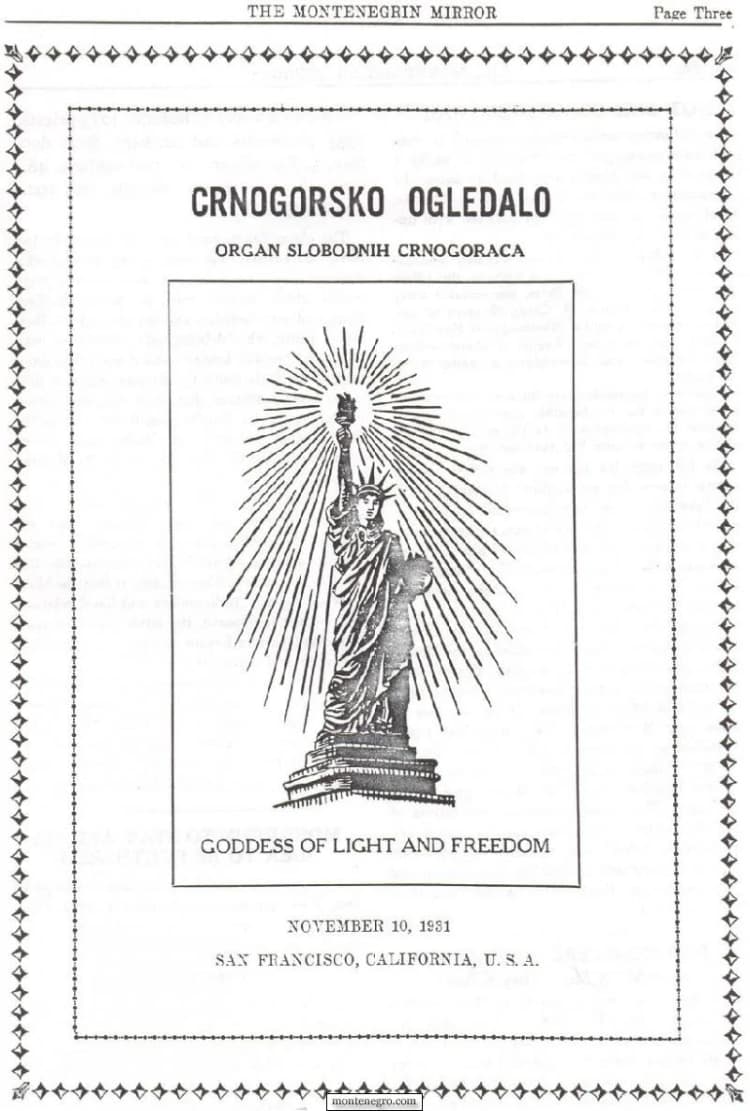
What The Montenegrin Mirror was designed to do
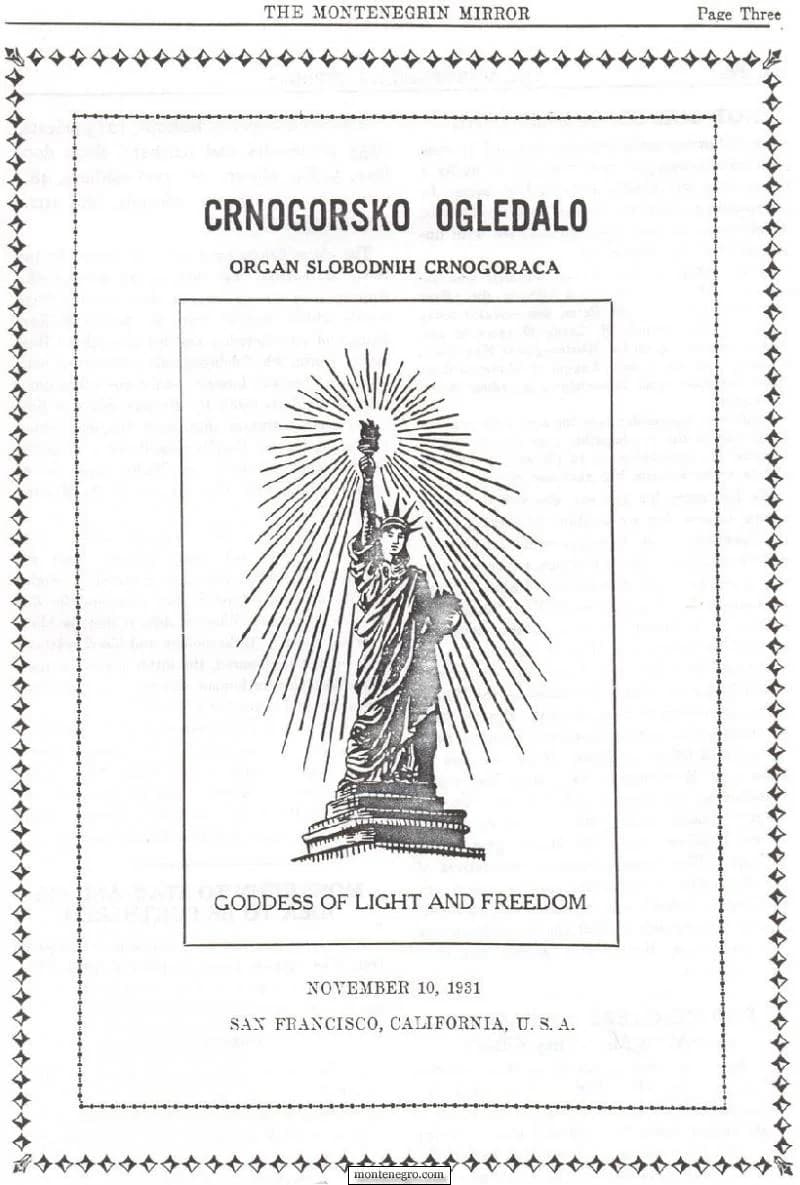
In 1927 Petanović became owner, editor and contributor to The Montenegrin Mirror and president of a San Francisco committee for a sovereign and independent Montenegro, according to CANU. The periodical was an instrument of advocacy: it tried to organize emigrants, preserve a political cause after exile institutions had weakened, and reach people outside the Montenegrin-speaking community.
Historian František Šístek describes it as a monthly, bilingual English–Montenegrin publication written largely by Petanović. Its subtitle presented it as a mirror of virtue, gentleness and heroism, published by “free natives of Montenegro.” English was therefore not incidental. It connected an exile organization to an anglophone public whose support Petanović hoped to mobilize. Readers interested in how language changes access can compare our practical Montenegro language guide and the later story of Montenegro's representation in the international press.
| Stage | Resources |
|---|---|
| DIASPORA | members · letters · funds |
| BILINGUAL PRESS | Montenegrin + English |
| PUBLIC ADVOCACY | US readers · institutions |
| Caveat | Reach does not equal influence: surviving evidence does not show mass circulation. |
Source: maticacrnogorska.me, leks.canu.ac.me
A referendum, not another war
Later editors and scholars consistently identify a democratic referendum as central to Petanović's programme. Kalezić's study describes his demand that inhabitants of the former Kingdom of Montenegro freely declare the state in which they wanted to live. The same account places this argument after the failure of armed resistance and amid declining international interest. It quotes his insistence that there had been enough war and that Montenegrins had to organize their own political work.
A specific example survives in research on political exile. A 2025 Matica study reproduces a September 1927 appeal addressed to the League of Nations concerning passports for Montenegrin loyalists. The document matters as evidence of lobbying: Petanović's circle was not only publishing abstractions but formulating petitions for an international institution. Its accusations remain the activists' case, not findings independently certified by the League.
The network crossed oceans. A State Archives of Montenegro study places Petanović's committee alongside the British supporter Alexander Devine. The broader story resembles other diaspora archives, where political memory, correspondence and institutions link a local community to a distant homeland. See the Montenegro.com account of Montenegrins in General Madariaga and its companion Argentina book archive for a different national setting.

How historians read his identity arguments
Šístek treats Petanović as evidence of an interwar transition. Older Montenegrin political language could overlap with wider Serb and South Slav frames, yet Petanović increasingly argued for a distinct Montenegrin nation formed by a different historical experience. The value of the analysis lies in its tensions: it does not turn him into a perfectly consistent modern theorist.
Some of Petanović's writing used ideas of race, blood and national superiority common to parts of interwar political rhetoric. These are historical claims to analyze, not scientific conclusions to endorse. Šístek distinguishes essentialist passages from a larger argument based on political history, institutions and divergent experience. Responsible biography must preserve that complexity: neither erasing troubling language nor presenting it as valid anthropology.
| Step | Question to ask |
|---|---|
| 1 · PURPOSE | What outcome did he seek? |
| 2 · CLAIM | What is rhetoric, event or inference? |
| 3 · CHECK | What do archives and scholars add? |
| Caveat | Context explains language; it does not excuse or validate every claim. |
Source: maticacrnogorska.me
The record conflicts are part of the story
The Archives of Yugoslavia catalogues Montenegrin Mirror as a San Francisco publication by Nikola Petanović-Najad for 1927–1932. A study in Istorijski zapisi also describes Petanović as its publisher and editor and uses the 1927–1932 span. CANU, Šístek, Kalezić and a State Archives journal article instead use 1927–1931. The difference might concern a late issue, the way a holding was dated, or a simple catalogue convention. Without issue-level collation, none of those explanations should be promoted from possibility to fact.
A cemetery index creates a second discrepancy. It lists “Nicholas Petanovich Naiad,” 1897–1932, at Saint Mary Cemetery, while the Montenegrin institutional and scholarly record consistently gives 1892. The index is useful evidence of a burial entry and spelling variant, but not enough to replace the broader consensus. Exact death days also vary in later accounts; only his death in San Francisco in 1932 is consistent across the records cited here.
These discrepancies show why diaspora history needs record linkage across languages, spellings and institutions. A name can appear as Petanović, Petanovic or Petanovich; the pen name appears as Naiad or Najad. Modern projects about Montenegrin cultural work abroad face a different media landscape, but the same question persists: which trace belongs to which person, and what does it actually prove?
Legacy: recovery rather than simple fame
No verified circulation or sales figures establish that Petanović's title reached a mass audience. His importance is archival and interpretive. He shows that the Montenegrin question continued in small American networks after its diplomatic visibility faded; that emigrants used English strategically; and that literature, political organization and publishing could occupy the same fragile platform.
Matica crnogorska made the work substantially more accessible in 2006 when Gordan Stojović edited a 280-page volume titled Nikola Petanović: Crnogorsko ogledalo. Its bibliography also records a 2004 journal presentation of Petanović texts. A centenary edition of Ponos života followed in 2023, according to Kalezić. “Rediscovery” here therefore means a chain of selection, editing and republication—not the recovery of an untouched, complete archive.
Practical archive checklist
When tracing Petanović, search at least Petanović, Petanovic, Petanovich, Naiad and Najad. Record the catalogue's exact title, date range, holding and page or issue number before quoting it. Treat 1931 and 1932 as competing magazine endpoints until an issue-level run is collated. If a passage comes through translation, name the translator and edition; otherwise paraphrase it and label the language path. A cemetery index can identify a lead, but a birth year should be checked against civil, church or immigration records before replacing the scholarly consensus.
Frequently asked questions
Who was Nikola Petanović?
He was a Montenegrin emigrant, publicist, poet, political organizer and San Francisco editor active in the 1920s and early 1930s. His central political cause was restoring a free decision on Montenegro's state status.
When did he reach the United States?
Institutional sources give 1912. Matica says he first joined his brother Mitar in Butte, Montana, then moved to California. The cited records do not identify a port, ship or exact arrival date.
What was The Montenegrin Mirror?
It was a San Francisco political and cultural magazine associated with Petanović and a circle advocating Montenegrin sovereignty. Scholarship describes it as monthly and bilingual, designed for both emigrants and English-speaking readers.
Did it run until 1931 or 1932?
Both dates appear in institutional records. CANU and scholars use 1927–1931; the Archives of Yugoslavia catalogue uses 1927–1932. Issue-level evidence is needed to resolve the difference.
Why do records give two birth years?
Montenegrin institutional and scholarly sources give 1892. A San Francisco Bay Area cemetery index gives 1897. The scholarly consensus therefore remains 1892, with the cemetery entry preserved as a conflicting record.
Are the magazine's historical claims reliable?
They are primary evidence for Petanović's beliefs, strategy and rhetoric. They are not automatically neutral proof of every event or identity claim they describe; comparison with archives and scholarship remains necessary.