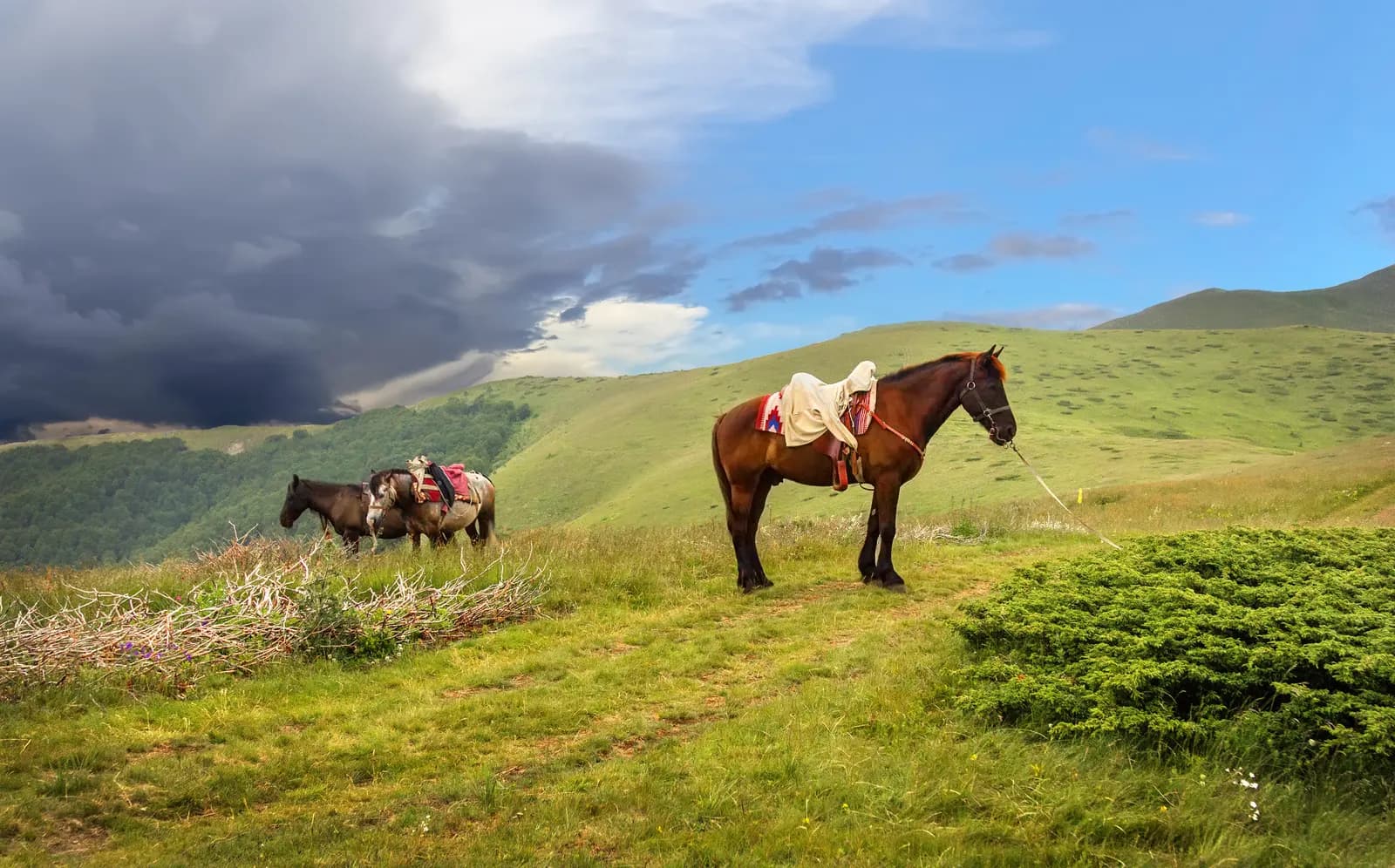
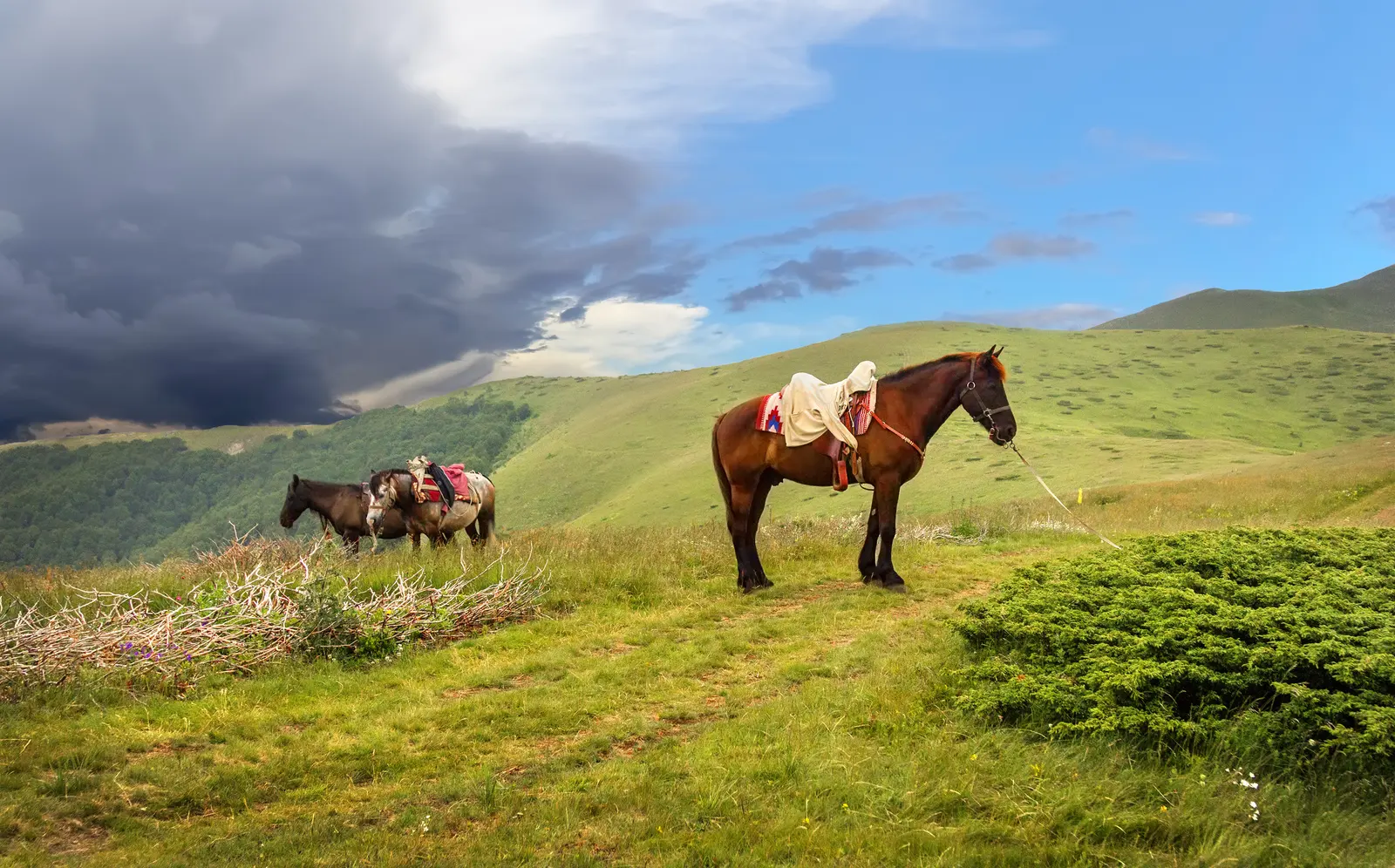
Horse riding in Montenegro can mean a quiet arena lesson, a guided highland circuit between summer pastures, or a longer expedition across exposed mountain country. Those are not interchangeable products. The right choice begins with a registered, insured provider; an honest assessment of every rider; a properly fitted helmet; and a route that suits the least experienced person in the group. This guide explains how to make those checks without treating destination marketing as a safety certificate.
| Setting | Areas | Ask about |
|---|---|---|
| North | Bjelasica · Durmitor; Sinjajevina · Piva | Exposure and gradients; weather escape points; remote-road access; horse fitness and water — route-specific check |
| Central / Lake | Podgorica surrounds; Komani · Skadar area | Road and village traffic; heat and shade; surface and footing; land access — route-specific check |
| Coast | Jaz / Mrčevo; Ulcinj / Ada Bojana | Beach permission; other beach users; tides, heat and footing; pace restrictions — route-specific check |
Source: montenegro.travel
Where riding is promoted—and what that does not prove
The Montenegro National Tourism Organisation presents Bjelasica, Durmitor, Sinjajevina and Piva as northern riding areas. It also describes possibilities around Podgorica and Komani, Skadar Lake, Jaz and Mrčevo near Budva, and the long sands around Ulcinj and Ada Bojana. That is useful destination orientation. It is not a current directory of licensed operators, proof that a named excursion runs in 2026, or permission to ride on every track and beach.
In the north, the attraction is scale: pasture ridges, katuns, forest edges and long views. Bjelasica gives access to the cultural landscape surrounding Biogradska Gora; Žabljak is the practical gateway for Durmitor, with accommodation choices explained in our Žabljak base guide. UNESCO describes Durmitor National Park as a landscape shaped by glaciers, rivers and underground streams. That protected status adds responsibility: it does not grant horses access to any particular path. Ask the operator which route is authorized and whether park or land-manager rules affect it.
Kolašin is a common planning base for Bjelasica, and our Kolašin neighbourhood guide helps separate town stays from mountain lodging. Sinjajevina and Piva can feel more remote, so transport, communications, water stops and turnaround points matter more than an advertised kilometre count. Experienced hikers will recognize the same exposure questions from our Montenegro hiking guide, but walking competence does not equal riding competence.
On the coast, open sand looks simple but adds other variables: pedestrians, dogs, vehicles, soft or wet footing, waves, heat and changing access rules. The NTO's promotional page mentions Ulcinj, but our Velika Plaža guide should be read as place context, not equestrian permission. Ask the operator who authorizes the exact section, at what time, at what pace, and how other users are separated. If those answers are vague, do not ride there.
| Setting | Why riders consider it | Verify before booking |
|---|---|---|
| Bjelasica / Kolašin | Pastures, katun landscape and forest-edge routes | Exact route, protected-area rules, exposure, horse water and vehicle access |
| Durmitor / Žabljak | Plateau scenery and a major mountain base | Trail permission, weather alternative, gradients, group ratio and emergency extraction |
| Sinjajevina / Piva | Open highland and remote pastoral country | Communications, support vehicle, overnight logistics, land access and turnaround plan |
| Podgorica / Komani / lake country | Lower-elevation routes and village landscapes | Heat plan, road crossings, shade, footing and current operating status |
| Budva or Ulcinj coast | Open views and beach setting | Written route permission, time restrictions, other users, pace, tide/footing and heat |
What Montenegro law requires from a provider
The government's English translation of the Law on Tourism and Hospitality expressly includes “riding” among tourism services involving sports, recreational and adventure activities. Articles 54 and 55 set the important structure: professionally trained people with an appropriate national or international licence or certificate; entry in the Central Tourist Register; accident-liability insurance documentation; visible written and verbal risk warnings; and parent or guardian consent for a person under 18.
The current Central Tourist Register search, checked on 30 August 2026, describes the register as a public electronic database. Ask the business for its registered legal name and decision or registration details, then search that name rather than only its social-media brand. If the interface is unavailable or returns no usable result, ask the Ministry to verify the record; do not interpret a broken or empty search as registration. Ask whose insurance covers the riding service and rider, the insurer, territorial scope, exclusions and claim contact. A verbal “yes, insured” is not the same as a policy that covers the advertised activity.
There is a timing caveat. The Official Gazette still marks the 2018 law as valid and links its amendment chain, while the Ministry's current regulation index lists amendments through 2020. On 18 June 2026, the government announced that it had adopted a proposal for a replacement tourism law. A government proposal is not automatically enacted law. This guide therefore explains the published framework but is not legal advice; check the Ministry, Official Gazette and provider for changes before relying on it.
| Step | What to obtain |
|---|---|
| 1 | Legal name + Central Tourist Register details |
| 2 | Instructor / guide qualification for the service |
| 3 | Accident-liability insurance details |
| 4 | Written + verbal risk information |
| 5 | Rider assessment + minor consent + route decision |
Source: gov.me, ctr.gov.me, sluzbenilist.me
What the 2019 regulation does—and does not—say
A separate 2019 government regulation sets minimum technical conditions for a named subset of activities: diving, parachuting or paragliding, cable-car riding, canyoning, kitesurfing, bungee jumping and zip-line riding. It does not establish equipment rules for horse riding. It would therefore be inaccurate to cite that regulation as the source of a Montenegrin riding-helmet mandate.
That gap does not make riding without a helmet sensible. The British Horse Society's guidance, reviewed in January 2026, says riding hats are designed to minimize potential head injury but cannot guarantee protection. It emphasizes correct fit and fastening, an accepted standard and quality-assurance mark, avoiding second-hand helmets with unknown impact history, and replacement after a fall. Apply that safety standard every time you ride while keeping its legal provenance honest.
Match the ride to the least experienced rider
“Beginner,” “intermediate” and “advanced” are too blunt on their own. Tell the operator when you last rode, whether you can mount independently, control speed and direction, post to the trot, canter in balance, ride outside an arena, and handle steep or uneven ground. For an injury, health condition or medication effect that could affect participation, obtain guidance from your own clinician before booking; a tourism operator is not the medical decision-maker. Then share the functional limits needed for a safe horse, tack and route assessment, plus fear and the rider's approximate height and weight when asked.
Do not ride during pregnancy. The American College of Obstetricians and Gynecologists lists horseback riding among activities to avoid during pregnancy because they may result in a fall. This is a medical safety exclusion, not something an operator should solve by assigning a quieter horse or easier route.
A first-time rider belongs in a controlled introduction with an instructor, a mounting block where appropriate, and a short low-complexity route only after basic controls are understood. An arena-confident rider may still be a novice on loose rock, narrow tracks, water crossings or open terrain. A multiday trip adds fatigue, saddle time, remoteness and repeated mounting; it should not be sold merely as several easy day rides placed together.
| Order | Stage |
|---|---|
| 1 | Disclose real experience + limits |
| 2 | Fitted helmet + closed footwear |
| 3 | Controlled skills assessment |
| 4 | Horse + tack matched by staff |
| 5 | Route, pace + group chosen |
Source: bhs.org.uk, gov.me
Equipment to settle before mounting
- Helmet: properly fitted, securely fastened and designed to an accepted riding standard. Bring your own known-history helmet if practical; otherwise ask the operator for the standard, sizes, condition and fitting process.
- Footwear: closed, secure shoes or boots appropriate to the stirrup and terrain; avoid sandals and loose footwear.
- Clothing: long trousers without flapping straps, layers for the forecast, and no loose bag or camera strap that can catch.
- Tack: staff should check the girth, stirrup length and fit before departure and again if needed. Tell them immediately about pinching, slipping or instability.
- Phone and essentials: do not assume mobile coverage. The guide should hold the route and emergency plan; a rider can carry a securely stowed phone, prescribed medication and water as agreed.
Read horse welfare before you ride
Tourism quality includes the horse. World Horse Welfare's responsible-tourism guidance tells travellers not to use a horse that is obviously lame, in poor body condition or not up to the job, and not to bargain for two people to ride one animal. Those are screening principles, not a substitute for professional care.
Visitors cannot diagnose a horse from a few minutes in a yard, and one still photograph cannot establish welfare. They can ask useful questions and decline obvious concerns. Look for alert horses without untreated wounds, severe lameness or tack rubbing; clean, serviceable tack; calm handling; access to water and planned breaks; and workloads adjusted for heat, gradients and the animal. Ask whether the horse has already worked that day and how the operator responds if it becomes sore, distressed or unwilling.
| Check | Question |
|---|---|
| Fitness | Fit for this route? |
| Health | Sound + healthy? |
| Tack | Tack clean, fitted, sound? |
| Water + rest | Water + rest planned? |
| Workload | Workload + heat adapted? |
| Handling | Calm, humane handling? |
| Outcome | Unresolved concern → do not mount |
Source: int.worldhorsewelfare.org
Weather, route permissions and emergencies
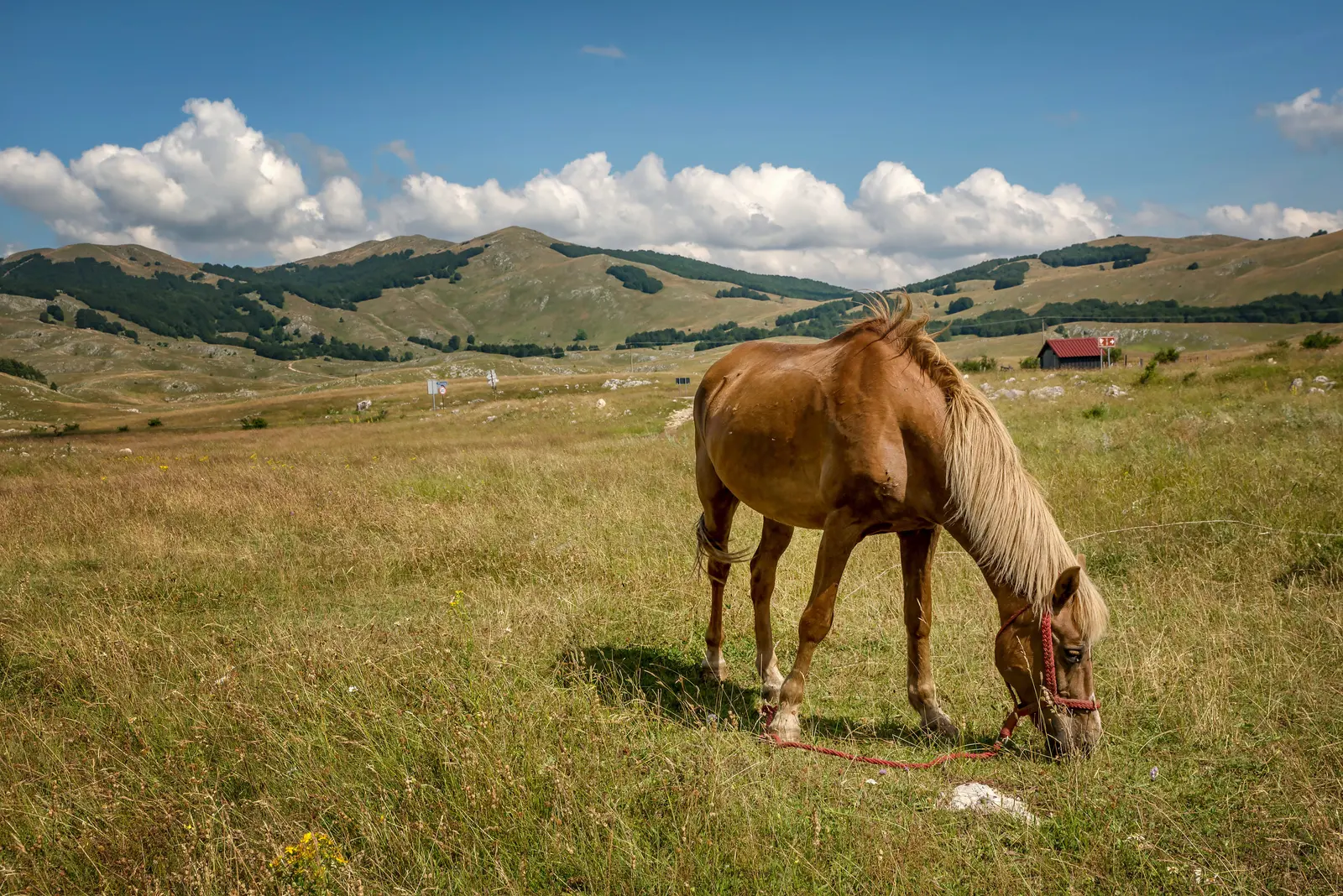
Montenegro's national tourism page broadly positions riding in spring, summer and autumn, but a season label cannot open a high route or make a hot beach safe. Elevation, snow cover, heat, wind, thunderstorms, visibility, wildfire restrictions and recent rain can all change the decision. Obtain a route-specific forecast close to departure and ask for the operator's weather threshold, alternative route and cancellation or refund policy.
Agree what ends the ride: lightning risk, deteriorating visibility, an unwell horse, a loose shoe, a rider losing confidence, unsafe footing or a route conflict. A reputable guide should be able to shorten or stop without pressuring the group to “get the full experience.” For spring transition conditions around Durmitor, our Durmitor thaw guide explains why the calendar alone is misleading.
Share the operator, start point, route, group and expected return with somebody not on the ride. Ask whether the guide carries first-aid and communications equipment, where vehicle access is possible, and how an injured rider or horse would be evacuated. Montenegro's Ministry of Interior says 112 is the single emergency-call point used to coordinate services for citizens and tourists. Save 112, but understand that remote terrain can delay help and that coverage is not guaranteed.
Children and family rides
Do not assume “family friendly” means suitable for every age, size or temperament. Montenegro's law text prohibits participation by a person under 18 in adventure activities without parent or guardian consent, but consent alone does not establish suitability. Ask for the operator's minimum age, height or weight rules; instructor-to-child ratio; whether the child rides independently, on a lead rein or in a controlled arena; and who may stop the session.
The British Horse Society's helmet guidance applies its fitted-and-fastened recommendation whenever a person rides, while its footwear guidance explains why purpose-designed boots and compatible stirrups reduce entrapment risk. The child should receive a simple briefing on approaching, mounting and following instructions. An adult's desire for a trail photograph is never a reason to put two riders on a one-person saddle, remove a helmet, use open footwear or continue when a child is frightened.
| Item | Requirement |
|---|---|
| Consent | Parent / guardian consent |
| Operator rules | Age, size and participation rules met |
| Equipment | Fitted helmet + secure closed footwear |
| Introduction | Controlled introduction + child comfortable |
| Supervision | Supervision and route appropriate |
| All yes | Ride may proceed |
| Any unresolved item | No ride |
Source: gov.me, bhs.org.uk
Recreational riding is not hippotherapy
The inherited version of this article described horse riding or “hippotherapy” as one recognized treatment and promoted a local ranch. That collapses a clinical service into a tourism activity. The American Hippotherapy Association defines hippotherapy as the purposeful use of equine movement within occupational therapy, physical therapy or speech-language pathology, delivered by licensed professionals using clinical reasoning.
A pleasant guided ride may have personal, social or recreational benefits, but it is not medical treatment merely because a horse is involved. Anyone seeking therapy should work through a qualified healthcare professional and verify the therapist's licence, clinical assessment, treatment plan, trained equine team and emergency procedures. We found no current authoritative Montenegro healthcare record sufficient to recommend a specific hippotherapy provider, so this guide does not repeat the old ranch claim.
Practical booking questions before paying
| Ask | A useful answer contains | Warning sign |
|---|---|---|
| Who legally provides the ride? | Registered name and Central Tourist Register details | Only a social handle or cash contact |
| Who leads it? | Name, role and relevant licence/certificate | “Very experienced” with no specifics |
| What insurance applies? | Insurer, activity, rider coverage, exclusions and claim process | Assurance without policy detail |
| How are riders assessed? | Experience questions and controlled pre-ride check | Horse assigned from age or photo alone |
| What helmet is supplied? | Riding standard, sizes, fit check and known condition | No helmet, bicycle helmet or optional child helmet |
| What exactly is the route? | Terrain, duration in saddle, pace, gradients, permission and exit points | Only scenic language |
| What is the group ratio? | Maximum riders and qualified staff for that route | No cap or one guide for mixed unknown ability |
| What cancels or changes it? | Weather/footing thresholds, alternative and refund terms | “We always go” |
| How are horses managed? | Workload, water, rest, tack checks and response to lameness | Pressure to mount despite concern |
| What is the emergency plan? | First aid, communications, location sharing and evacuation access | Reliance on a rider's phone alone |
Keep the answers and payment terms in writing. Confirm what “two hours” means—total experience or time in the saddle—and whether transfer, equipment, food or park fees are included. Do not publish your passport or medical details in a public message; use the provider's appropriate private channel. Travel insurance should expressly cover recreational horse riding at the planned level and location. For wider logistics, border, driving and connectivity preparation, use our first-time Montenegro guide.
FAQ
Do I need riding experience?
Not necessarily for a controlled introduction, but “no experience required” must not be confused with “no assessment required.” A first-time rider should learn basic controls in a contained setting before any simple route, and the operator should decide from observed ability.
Is a helmet legally required in Montenegro?
The tourism-law and 2019-regulation materials reviewed do not establish a horse-riding helmet rule. The 2019 regulation covers other named adventure activities. Regardless, current British Horse Society guidance supports a properly fitted, fastened riding helmet every time. Ask the provider to supply an appropriate riding helmet; decline if it will not.
Can children ride?
Montenegro's published law text requires parent or guardian consent for under-18 participation in adventure activities. The operator must also apply its age, size and ability rules, supply suitable equipment and supervision, and assess the child. Consent does not make an unsuitable ride suitable.
Can I ride on Velika Plaža or Ada Bojana?
National destination marketing mentions Ulcinj-area beach riding, but it does not prove present-day permission for a particular beach section, hour, speed or operator. Obtain route-specific confirmation from the provider and relevant land or beach manager.
What is the best month?
There is no single answer across coast, lowlands and high mountains. Choose the region, then evaluate current route conditions, heat, snow, storms, footing, horse workload and the operator's seasonal availability. A broad spring–autumn label is not a go decision.
Is a mountain horse automatically safe for beginners?
No. Size, breed or local reputation cannot guarantee temperament, training, soundness or rider fit. Qualified staff must match the individual horse and tack to the individual rider and route.
Is horse riding the same as hippotherapy?
No. Hippotherapy is a clinical treatment strategy used by licensed occupational, physical or speech-language therapy professionals. A tourist trail ride is recreational unless it is part of a properly assessed and delivered clinical service.
Methodology and source limits
This guide uses Montenegro's government-hosted tourism law, Official Gazette status page, current Ministry regulation index and the live public-register interface for the regulatory framework. It uses the National Tourism Organisation only to identify promoted riding regions—not to certify live operators, permissions, prices or safety. The British Horse Society and World Horse Welfare provide clearly labelled safety and welfare guidance. The American Hippotherapy Association controls the clinical distinction, while ACOG controls the pregnancy warning.
We rejected unsupported claims that a local horse type is inherently forgiving, that numerous schools are currently operating, that a specific therapy ranch welcomes visitors daily, or that beach access and galloping are generally permitted. We also rejected two available images that showed riders without visible protective equipment. Before combining a ride with a broader trip, the seven-day itinerary can help with geography—but leave enough flexibility to cancel when the horse, rider, route or weather says no.