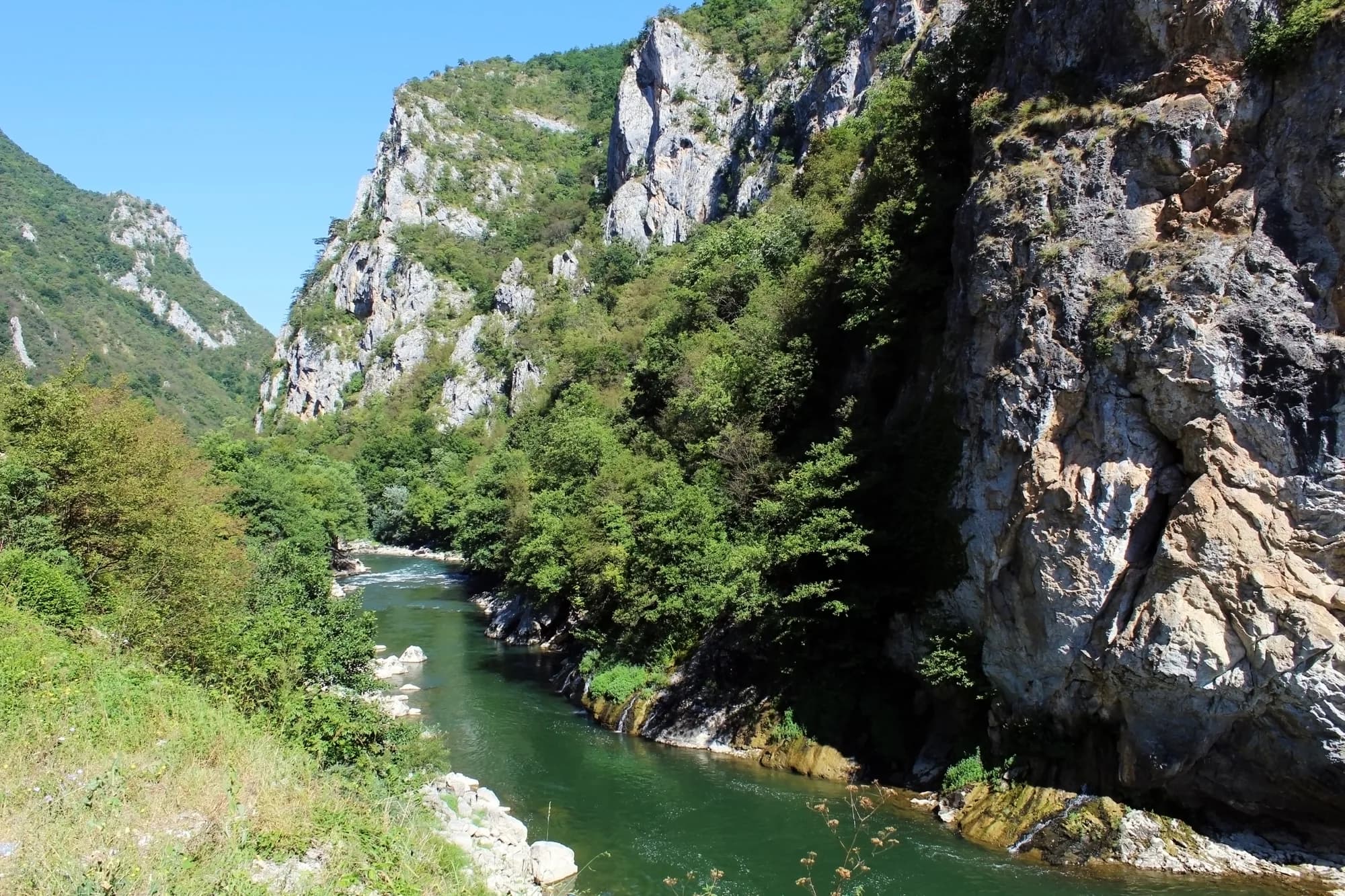
Thirty-four people in the Bistrica valley east of Bijelo Polje, at the road-head for the longest cave in Montenegro and a gorge the state has spent more than a decade trying to open.
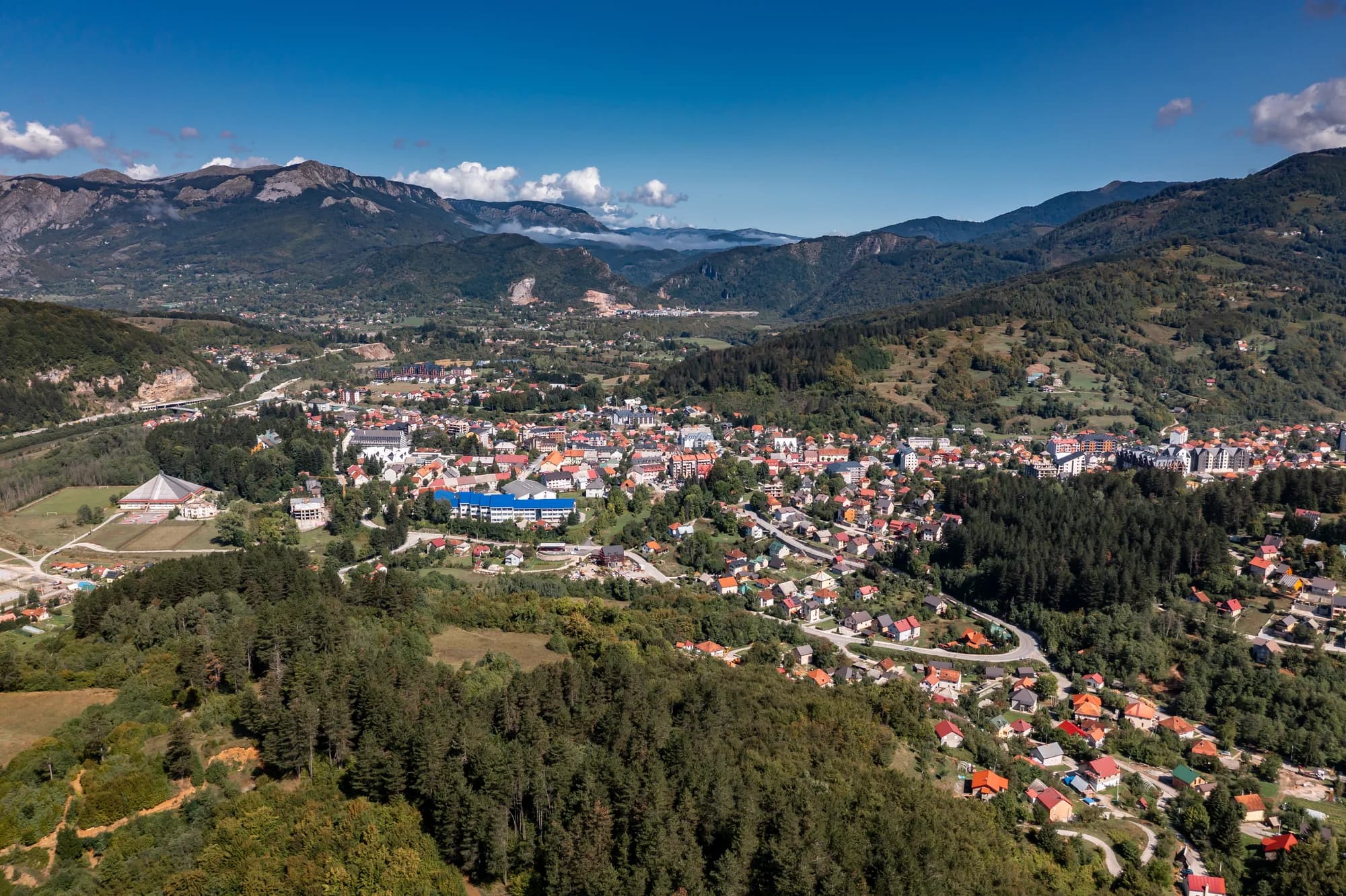
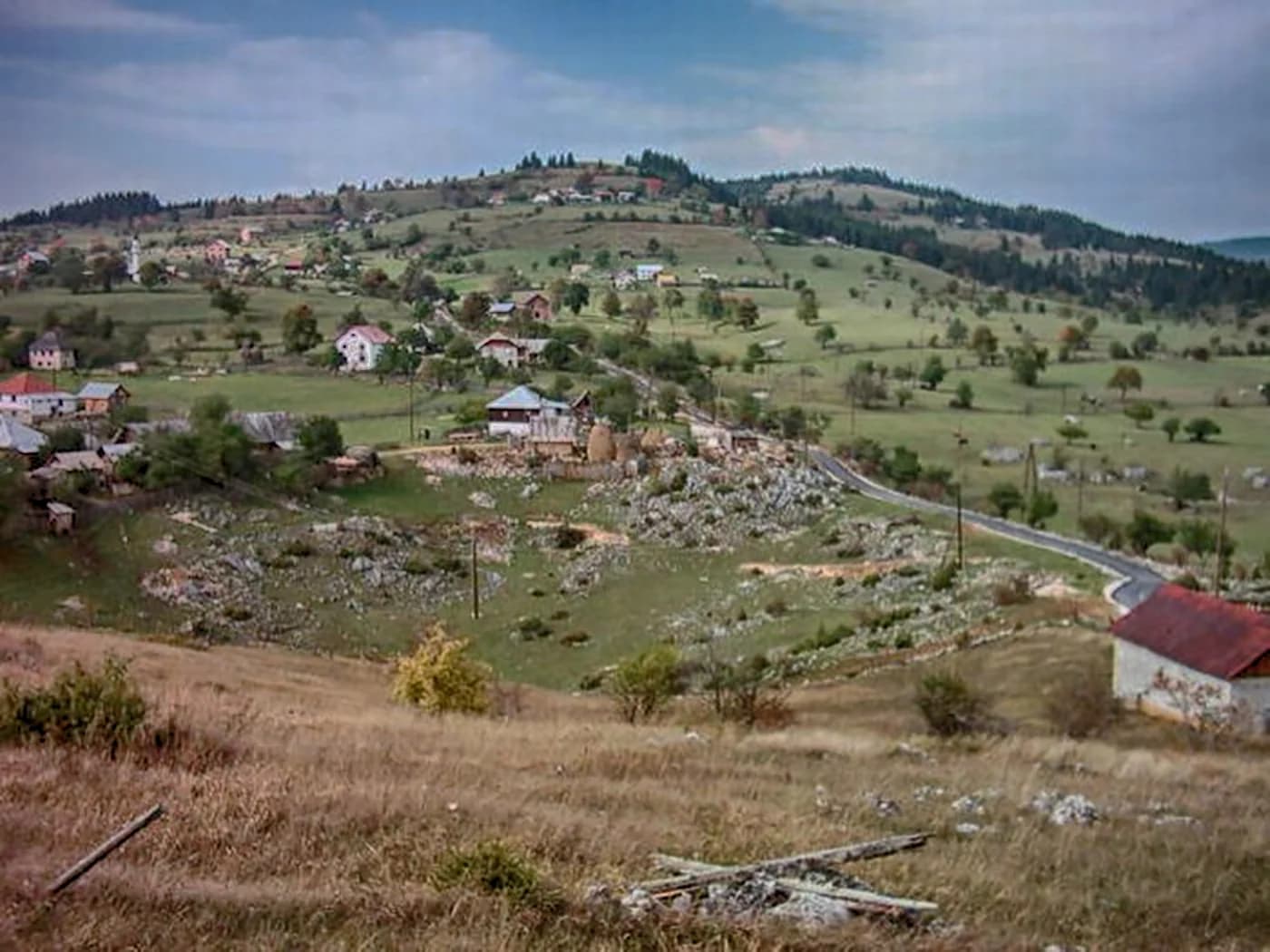
Bistrica is a village in northern Montenegro, in the Bijelo Polje municipality, set where the Bistrica river comes down out of the hills to join the Lim. It is a farming settlement of scattered houses, hayfields and mixed forest, spread over rolling ground rather than clustered around a centre, and it looks and works much as the villages of the Lim valley have for generations. Meadows are still cut for hay in high summer, smallholdings keep a few cows and sheep, and plum and apple orchards line the slopes above the river. The village lies on the main corridor between Bijelo Polje and the Serbian border, and the Belgrade–Bar railway runs through the valley here, so it is easier to reach than its size suggests. That said, nothing about Bistrica is organised around visitors. There are no sights in the conventional sense — the appeal is the landscape and the pace: unhurried, agricultural, and generous in the way northern Montenegrin villages tend to be with anyone who stops. What the surroundings offer is space. The river holds trout, forest tracks climb into the hills on both sides of the valley, and the wider region opens onto some of the best country in the north. Bjelasica and Biogradska Gora National Park lie to the southwest, the Đalovića gorge and its cave system to the south, and the Tara canyon and the rafting stretches beyond that. Bijelo Polje itself, with shops, the railway station and the 12th-century church of Saints Peter and Paul, is a short drive away. Bistrica suits travellers with a car who are working their way through the north, people looking for village accommodation and home cooking rather than hotels, and anyone crossing between Montenegro and Serbia who would rather break the journey somewhere quiet. Late spring through autumn is the season; winters here are cold, snowy and genuinely rural.
The longest caves in Montenegro
Surveyed length in metres
Four of the five caves behind it are on Lovćen or around Cetinje. The one at the top is in the north, and it is nearly twice the length of the runner-up.
The villages of the gorge
Residents by settlement, 2023 census
The five settlements the management plan names as the gorge’s neighbours hold 155 people between them. Mokri Lug, which has the monastery, has eighteen.
Who visits Montenegro
Share of foreign overnight stays, 2025
MONSTAT · 2025
Bistrica has no dated founding. What is dated here is the church up the road, the Ottoman sanjak the village sat in until 1912, and the cave. Widths are to scale.
Bihor 1455 and the First Balkan War (Wikipedia); the sanjaks of Novi Pazar and Sjenica to 1912; Manastir Podvrh; Vijesti on the municipal natural-assets Agency.
A decade of state announcements about one cave, and what came of each.
Vijesti Five million euros for the reconstruction of the Gubavač–Bistrica road and a new bridge over the Bistrica.
Vijesti The Secretariat for Investments says the visitor centre is finished and the water main is going in; cable-car works will resume in April and the first riders could go up by the end of August.
Radio Free Europe About €19 million of a planned €25 million is already spent. The works stopped in 2021, after an entrance was cut into the cave without permission and large numbers of bats died; nobody has been identified as responsible.
Vijesti The first layer of asphalt goes down on the Gubavač–Bistrica road after months of campaigning by a local party, whose chairman calls it asphalt for first aid rather than a finished road.
Vijesti At the hearing on the 2026–2030 management plan it is spelled out that the cave lies outside the Natural Monument it is always named with, and that the protected stretch of the Bistrica runs about three kilometres.
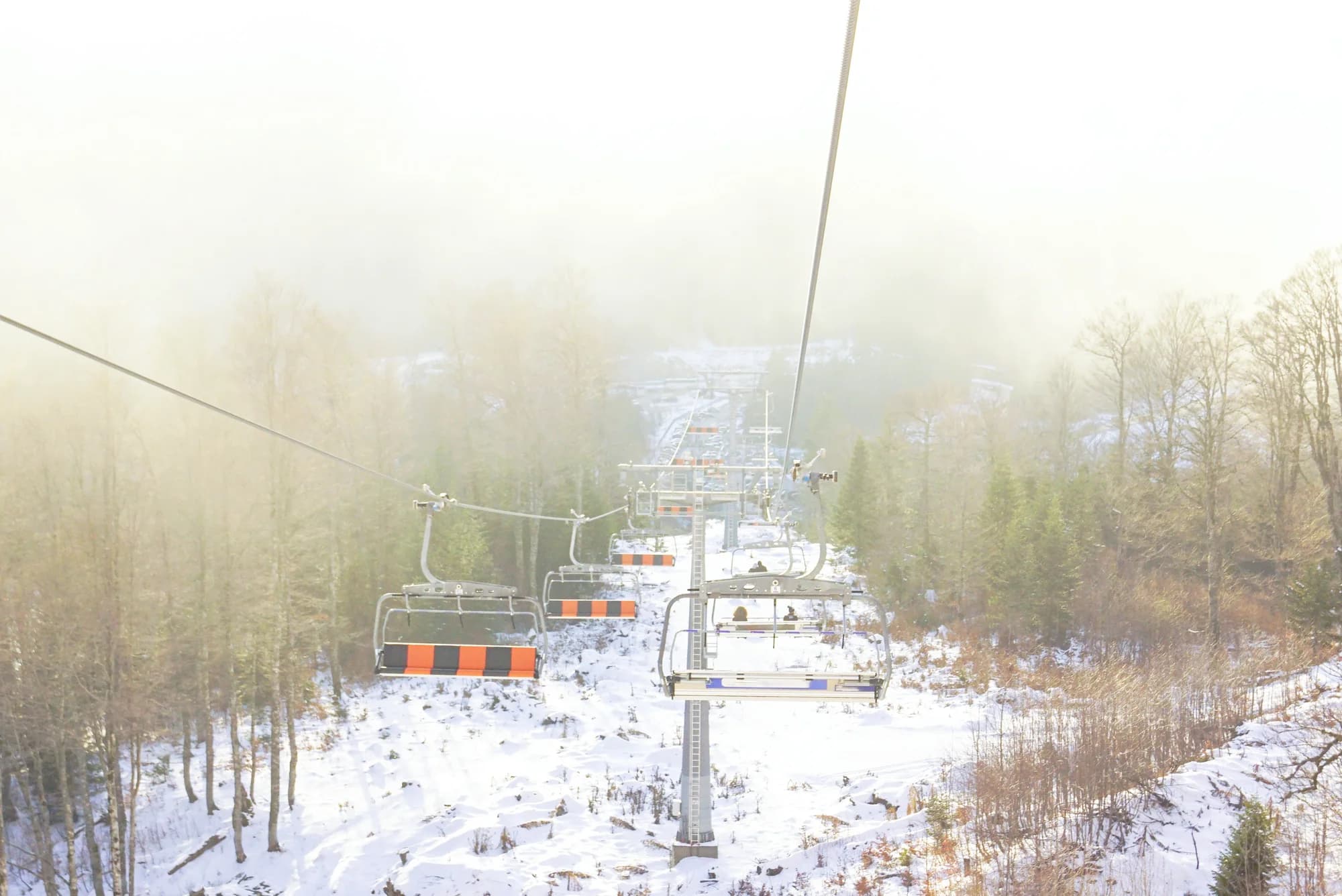
Radio televizija Nikšić Work resumes on the 1.7-kilometre cable car from Podvrh monastery to the cave mouth — two eight-seat gondolas, a six-minute ride — promised in service by the end of summer.
Meanwhile, in 1987
Đalovića klisura, 1987: the speleological section of the Belgrade mountaineering association, at work in the area since 1979, first explores the Cave above the Devil’s Whirlpools.
The register — 10,550 metres of surveyed passage and 120 metres of vertical range. The next longest cave in the country, Njegoš pećina on Lovćen, is 5,300 metres; nothing else in Montenegro is close.
Czech cavers — between 2006 and 2009 they worked the system again, including a dive through a sump 80 metres long and 20 metres deep. Published lengths have run from 11 to 17.5 kilometres ever since; the surveyed figure has not moved.
Bistrica, still — the visitor centre is built and the road up to Podvrh is good. In August 2026 the minister of public works said the cable car was held up by three walnut trees.
“The gorge is cut into the limestone massif and reaches a depth of 627 metres, which makes it one of the most dramatic landscapes in the region. … Glava Bistrice and the Juriška springs stand out in particular, as does the permanent flow of the Bistrica, which joins the Lim downstream.”
Željko Madžgalj, director of the Agency for the Protection of Natural Assets
At the public hearing on the 2026–2030 management plan for the Đalovića klisura Natural Monument, reported by Vijesti on 26 May 2026.
“Journalists tend to write spectacular estimates instead of dull surveyed length, so numbers include 11 to 17 km of length, while the surveyed length is actually 10,550 m.”
showcaves.com, on Đalovića pećina
The ASAK register agrees on the survey: 10,550 metres of passage and 120 metres of vertical range, mapped by Belgrade speleologists from 1987. Radio Free Europe still called the cave “a little over 17 and a half kilometres” in January 2025.
Search thousands of hotels and apartments with live prices.
We may earn a commission from partner links. This helps us keep Montenegro.com free for travelers.
Search hotels, apartments and guest houses with live availability.
We may earn a commission from partner links. This helps us keep Montenegro.com free for travelers.
Bistrica is a village in northern Montenegro, in the Bijelo Polje municipality, set where the Bistrica river comes down out of the hills to join the Lim. Bijelo Polje itself is a short drive away.
Easier than its size suggests. The village lies on the main corridor between Bijelo Polje and the Serbian border, and the Belgrade–Bar railway runs through the valley here, so it can be reached without a car.
A farming settlement of scattered houses, hayfields and mixed forest spread over rolling ground rather than clustered around a centre. Meadows are still cut for hay in high summer, smallholdings keep a few cows and sheep, and plum and apple orchards line the slopes above the river.
None in the conventional sense, and nothing here is organised around visitors. The appeal is the landscape and the pace: unhurried, agricultural, and generous in the way northern Montenegrin villages tend to be with anyone who stops.
The river holds trout and forest tracks climb into the hills on both sides of the valley. Bjelasica and Biogradska Gora national park lie to the south-west, the Djalovica gorge and its cave system to the south, and the Tara canyon and its rafting stretches beyond.
Travellers with a car working their way through the north, people looking for village accommodation and home cooking rather than hotels, and anyone crossing between Montenegro and Serbia who would rather break the journey somewhere quiet. Late spring through autumn is the season.
No — the nearest is Podgorica Airport (TGD), 128 km away by road.
11.9 km by road, about 26 min by car.
The UK Foreign, Commonwealth & Development Office (FCDO) has no advisory against travel to Montenegro; it last reviewed its guidance on 13 August 2026. That is their assessment of the country as a whole, not ours and not a judgement about Bistrica, so read it yourself before you travel. The emergency number in Montenegro is 112.
The nearest places to Bistrica, at their true positions — Biogradsko Jezero is about 28 km away in a straight line.
Schematic. Positions and straight-line distances from the coordinates we hold for each place; mountain roads make the drive longer. Coastline and Lake Skadar © OpenStreetMap contributors.
Bistrica in numbers
the surveyed length of Đalovića pećina — the longest cave in Montenegro, and nearly twice the second
the depth the Đalovića gorge reaches where the Bistrica cuts the limestone
the altitude at which the Goševska and Grebska rivers meet and become the Bistrica
the date on the stone plaque at Podvrh, six kilometres up the new road
the Đalovića klisura Natural Monument — the cave itself falls outside it
2023 census, Bistrica settlement; 38,662 in the municipality
MONSTAT, Popis 2023, settlement table · ASAK cave register · Agency for the Protection of Natural Assets, via Vijesti (2026) · Manastir Podvrh, Eparchy of Budimlja–Nikšić
A few hours
Bistrica is a road-head rather than a village to walk around. The reason to come is what the road reaches.
One full day
The Agency ran its first promotional tour as Podvrh – gorge – Bistrica, downhill all the way. Walk it the other way and it is a climb.
Bijelo Polje
Best for the only real supply of rooms within reach, and the station on the Belgrade–Bar line — twelve kilometres west by road
Bistrica and Mojstir
Best for the road-head hamlets: 34 and 41 people at the 2023 census, so ask locally rather than expect to book
Đalovići
Best for the other way in — the road ends at the village, and Akovo’s cave-trekking parties walk an hour up the riverbed to the cave mouth, summer and autumn only
Best time: June · July · September
| Place | By road | Driving |
|---|---|---|
| Bijelo Polje | 11.9 km | about 26 min |
| Berane | 32.6 km | about 1 h 1 min |
| Mojkovac | 34.7 km | about 1 h 5 min |
| Murino | 37.6 km | about 1 h 11 min |
| Podgorica | 118.6 km | about 2 h 31 min |
| Budva | 177.5 km | about 3 h 47 min |
| Kotor | 189.4 km | about 3 h 58 min |
Road distances routed over OpenStreetMap data, © OpenStreetMap contributors. Driving times are free-flow and take no account of summer traffic or a queue at the ferry ramp.
Vijesti A party of Bijelo Polje journalists becomes the first to walk the Agency’s new trail: Podvrh monastery, the gorge, Bistrica.
Vijesti The minister of public works says the whole project is blocked because the owners of three walnut trees will not let the power line cross their land.
The cable car was not carrying passengers when this page was written.