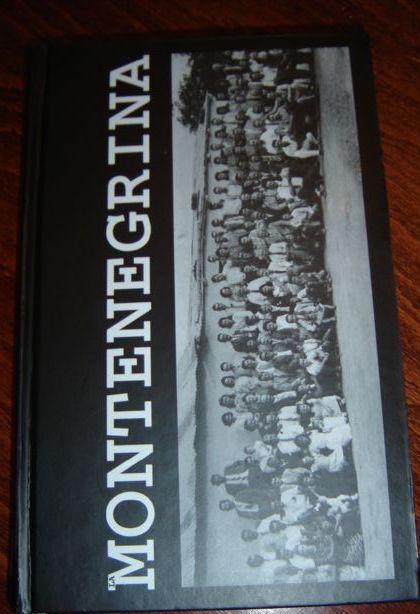
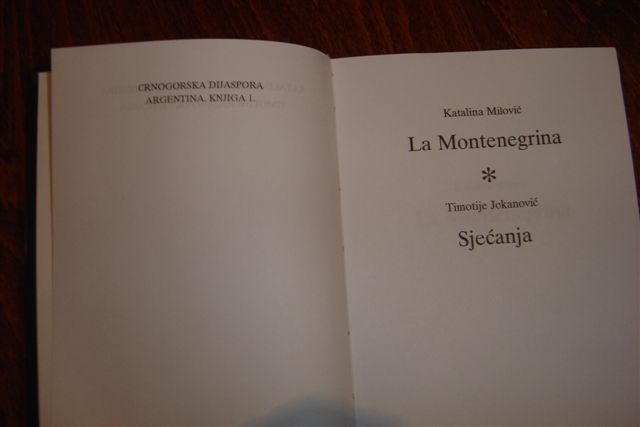
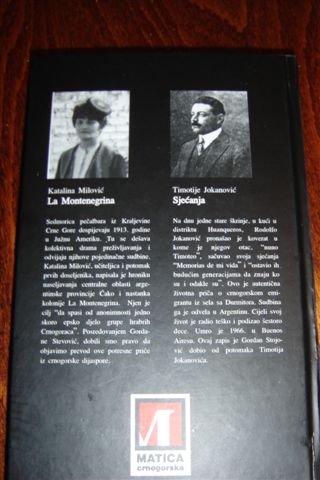
La Montenegrina – Sjećanja is not simply a notice for two old books. It is a 234-page Matica crnogorska volume that puts two kinds of diaspora evidence beside each other: Katalina Milović’s community chronicle of a Montenegrin settlement in Argentina’s Chaco province, and Timotije Jokanović’s first-person account of leaving Trsa and making a life in Argentina.
The pairing matters. One text remembers a colony; the other remembers a person. Read together, they show how migration changes names, languages, work and family memory. They also require care: a memoir is testimony, not a passenger manifest, and a commemorative history is not automatically the final word on every date.
The edition at a glance
| Field | Catalog information | Why it matters |
|---|---|---|
| Authors | Katalina Milović; Timotije Jokanović | Two works share one physical volume |
| Titles | La Montenegrina; Sjećanja | Search both author-title combinations |
| Publisher and year | Matica crnogorska, 2004 | Separates this edition from the earlier Spanish presentation |
| Place | Cetinje/Podgorica | Catalogs render the place statement differently |
| Extent | 234 pages, illustrated, 20 cm | Useful for identifying a complete copy |
| Series | Crnogorska dijaspora: Argentina, book 1 | Places the volume in a wider diaspora publishing project |
| Print run | 500 | Explains why ordinary retail availability may be limited |
| Catalog identifier | COBISS.CG-ID 8115984 | The safest exact search key |
These details come from the National Library of Montenegro’s 2004 bibliography. Matica crnogorska’s current publishing index still lists “Katalina Milović: La Montenegrina; Timotije Jokanović: Sjećanja mog života,” confirming that the publisher treats the texts as a paired edition. An earlier form of Jokanović’s memoir also appeared in Matica’s journal in 2001, where the bibliography says the autobiographical story was completed by his son and accompanied by editorial notes from Gordan Stojović.
That record corrects two easy mistakes. The English archive heading “Books” can imply two separately issued volumes, while the 1997 date attached to La Montenegrina refers to Milović’s Spanish-language presentation in Argentina, not the verified Montenegrin edition.
Two voices, one migration history
Katalina Milović was a teacher and a descendant of early settlers. Her chronicle follows the formation and social life of La Montenegrina, a rural colony southwest of Presidencia Roque Sáenz Peña. A preserved publisher text says her aim was to rescue the founders’ achievement from anonymity. The work is valuable precisely because it records family names, community practices, schooling and remembered speech that broad immigration statistics tend to flatten.
Timotije Jokanović writes from the opposite scale. In the archived full text of the memoir, he dates his act of remembering to 5 February 1949, at Monte Aguará in the Huanqueros district, with his wife Ana Buratović and their six sons. A long-delayed letter from his brother turns his attention back to Trsa, his parents and the departure that separated them. The narrative then follows travel, work, vulnerability and adaptation rather than presenting migration as a clean success story.
The companion Montenegrin Emigration to Argentina book archive places Jokanović’s testimony inside a wider documentary project. The Montenegro.com and Vijesti diaspora archive explains how web publishing, newspapers and family networks helped material travel back to Montenegro. Neither replaces the book; both show the chain through which private memory became public history.
What can be verified about La Montenegrina
The explanatory memorandum to Senator Jorge Capitanich’s proposed 2004 bill 0467-S-04 gives the most precise foundation account located. It says seven immigrants of Montenegrin origin arrived on 27 March 1917: Marcos Capitanich, Pedro Capitanich, Lázaro Cosanovich, Mitar Michunovich, Pedro Milovich, Mitar Milovich and Daniel Svorcan. The place became known as La Montenegrina because of their origin. The memorandum supports the historical claim but is not an adopted congressional declaration. Spellings differ from Montenegrin forms such as Kapitanić, Kosanović, Mićunović and Švorcan; that is normal evidence of names crossing alphabets and administrative systems, not proof of different people.
A 1975 historical account held by the Municipality of Sáenz Peña supplies a second layer. It identifies the official colony as José Mármol, describes “La Montenegrina” as the name in use, and records Club Durmitor’s construction in 1928. The club included meeting and recreation space and housed a school from 1930 until a new Argentine government building opened in 1950. The account identifies it as School No. 180, “Colono Montenegrino,” 45 kilometres from Sáenz Peña.
The municipality’s historical archive also records theatrical performances at Durmitor. Milović’s recollections describe gatherings, songs, gusle, weddings, baptism and language transmission. Institutional evidence therefore supports the broad picture of the club and school as social infrastructure, while her text supplies the experience inside it.
| Year | Milestone |
|---|---|
| 1917 | seven founders |
| 1928 | Club Durmitor |
| 1930–1950 | school at club |
| 1997 | Spanish presentation |
| 2004 | paired edition |
Source: hcdn.gob.ar, saenzpena.gob.ar, digitalnabibliografija.nb-cg.me
Why some dates do not match
Good diaspora history preserves conflicts instead of forcing a neat chronology. The explanatory memorandum for proposed Senate bill 0467-S-04 says 27 March 1917. A Montenegro government report from the 2018 centenary describes Danilo Švorcan and six others as founding the colony in 1918. The difference may reflect arrival, settlement, naming or a commemorative convention, but the sources inspected here do not resolve it. The precise 1917 claim is therefore attributed to the bill memorandum, while 1918 remains an official commemorative tradition.
Jokanović’s departure has a similar conflict. The memoir’s own opening looks back to leaving Trsa in 1907. A later Montenegro.com book notice summarizes his journey as beginning in 1904. The first-person dated text is the stronger evidence for his recollection, but even it should be checked against passenger records before becoming a genealogical fact. Ages, calendar memory, transcription and translation can all introduce error.
This caution is not a criticism of Milović or Jokanović. It is how memoir becomes research: testimony tells investigators where to look, while independent records test dates, ships, occupations and relationships.
How to read names across two continents
Search variants are essential. Argentine sources may render Kapitanić as Capitanich, Kosanović as Cosanovich, Milović as Milovich and Jokanović as Jokanovich. A person may also appear under a Spanish given name—Timoteo rather than Timotije—or a political nationality used by the state that issued or recorded a document. “Montenegrin,” “Yugoslav,” and broader regional labels can all appear in records from different periods.
Language shift is part of the evidence. Milović describes a generation taught the parents’ language, songs and customs, followed by descendants living and working in Argentine cities. The practical Montenegro language guide explains today’s related language names, but it should not be projected backward as though every family used modern official terminology.
Keep a variant table for each person: original spelling, Spanish spelling, nickname, estimated birth year, spouse, settlement and source. Never merge two records on surname alone. Capitanich or Milovich may identify an extended family, not a single individual.
Practical research route
- Identify the edition. Search COBISS.CG-ID 8115984, both authors and the 234-page extent. Matica’s publishing page confirms the title but does not promise stock, a price or a digital download.
- Read the testimony before extracting facts. Record exactly what the narrator claims, the date of writing, and whether an editor, translator or descendant completed the text.
- Search Argentina’s official passenger index. The Archivo General de la Nación passenger search covers maritime arrivals at Buenos Aires from 1882 to 1937 and allows searches by name, surname, ship and date range. Try every spelling variant.
- Request deeper records when needed. Argentina’s Maritime Inspection Acts cover ship documentation from 1901 to 1954. The archive warns that digitization requests can take up to 60 days; that is a service estimate, not a guaranteed turnaround.
- Cross-check locally. Civil registers, cemetery inscriptions, school records, association minutes and land files can distinguish people with similar names. Family photographs need names, dates and provenance written down now.
- Preserve uncertainty. Label an unverified family statement as oral history. Do not rewrite it as an archival conclusion.
The method resembles the careful attribution used in the Kuči photo archive: images and testimony remain valuable even when every face or date cannot be recovered. For the landscape left behind, the Lovćen cultural guide explains why a mountain could function as a powerful homeland symbol, while Jokanović’s actual point of origin was Trsa near Durmitor.
What survives beyond the pages
The community described by Milović is not only historical. In 2018 Montenegro’s government opened a Montenegrin House in Sáenz Peña during centenary commemorations. A 2020 diaspora delegation visited La Montenegrina, the Durmitor club and community organisations. In December 2025, the municipality reported inaugurating a stone gumno—a circular gathering space—supported by local Montenegrin families and organisations.
Continuity should not be confused with stasis. A community can preserve names and symbols while speaking different languages, marrying beyond the founding group and forming new institutions. The General Madariaga diaspora report shows another Argentine setting with its own history; it should not be folded into the Chaco colony as though all Montenegrin-Argentine experiences were identical.
FAQ
Are La Montenegrina and Sjećanja separate books?
The verified 2004 Matica crnogorska catalog record places both works in one 234-page volume. Jokanović’s memoir also had an earlier journal appearance, and Milović presented her Spanish work in Argentina in 1997, which can make searches look like multiple editions.
Is the book available to buy now?
No current seller, price or stock status was verified. Search the publisher and national-library catalog by identifier, then contact libraries or antiquarian booksellers directly. Do not send money to the obsolete email field in the archived notice.
Did La Montenegrina begin in 1917 or 1918?
The explanatory memorandum for proposed Senate bill 0467-S-04 specifies 27 March 1917; a Montenegro government centenary account uses 1918. The inspected sources do not explain the difference, so both traditions are recorded with attribution.
Can the memoir prove an ancestor’s arrival?
It can provide names, approximate dates and narrative context. Use Argentina’s official passenger and ship-document archives to test an arrival claim, and keep spelling variants in every search.
Why preserve a source with inconsistencies?
Because memory records emotions, motives, kinship and daily life that administrative forms omit. Its best use is alongside—not instead of—catalogs, registers, association records and family documents.