Three trunk roads and two border crossings meet at a village of 132 people — and it wrote and directed the most expensive film Yugoslavia ever made.
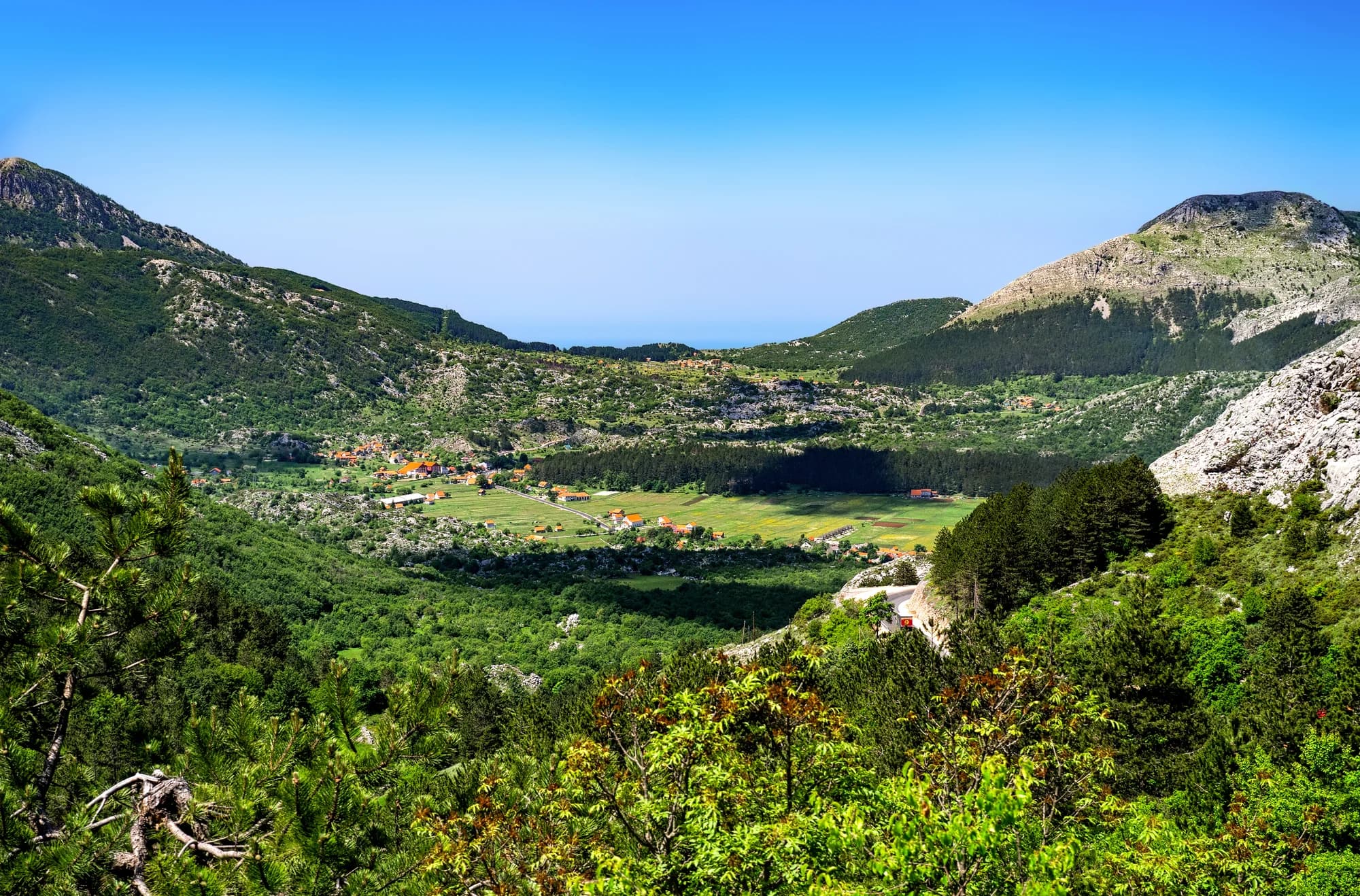
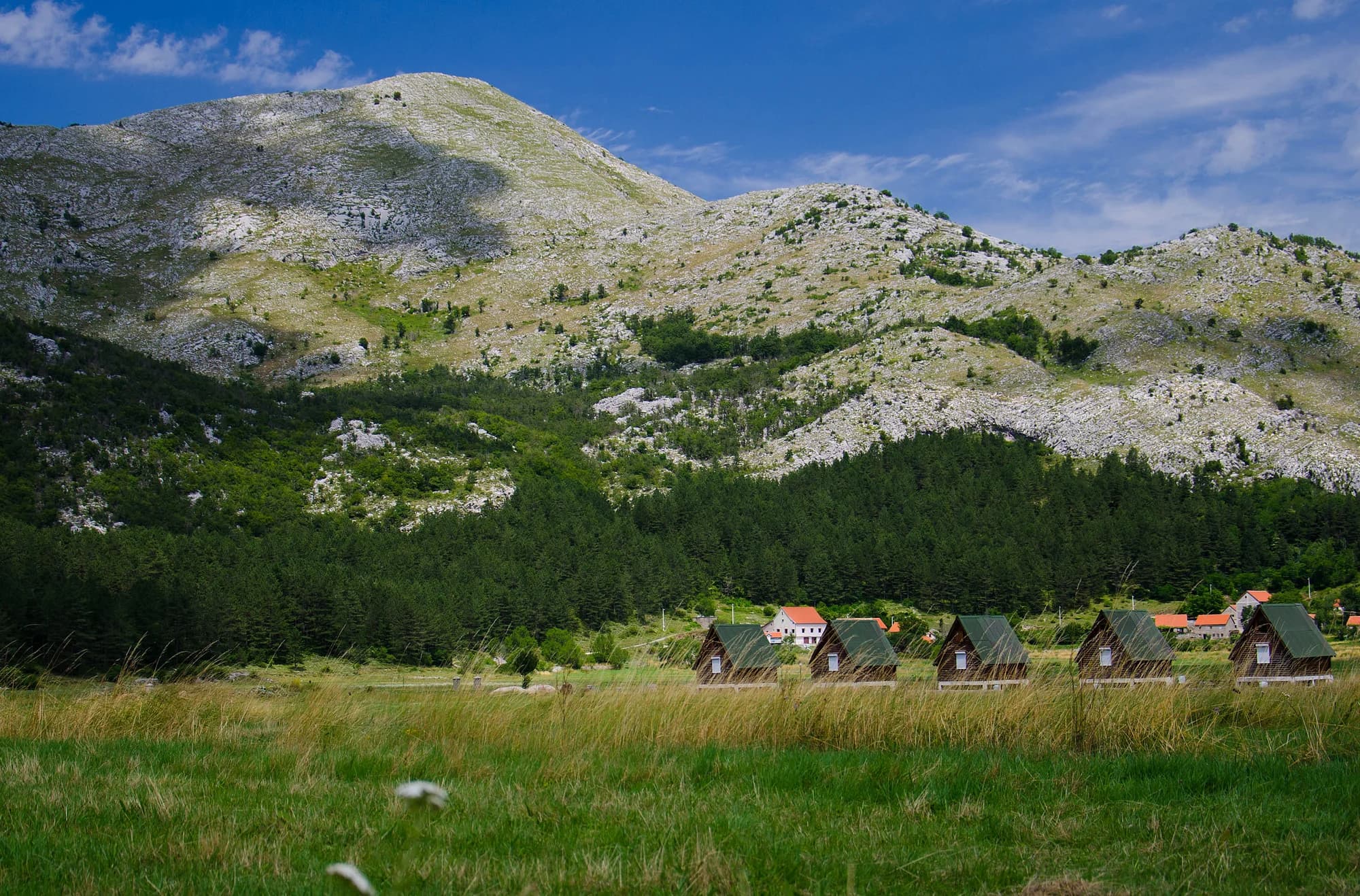
Vilusi lies on the karst plateau west of Nikšić, on the old road running from central Montenegro toward Trebinje and the Bosnian border. It is a small, strung-out settlement in wide open country: pale limestone, thin grass, dry-stone walls and sinkholes, with long views in every direction and few trees to interrupt them. The altitude and the exposure make it cold in winter and bright and wind-scoured in summer. Life here has always been pastoral. The plateau holds little surface water, since rain drains straight into the rock, so grazing rather than crops has shaped the land, and sheep and cattle still move across it between seasonal pastures. Stone is the local material for everything, from houses and sheepfolds to field boundaries and cisterns. Settlement is thin and follows the springs and the few pockets of workable soil in the depressions between ridges. The road through Vilusi has always mattered more than the place itself. It carries traffic between Nikšić and Herzegovina, and the region's history is largely the history of that route, contested and fortified and fought over through the long Montenegrin and Ottoman conflicts, remembered in local tradition ever since. For a traveller today it means a stretch of driving through some of the emptiest landscape in the country, with Piva and Durmitor to the north and the Bay of Kotor beyond the mountains to the south. Vilusi suits travellers taking the inland route toward Bosnia who want to understand the terrain rather than simply cross it, and anyone drawn to karst country and pastoral landscape. Late spring to early autumn is the sensible window, as winters bring snow and hard frost. Services are limited to what a small village provides, so treat Nikšić as the place to eat, refuel and stock up before setting out.
Vilusi by road
Kilometres from the junction, measured on the road
Two towns in Bosnia and Herzegovina are closer than Nikšić, the seat of the municipality Vilusi belongs to. The nearest border post, Ilino Brdo, is 3.5 km down the M-7.
The old Grahovo district today
Residents by settlement, 2023 census
These villages were a municipality of their own until 1960. The largest of them now holds 133 people, and Grahovo, the seat, is down to 102.
Who visits Montenegro
Share of foreign overnight stays, 2025
MONSTAT · 2025
Census population, Vilusi municipality
From 477 people in 1953 to 132 in 2023 — down 72 per cent in seventy years. MONSTAT had to suppress three of Vilusi’s eight age brackets in 2023 because 0–9, 10–19 and 30–39 hold 21 people between them; 36 residents, better than one in four, are 70 or older. Forty-four households remain.
A Kotor document names Vilusi in 1440. The village sat in the Ottoman nahija of Riđani, administered from Grahovo, until the Ottoman column was broken at Grahovac in May 1858 and the whole district passed to Montenegro. Widths are to scale.
Vilusi in a Kotor document of 1440, after Bulajić (1987) · nahija of Riđani, seat at Grahovo, a subaşi recorded in 1466 · Battle of Grahovac, 11–13 May 1858 new style, 28 April – 1 May old style · Момчило Мићовић, Бањани (Београд, 2013), стр. 25, on the srez seated at Vilusi 1919–1921.
Vilusi reaches the national press when its roads do — and once when its most famous son died.
SeeNews The rebuilt Vilusi–Petrovići road opens to traffic, the first section of the route north to the Vraćenovići crossing.
Government of Montenegro Transport minister Ivan Brajović opens 5.5 km of rebuilt trunk road at Kuside, on the Nikšić–Vilusi route.
Onogošt Another 2.5 km is rebuilt at Trubjela on the road to Vilusi, with the tender for the Ilino Brdo stretch still to come.
CdM The five kilometres from Vilusi to the Ilino Brdo crossing are rebuilt for €2.5 million, and the crossing itself widened to three lanes.
Al Jazeera Balkans Veljko Bulajić dies in Zagreb at 96; the obituary calls Battle of Neretva by far the most expensive spectacle ever shot in the former Yugoslavia.
Four road-works stories and an obituary: the press record of a junction.
Meanwhile, in 1969
Sarajevo, 29 November 1969: Battle of Neretva premieres, with Tito in the audience. Veljko Bulajić, born in Vilusi in 1928, directed it; his brother Stevan, born in Vilusi in 1926, wrote the screenplay. Estimates of the budget run from $4.5 to $12 million — either way it is still the most expensive film made in Yugoslavia.
Hollywood — the film takes a nomination for Best Foreign Language Film at the 42nd Academy Awards. Orson Welles, Yul Brynner, Sergei Bondarchuk, Franco Nero and Curd Jürgens are in the cast.
The poster: Pablo Picasso drew one of the posters. By Bulajić’s telling he waived his fee and asked for a case of the best Yugoslav wine; no independent account of the deal has surfaced.
Vilusi — the family had come back here from Sarajevo when the war began, and all three brothers joined the uprising on 13 July 1941. The eldest, Đorđe, died of his wounds. The village behind them held 396 people at the 1961 census and 283 by 1971. It holds 132 now.
“Five thousand people waited at the new station on a hot day, two hours past the timetable; two old fighters led a kolo on the tracks until the train came.”
Boško Roganović, „Ćiro“ je stigao u Nikšić, Novine Nikšića, 10 March 2014
The first train up from Bileća reached Nikšić on 12 July 1938, after thirteen years of intermittent building. Vilusi had seen one a year earlier: a construction train got to the village in August 1937, reported by the Belgrade daily Vreme on 11 August. Near Trebinje the 760 mm line branched for Čapljina, Dubrovnik and Zelenika on the Bay of Kotor. Nikšić–Čapljina closed in 1976.
“Kadri Pasha was cut down — by one version by Spasoje Vučetić of Vilusi, by another by Staniša Koprivica of Banjani.”
Local legend
Јагош Јовановић, Стварање црногорске државе и развој црногорске националности (Цетиње, 1948)
Search thousands of hotels and apartments with live prices.
We may earn a commission from partner links. This helps us keep Montenegro.com free for travelers.
Search hotels, apartments and guest houses with live availability.
We may earn a commission from partner links. This helps us keep Montenegro.com free for travelers.
Vilusi lies on the karst plateau west of Niksic, on the old road running from central Montenegro toward Trebinje and the Bosnian border. It is a small, strung-out settlement in wide open country.
Pale limestone, thin grass, dry-stone walls and sinkholes, with long views in every direction and few trees to interrupt them. The altitude and exposure make it cold in winter and bright and wind-scoured in summer.
Pastorally. The plateau holds little surface water, since rain drains straight into the rock, so grazing rather than crops has shaped the land. Stone is the local material for everything, from houses and sheepfolds to field boundaries and cisterns.
Because it carries traffic between Niksic and Herzegovina, and the region's history is largely the history of that route — contested, fortified and fought over through the long Montenegrin and Ottoman conflicts, and remembered in local tradition ever since.
A stretch of driving through some of the emptiest and most striking landscape in the country, with Piva and Durmitor to the north and the Bay of Kotor beyond the mountains to the south. It suits people who want to understand the terrain rather than simply cross it.
Late spring to early autumn is the sensible window, as winters bring snow and hard frost. Services are limited to what a small village provides, so treat Niksic as the place to eat, refuel and stock up before setting out.
No — the nearest is Tivat Airport (TIV), 54 km away by road.
13.2 km by road, about 30 min by car.
The UK Foreign, Commonwealth & Development Office (FCDO) has no advisory against travel to Montenegro; it last reviewed its guidance on 13 August 2026. That is their assessment of the country as a whole, not ours and not a judgement about Vilusi, so read it yourself before you travel. The emergency number in Montenegro is 112.
JulStatehood Day, 13 July — the holiday marks both the Berlin recognition of Montenegro in 1878 and the 1941 uprising, which the Bulajić brothers joined in this village on that date
The local plate
Yellow or white cornmeal worked with kajmak — the clotted cream skimmed off slowly boiled milk — until the melted kajmak floats on top. It is eaten with a spoon, and in Montenegro a plate of it set before a guest with sliced pršut is the highest honour the house can pay. Its country is exactly this one: the karst highlands of Montenegro, eastern Herzegovina 3.5 km up the road, and south-western Serbia. Half the Grahovo field below the village is meadow.
Where Konoba Timor at the junction, 07:00 to 23:00, cooking local and regional — the only kitchen in Vilusi
The nearest places to Vilusi, at their true positions — Nikšić is about 22 km away in a straight line.
Schematic. Positions and straight-line distances from the coordinates we hold for each place; mountain roads make the drive longer. Coastline and Lake Skadar © OpenStreetMap contributors.
Vilusi in numbers
2023 census — 44 households, and 36 residents over 70
at the junction; the Grahovo field below sits at 695–780 m
Tivat by road; Dubrovnik 63 km, Podgorica 85 km
the 760 mm line through the village closed; a construction train had reached Vilusi in August 1937
a year on the Grahovo field, 13 km down the M-8 — Nikšić records 1,990 mm
an antique castle of that name is placed at Vilusi by Milan Šufflay, 1925 — on one line, in one book
MONSTAT, Popis 2023, settlement tables · Republički zavod za statistiku, comparative census 1948–2003 · road distances by OSRM over OpenStreetMap · rainfall: Grahovo field, and Nikšić 1991–2020 from the Hydrological and Meteorological Service of Montenegro
A few hours
Twenty minutes and a geography lesson: Trebinje is 33 km from here, Nikšić 35.
One full day
The M-8 is the reason to come: one road from this junction to the Bay of Kotor, dropping 900 m in 38 km.
A weekend
A weekend here is a border loop, and the roads still run as if the frontier were not there.
Vilusi, at the junction
Best for a school, a Serbian Orthodox church, an EKO station and one konoba — 44 households, and the plateau
Grahovo, 13 km down the M-8
Best for the old district seat at 720 m, above the field, halfway to the sea
Nikšić, 35 km east
Best for the nearest town with hotels, and the municipality Vilusi belongs to
Trebinje, 33 km west
Best for over the border and nearer than Nikšić — the reason the crossing is here at all
Best time: April · May · October
| Place | By road | Driving |
|---|---|---|
| Rudine | 13.2 km | about 30 min |
| Grahovo | 18.7 km | about 45 min |
| Nikšić | 29 km | about 50 min |
| Kotor | 66.2 km | about 1 h 41 min |
| Budva | 77.6 km | about 1 h 53 min |
| Podgorica | 79.8 km | about 1 h 49 min |
Routes marked ⛴ cross on the Kamenari–Lepetane ferry. Road distances routed over OpenStreetMap data, © OpenStreetMap contributors. Driving times are free-flow and take no account of summer traffic or a queue at the ferry ramp.