Montenegrin wine becomes easier to understand once three different things stop being treated as synonyms: Vranac is a grape variety, Crmnica is a protected place-name for qualifying wine, and “traditional” describes practices that vary by household and producer. A bottle can be Vranac without being Crmnica wine; a Crmnica wine can also be a blend or a white style allowed by its specification.
Those distinctions lead to practical decisions: what to read on a label, which styles to compare, what to ask a winery, and how to plan a tasting without driving or feeling obliged to drink. Montenegro's product specification, protected-origin register, 2024 agricultural data and grape-genetics research provide the details.
The 60-second answer
- Vranac: Montenegro's emblematic dark-skinned wine grape, genetically identified as the offspring of Kratošija and Duljenga.
- Kratošija: an old cultivar genetically identical to Zinfandel, Primitivo and Crljenak Kaštelanski; it can produce a different expression under different names, sites and winemaking.
- Krstač: a local white grape, not a white version of Vranac.
- Crmnica: a delimited, protected origin south and west of Lake Skadar, governed by a product specification.
- Podgorica and Ćemovsko Polje: a different major production landscape, including the country's dominant business-scale vineyard area.
The Montenegro wine-routes guide is the companion for geography and booking. This page focuses on what the names mean and how to taste them critically.
Crmnica is an origin, not a mood
Montenegro maintains a register of protected wine origins, and Crmnica appears as a protected designation of origin. The national specification defines the area, grapes, production rules, analytical ranges and links between the product and place. The name therefore rests on formal compliance and certification, not tradition alone.
That does not mean every homemade wine poured inside Crmnica automatically carries the protected designation. Legal origin claims require compliance and certification. It also does not mean Vranac grown near Podgorica, Ulcinj or elsewhere becomes “Crmnica” because the variety has historical roots there. Variety follows the vine; protected origin follows the specification.
The specification identifies Vranac as the leading Crmnica variety and says more than 90% of local grape producers grow it; nearly 60% grow Kratošija. It also documents Krstač as a white variety and Lisičina in rosé and red blends, alongside international grapes. The result is multiple wine categories rather than one fixed rustic red. The point of origin protection is traceability and shared rules, not a guarantee that every compliant producer will make the same style.
| Layer | What it covers |
|---|---|
| VARIETY | Vranac etc. |
| ORIGIN | Crmnica rules |
| PRODUCER | harvest + cellar |
| the bottle | the result |
Source: wapi.gov.me, gov.me
Vranac: parentage, not a guaranteed flavour
A 2020 population-genetics study sampled 419 vines in situ and 57 local collection varieties, identifying 144 genetic profiles. Its parentage analysis found Vranac to be the offspring of Duljenga and Kratošija, with no mismatch in the proposed trio and Duljenga identified as the female parent. That is stronger than the older shorthand that Vranac was merely “related” to Kratošija.
Genetics cannot tell you what is in tonight's glass. A young, fruit-led Vranac and a longer-aged, oak-influenced example may share the same variety while differing in tannin feel, aroma, alcohol, extraction and maturity. Elevation, soil, crop level, harvest date, fermentation, vessel, blending and bottle age all intervene.
Start tasting structurally. Look at colour without equating darkness with quality. Smell before swirling, then after. On the palate, separate acidity, tannin, alcohol warmth, fruit concentration and finish. Ask whether oak supports or dominates. “Powerful” can describe a style; it should not become a compulsory compliment.
| Variety | Role |
|---|---|
| DULJENGA | female parent |
| KRATOŠIJA | male parent |
| VRANAC | offspring |
Source: pmc.ncbi.nlm.nih.gov
Kratošija and the Zinfandel question
SSR marker research confirms that Kratošija has the same genetic profile as California's Zinfandel, Italy's Primitivo and Croatia's Crljenak Kaštelanski. Same genotype does not mean same bottle. Site, clonal or biotype variation, farming and winemaking can create meaningful differences, while the market name carries its own history.
The 2020 study found 106 Kratošija plants in old Montenegrin vineyards, multiple biotypes and a large parentage network, evidence consistent with long cultivation and a possible Montenegrin origin. The authors also state that an ancient variety's birthplace cannot be proved definitively.
For a useful comparison, taste Kratošija and Vranac from the same producer or region and similar vintage. Ask whether each is single-variety or blended. Compare acidity, tannin grain and aromatic development without expecting Kratošija to mimic a warm-climate California Zinfandel. The Montenegro–Croatia comparison helps with travel geography, but grape identity is not a contest between countries.
Krstač: the white wine entry point
Krstač is a white grape with an original genetic profile in Montenegrin research. Plantaže describes its Krstač plantings at Nikolj Crkva and Beri in Ćemovsko Polje and says the name refers to a cross-like cluster shape. Its exclusivity statement applies to the producer's own vineyard account, not to a national planting census.
Do not reduce it to “the white before Vranac.” Taste for balance among acidity, body, alcohol and fruit rather than forcing a universal note. Check whether the wine is varietal Krstač or a blend, and whether the vintage is intended for freshness or has cellar development. A comparative flight can begin with Krstač, move to Kratošija and finish with structured Vranac, but serving order should follow weight and sweetness, not prestige.
| Variety | Focus on | Ask first | Then ask |
|---|---|---|---|
| KRSTAČ | acidity / body | varietal or blend? | fresh or developed? |
| KRATOŠIJA | tannin / acidity | single variety? | site + vintage? |
| VRANAC | tannin / alcohol | oak + age? | origin claim? |
Source: pmc.ncbi.nlm.nih.gov, plantaze.com
Montenegro's vineyard economy in current numbers
The 2024 Agricultural Census shows a dual vineyard structure: far more family holdings than business entities, but most vineyard area and vines controlled by business entities. Many small family plots coexist with a highly concentrated commercial footprint.
| Measure | Family holdings | Business entities | Total |
|---|---|---|---|
| Holdings with vineyards | 1,562 | 18 | 1,580 |
| Grapevines | 2,157,205 | 8,248,641 | 10,405,846 |
| Vineyard area | 495.0 ha | 2,058.3 ha | 2,553.3 ha |
| Area in wine grapes with protected geographical provenance | 216.9 ha | 1,923.0 ha | 2,139.9 ha |
What the sources say
Business entities therefore held about 80.6% of vineyard area in the census. That statistic does not rank wine quality, nor does one “holding” necessarily equal one visitor-ready winery. MONSTAT separately reports 16,869.3 tonnes of grapes in 2024, including 16,765.9 tonnes produced on plantations. Grape tonnage must not be converted casually into bottled-wine output: processing losses, table grapes, stocks and production choices intervene.
What to read on the bottle
Begin with the exact producer and product name, then find vintage, alcohol by volume, volume, grape declaration if given, and the stated origin. A protected place-name matters only in the wording actually certified on the label. “From the Lake Skadar area,” a grape name, a winery address and the protected Crmnica designation are not four ways of saying the same thing.
Next ask what is not obvious. Is it dry, off-dry or a dessert style? Is it single-variety or blended? Was oak used, and for how long? Is sediment expected? At a winery, request the technical sheet rather than guessing from the bottle's weight, crest or folkloric design.
For souvenirs, buy from a traceable producer or retailer, keep the receipt and check your transport operator's current baggage and customs rules. Accurate labels and certification help consumers distinguish origin. The Montenegro food guide adds regional dishes, while the Plantaže tasting guide should be checked against today's booking page for current times.
Practical decision guide: choose a bottle or flight
| What you want to learn | Bottle or flight to seek | Ask first | Common mistake |
|---|---|---|---|
| What Vranac is | Young varietal Vranac | Origin, vintage, blend percentage | Assuming all dark wine is Vranac |
| How cellar choices change it | Young and aged Vranac from one producer | Oak vessel and ageing time | Equating more oak with higher quality |
| How Kratošija differs | Parallel Vranac/Kratošija flight | Same vintage and site? | Expecting California Zinfandel flavour |
| Montenegrin white wine | Krstač, then another local white | Varietal or blend; dry or sweet | Treating white as an intermission |
| What Crmnica means | Certified Crmnica bottles from two producers | Exact protected-origin wording | Confusing winery location with certification |
| You do not drink | Vineyard/cellar visit without alcohol | Food, juice or alcohol-free option | Assuming tasting requires swallowing |
Plan a winery visit that works
The National Tourism Organisation names Crmnica, the nahije, Komani, Bjelopavlići and settlements around Lake Skadar as major wine areas. It advises calling for an appointment at the large Šipčanik cellar. Apply the booking rule even more strongly to family wineries: a map marker does not prove daily public opening, English-language service, food, card payment or space for a group.
When contacting a producer, send the date, arrival window, group size, language, mobility needs, whether children are present, and whether anyone wants a no-alcohol visit. Ask for the price, duration, number and size of pours, included food, cancellation terms and exact parking point. Harvest is work, not an open festival; participate only when the producer explicitly offers it.
Choose one base and one compact area. Virpazar is practical for Crmnica and Lake Skadar; Podgorica is practical for Ćemovsko Polje and urban lodging. The Podgorica history guide adds a non-wine day, while the month-by-month weather guide helps with heat and rain. Never stack distant wineries simply because a map makes Montenegro look small.
| Step | What to settle |
|---|---|
| 1. Appointment | date + live reply |
| 2. Transport | sober return plan |
| 3. Tasting | price + duration |
| 4. Needs | access + food |
Source: montenegro.travel
Alcohol, driving and the right not to drink
WHO Europe states that no level of alcohol consumption is safe for health: alcohol itself creates risk, regardless of price or beverage type, and less is safer. Wine is not medicine, and “heart healthy” is not a safe reason to drink.
Arrange a sober driver, taxi or transfer before the first pour. Do not calculate driving fitness from tasting count, glass size, food or elapsed time. Montenegro Police continued drink-driving enforcement in June 2026, including arrests at high measured concentrations. The safe trip rule is simpler than a legal-threshold calculation: if you are driving, do not drink.
Spitting is normal in analytical tasting. Sharing a flight, declining a pour and drinking water are normal too. People who are pregnant, taking interacting medication, managing dependence, under legal drinking age or simply uninterested can skip alcohol completely. A good host can explain vineyards, grapes, labels and cellar work without requiring consumption.
| Stage | Choice |
|---|---|
| Before arrival | choose transport |
| Sober driver | no alcohol |
| Booked transfer | confirm return |
| Visit options | taste / spit / abstain |
Source: who.int, gov.me
A Crmnica household account, not a universal rulebook
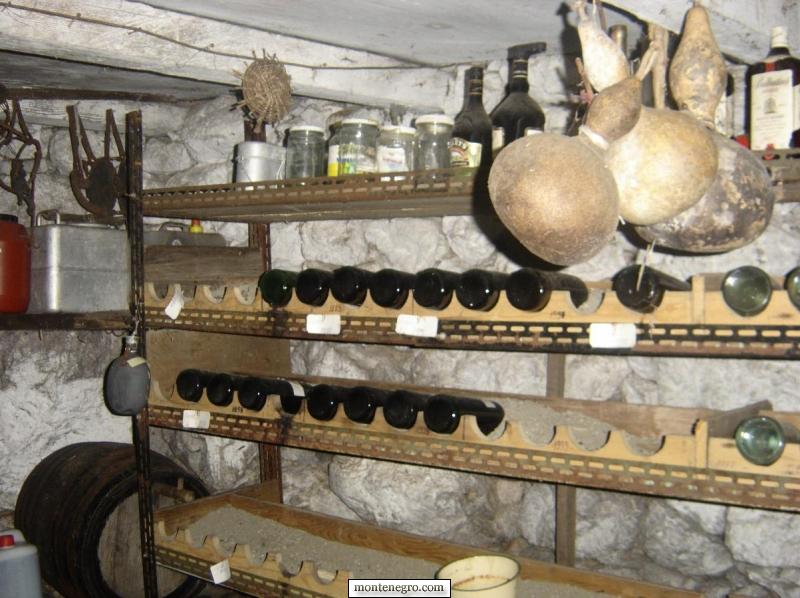
An unpublished household account attributed to Geneviève Meyer-Iličković, with thanks to Mijo Iličković, describes clear ribbed goblets, wine brought from barrel in a glass decanter, an apple placed on a wedding bottle, and a culture in which wine accompanied life events. It is a personal cultural snapshot, not a survey of every Crmnica household.
It is not evidence that every Crmnica household uses one glass, observes one wedding ritual or offers cellar access to strangers. Nor should hospitality be used to pressure a host into opening unlabelled wine or a visitor into drinking it. Ask, listen and let a producer describe which practices belong to their own family.
The archive's strongest insight survives: place is made by human practice as well as soil and climate. Protected-origin law formalizes part of that relationship, while family memory preserves another part. Neither should erase the other.
Frequently asked questions
Is all Montenegrin red wine Vranac?
No. Montenegro grows Kratošija and international dark-skinned varieties too, and many wines are blends. Read the grape declaration or technical sheet.
Is Vranac the same as Kratošija?
No. They are distinct cultivars. Genetic research identifies Kratošija as one parent of Vranac, with Duljenga the other.
Is Kratošija the same grape as Zinfandel?
They share the same genetic profile, as do Primitivo and Crljenak Kaštelanski. Wine expression and naming still differ by place, plant material and production.
Can any wine made in Crmnica use the protected name?
No. The protected designation is governed by a specification and certification system. Being poured in the region is not enough.
When is the best season for a wine trip?
Spring and early autumn often suit outdoor travel, but opening and harvest access depend on the producer. Summer heat can make midday vineyard walking uncomfortable. Confirm directly rather than relying on a generic season label.
Must I drink at a winery?
No. Ask for a cellar or vineyard visit without alcohol, spit samples, share a flight or abstain. Arrange transport in advance for anyone who chooses to drink.
Build one meaningful comparison
A strong first encounter needs only three deliberate samples, not a marathon: one Krstač, one Kratošija and one Vranac, or two Vranacs from different protected origins plus water and food. Photograph labels with permission, record vintage and origin, and write structural impressions before reading marketing copy.
Then widen the context. The wine-routes guide supports slower rural travel; the foreign-press audit shows how repeated romance can harden into “fact”; and the coffee invitation is a useful reminder that hospitality does not have to contain alcohol.
The goal is not to identify the most “authentic” bottle in one sip. It is to understand what the label can prove, what the grape's genetics can explain, what the producer changed, and what your own glass actually shows.