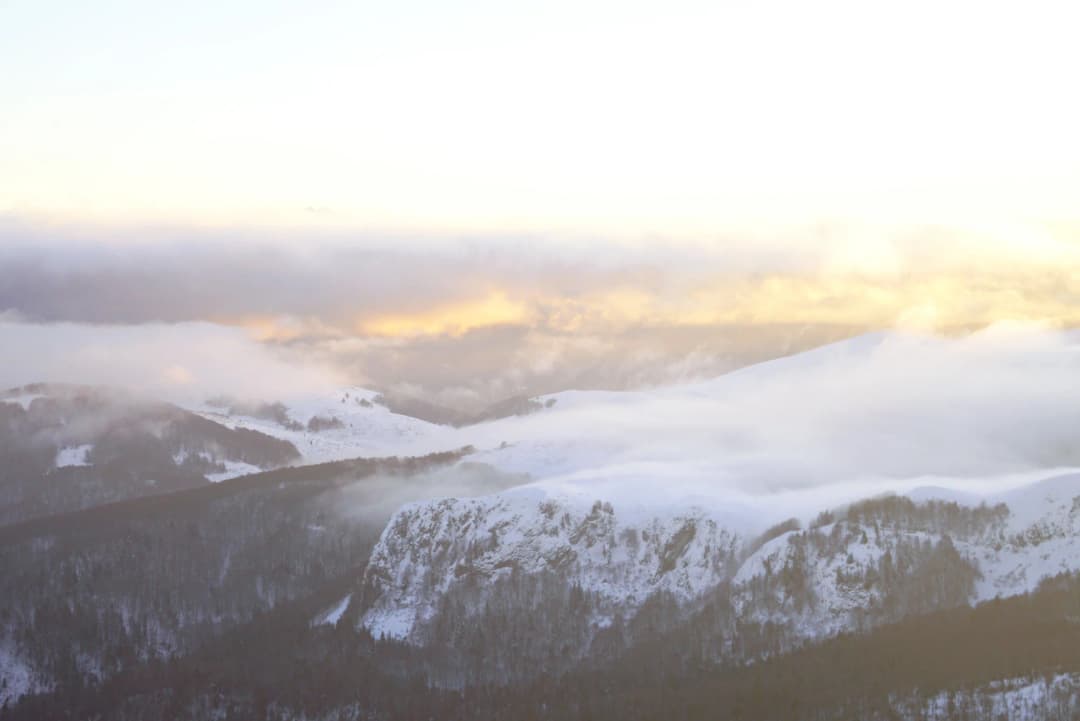
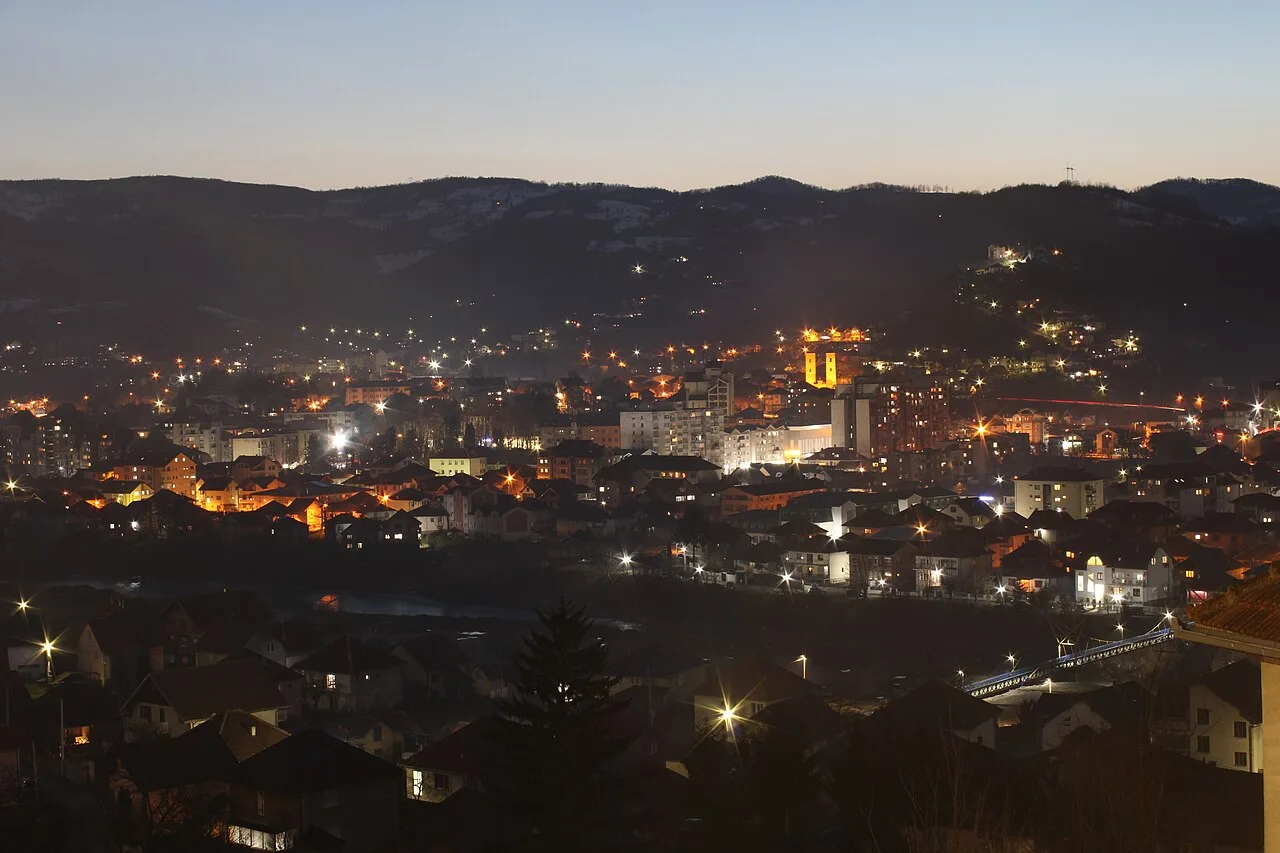
Bijelo Polje (White Field) is northern Montenegro’s working rail city on the Lim corridor, not a compact resort assembled for visitors. It straddles the emerald Lim in a broad valley framed by forested hills, and its name refers to that rare expanse of level ground in mountainous northern Montenegro — a field which, in certain light, especially under morning mist or winter snow, does appear strikingly white. Its centre rewards a slow cultural walk; its municipality spreads into river valleys, villages and limestone country that require separate transport and current access checks. The best trip combines the two without pretending that an unfinished cave project or a distant monastery is a walkable city sight.
As one of Montenegro’s largest northern cities, Bijelo Polje serves as a regional centre for the upper Lim valley and a cultural crossroads where Montenegrin, Serbian and Bosniak communities have coexisted for centuries. It rarely appears on tourist itineraries, yet it rewards the curious traveller with a genuine glimpse of northern Montenegrin life: Ottoman-era mosques standing alongside Orthodox churches, vibrant daily markets, excellent river fishing, and the deep quiet of surrounding mountain villages largely unchanged since the 19th century. For visitors driving between the coast and Serbia, or those seeking a base for exploring Bjelasica, Biogradska Gora and the monasteries of northern Montenegro, it is an authentic and hospitable stopping point.
This 2026 guide starts with a correction. The often-repeated population of 46,051 belongs to the 2011 census for the whole municipality. MONSTAT’s final 2023 result is 38,662—also municipal, not city-centre population. That distinction shapes everything from accommodation supply to distances: “Bijelo Polje” can mean the urban centre or a large administrative area. The same discipline applies to the road north, which older copy called a “highway”; to the Miroslav Gospel, which is associated with the city but kept elsewhere; and to Đalovića Cave, which official documents describe as a project rather than a ticketed attraction.
Is Bijelo Polje right for your trip?
| Priority | What Bijelo Polje offers | Constraint to plan around |
|---|---|---|
| Urban heritage | Church, mosque, museum and literary culture in a lived-in northern centre. | Religious and museum interiors do not share one guaranteed daily timetable. |
| Rail travel | A station on Montenegro’s main north–south railway; a government programme planned future joint interstate processing. | Search the operator by date and confirm present border and engineering conditions. |
| Nature | The Lim valley and a wider municipality of gorges, forest and karst landscapes. | Many sites need a vehicle, guide or verified public route. |
| Đalovića Cave | An important cave system and long-running public tourism project. | A December 2025 report does not establish opening, and no later verified opening notice was found. |
| Short stay | A worthwhile one-night cultural stop between central Montenegro and the Serbian border. | A rushed through-trip misses the centre; rural excursions need a second day. |
| Accessibility | Some central streets and public institutions can be approached by road. | Historic thresholds, gradients and rural surfaces require venue-specific confirmation. |
A second table answers the question travellers ask next: which claims are settled, and which must be re-checked on the day of travel.
| Place or question | Verified position | Check before relying on it |
|---|---|---|
| Municipality population | 38,662 in the 2023 census | Do not use it as the town-only count |
| Municipal museum | Protected former school with five collection groups | Opening hours and temporary displays |
| Miroslav Gospel | National Museum of Serbia collection; UNESCO register | Rare original-display dates in Belgrade |
| Churches and mosque | Living religious heritage | Entry, services, dress and photography |
| Đalovića Cave project | Still described in 2026 government records as works and development | Public opening, cable car, tours and tickets |
| Rail | Bijelo Polje is on the national passenger network | Live timetable on the day of travel |
City and municipality are not interchangeable
Official population data describe the municipality. MONSTAT counted 46,051 residents in 2011 and 38,662 in the final 2023 census, a decline of 7,389 people, or about 16%. Those numbers should not be used as the population of the urban settlement. They are useful for understanding the wider region’s demographic pressure, but not for guessing how busy the pedestrian centre will feel on a particular afternoon. The town itself is frequently described as a city of approximately 15,000 people; that is a widely repeated urban-settlement estimate rather than a census release, and it should be labelled as such whenever it is quoted.
What the sources say
MONSTAT’s final 2023 release counts 38,662 residents in Bijelo Polje municipality: 19,441 men and 19,221 women. A later household release records 12,363 households. These are municipality-wide figures covering the urban centre and a broad rural hinterland; they are not a licence to describe the compact town itself as having 38,662 inhabitants.
The distinction changes a visit. The walkable centre, museum and main religious landmarks form one layer. Bistrica, Podvrh, Samograd and mountain settlements form another, requiring transport and more planning. The full northern cultural-crossroads guide places the city in the wider Lim landscape. Here, the practical rule is simpler: use central addresses for a walking day, and treat every village, cave, monastery or mountain reference as a separate route until a map and host confirm otherwise.
How to read the destination
Plan Bijelo Polje in three layers. The centre contains civic life, the museum and a mix of religious and literary heritage. The Lim corridor carries the railway and main road, making the city a transport hinge rather than an isolated mountain town. The wider municipality contains Bistrica, rural monasteries, gorge country and large development projects. A single booking pin does not bridge those layers.
| Layer | What it covers |
|---|---|
| Centre | Walk + culture |
| Lim corridor | Rail + road |
| Wider municipality | Vehicle / guide / route check |
Montenegro.com editorial framework
| Zone | What it requires |
|---|---|
| Centre | Walk + institution checks |
| Samograd | Access + local guidance |
| Đalovića Cave | Operating confirmation |
| Rule of thumb | Distance from town increases the verification burden |
Source: wapi.gov.me, gov.me
Two nights is the comfortable minimum for travellers arriving by train: one day for the centre, one for a pre-arranged rural excursion or simply a slower city day. A single night works as a purposeful rail stop. Longer stays depend on a specific reason—family, hiking with local support, an event or work—not on a checklist of supposedly open attractions.
Getting there without freezing a timetable
Rail is a genuine reason to choose Bijelo Polje, and it is the city’s strongest public-transport advantage. The station sits on the Belgrade–Bar railway line and is served by several trains daily. The journey from Podgorica takes about 2.5 hours and traverses some of the most spectacular railway scenery in Europe, including the Mala Rijeka viaduct — at 198 metres, one of the highest railway bridges in the world. Trains from Bar on the coast take about 4 hours.
Railway Transport of Montenegro provides a live journey search and lists Bijelo Polje station at +382 50 478 560. Its sales-point page listed the station ticket office as operating 00:00–24:00 when checked on 30 August 2026. Recheck before relying on those hours. The operator’s timetable tool includes the station on domestic routes and asks users to search by route and date, so use that live search close to departure rather than inheriting a time or fare from this article: engineering work, seasonal changes and international service adjustments make copied details age badly.
The Government’s Economic Reform Programme records reconstruction activity and says that, going forward, Bijelo Polje station was intended to serve as a joint interstate railway border station for Montenegro and Serbia; joint train operation was listed as a 2025 target. That is a plan, not proof the joint arrangement began. For an international journey, confirm present border procedures, carry the required identity and entry documents, keep medicines and valuables accessible, and do not book a tight onward road connection.
| Step | Check |
|---|---|
| Search date | Operator result |
| Check border | Documents |
| Add margin | Works + delay |
| Final transfer | Station to lodging |
| Caution | Do not freeze a departure time or fare in a long-lived guide |
Source: zpcg.me, wapi.gov.me
By road from Podgorica: the drive takes about 2 hours (approximately 120 kilometres) via the E65, which follows the Morača Canyon north through some of Montenegro’s most dramatic scenery, passing the canyon’s deep gorges, the Mrtvica River bridge and several tunnels before reaching the Lim valley. Do not picture one uninterrupted high-speed motorway to the Serbian border: the route through northern terrain is demanding, narrow in places, with tunnels and heavy truck traffic. Weather, works and mountain driving can alter the trip. Check current road conditions, drive carefully — especially in winter when ice is possible — refuel before remote diversions and never let an estimated app arrival replace a safe margin.
From Serbia: Bijelo Polje is only about 40 kilometres from the Serbian border at Dobrakovo. The road from Prijepolje in Serbia is in good condition and the crossing is typically straightforward.
By bus: regular services connect Bijelo Polje to Podgorica (2–2.5 hours), Nikšić, Pljevlja and destinations in Serbia, and the bus station is centrally located. The network is useful for regional travel, but no single current official timetable covering every operator was verified here; confirm the exact carrier, platform and return before leaving.
From Podgorica or the coast, allow the train journey to be part of the day rather than placing a fixed appointment immediately after arrival. Ask the accommodation for a realistic station transfer, especially after dark or with luggage. “Central” does not guarantee a comfortable walk, and a late arrival is the wrong time to discover an unlit incline. Within the centre, walking works for the main cultural circuit if mobility allows, but slopes and crossings deserve attention. The cave, Bistrica and Samograd are not extensions of that walk. Arrange lawful transport and a return plan. First-time visitors can cross-check money, connectivity and emergency basics in our Montenegro 2026 practical guide.
A respectful centre walk that does not overpromise interiors
Begin with the Church of Saints Peter and Paul, whose twelfth-century origin and connection to Prince Miroslav anchor the city’s medieval narrative. Municipal history also connects the site to the 13th-century episcopal seat and the settlement that grew around it. Continue through the civic centre to the mosque heritage and the municipal museum. This is not a ranking of religions or eras. It is a way to read a place where Orthodox Christian, Islamic, Ottoman-period civic and modern literary histories occupy the same urban fabric.
| Stop | Context |
|---|---|
| Saints Peter + Paul | Medieval attribution |
| Mosque heritage | Living worship context |
| Municipal museum | Protected collections |
| Note | Check entry, dress, services and museum opening separately |
Source: bijelopolje.co.me
Local cultural tradition connects the church with the Miroslav Gospel, commissioned for Prince Miroslav in the late 12th century. Treat the building as a functioning sacred place: look for posted guidance, avoid services unless attending respectfully, and ask before photographing an interior. At any church or mosque, cover shoulders and knees, silence phones and avoid photographing worshippers.
Continue toward the municipal museum. Its official page says the institution was founded on 31 January 1957 and now holds archaeological, ethnographic, historical, numismatic and art collections; the municipality also says the late Ottoman school building is protected cultural property. It was erected between 1897 and 1905 for the Ottoman state secular school known as a ruždija. That makes the building part of the interpretation, not just a container for objects.
The museum page publishes a street address and telephone but no dependable public hours in the material reviewed for this guide. Call before structuring a day around entry, or before making the museum the centrepiece of a short stop. A closed door does not make the stop wasted—the exterior and elevated relationship to the Lim still help explain the town—but it should change how much time you reserve.
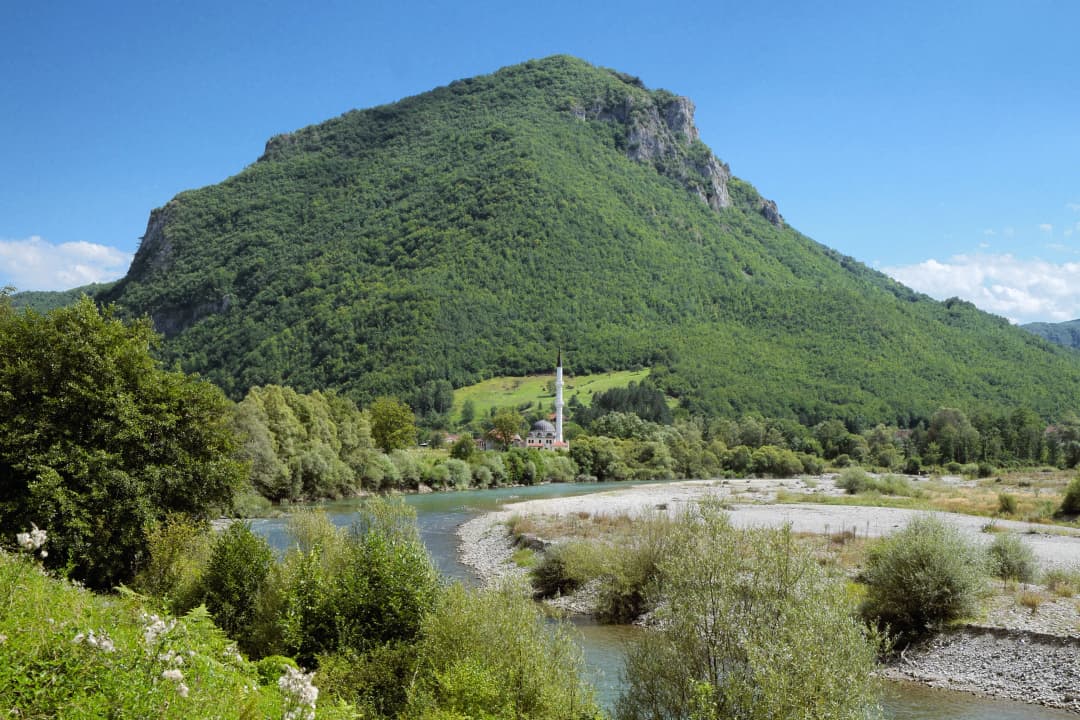
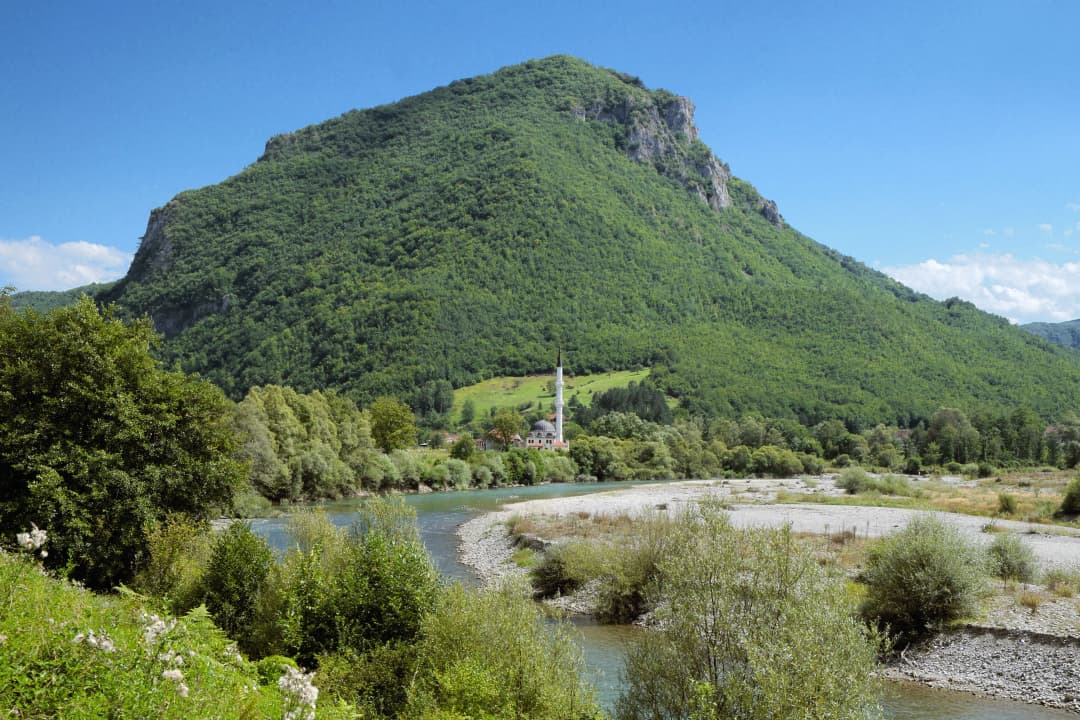
Add the city mosque as a living counterpart to the Orthodox sites. The municipal tourist guide says the mosque was moved stone by stone from the Ljuboviđa valley in 1741. The approved regional photographs in this guide include a distant mosque, but it is not identified as the city mosque and is not used to authenticate that transfer story. Dress conservatively, avoid prayer times as a sightseeing interruption, and request permission for interior photography.
| Stop | Layer |
|---|---|
| Saint Peter and Paul | Medieval settlement |
| Municipal museum | Protected collections |
| City mosque | Living worship |
| Before you go | Verify entry and photography at every interior |
Source: bijelopolje.co.me
The old town centre retains several structures from the Ottoman period, including mosques, the old bazaar area and residential towers. The most prominent mosque named in destination material is the Husein-Paša Boljanić Mosque, a graceful structure with a slender minaret. The Redzepagić Tower (Kula Redžepagića), a fortified stone tower house typical of Ottoman-era Balkan architecture, is one of the best-preserved examples in Montenegro. Walking through the old quarter, you encounter a layered architectural history — Ottoman stone walls next to Austro-Hungarian facades next to Yugoslav-era apartment blocks.
About 3 kilometres from the city centre, on the banks of the Lim, stands the Church of St. Peter on the Lim (Crkva Svetog Petra na Limu), also known as Nikoljac, described in destination material as dating from the 12th century and as the oldest monument in the area and one of Montenegro’s oldest surviving Orthodox churches. Its simple Romanesque architecture, with thick stone walls and narrow windows, reflects the austere spirituality of the medieval Serbian church; inside, fragments of original frescoes are still visible. The churchyard is peaceful and shaded, overlooking the river, and the monastery complex that grew around the church includes later buildings and a small garden. Entry is free, though modest dress is expected. Note that this riverside church is described separately from the central Church of Saints Peter and Paul with which municipal sources associate the episcopal seat and the Miroslav Gospel; confirm locally which building you are being directed to before setting out.
This combination is more revealing than a checklist of “sights.” Medieval ecclesiastical influence, Ottoman urban history and modern museum stewardship overlap within a small centre. Our dedicated Bijelo Polje cultural walk provides the deeper building-by-building sequence. For another Montenegrin example of a building interpreted through more than one religious period, compare the church-mosque of Ulcinj; the histories are distinct, so do not use one as a template for the other. The broader lesson resembles the evidence method used in the Ulcinj Sabbatai Zevi history: a layered town is better understood when claims are attributed and places of worship remain living institutions, not theatrical scenery.
The Miroslav Gospel: local connection, distant original
The municipality’s tourist guide says the Miroslav Gospel was written at the Church of Saints Peter and Paul in the twelfth century. That is an important local heritage attribution, and the manuscript is central to Bijelo Polje’s cultural identity — but it must not be stretched into a display claim, because the original is not a normally accessible object in the town.
What the sources say
UNESCO lists the manuscript in the Memory of the World programme; its nomination identifies the manuscript from about 1180, the main codex in Belgrade and one separated leaf in the Russian National Library in Saint Petersburg. The National Museum of Serbia identifies it as a late-12th-century illuminated Cyrillic manuscript in its medieval collection and notes registration in 2005.
A detailed National Museum page says the book has 181 parchment leaves and 296 miniatures, was commissioned for Prince Miroslav, and is kept in Belgrade; one leaf is in the National Library in Saint Petersburg. It also says Serbian conservation rules limit exhibition of the manuscript to ten days in a year. That is why a visitor should not arrive at Saint Peter and Paul expecting the original Gospel in a display case. UNESCO recognition concerns documentary heritage and custody, not a guarantee that a fragile object is regularly exhibited.
The careful formulation is this: Bijelo Polje’s church tradition and municipal cultural record place the manuscript in the city’s historical story, while UNESCO and the National Museum establish international status and present custody. Questions about the exact place of production, the division of scribal and illuminator work, and the manuscript’s long journey deserve scholarship rather than a single romantic sentence. This distinction between site association and object location is the same discipline used when assessing archaeological claims in our prehistoric-to-ancient evidence guide. For wider sacred-site planning, use our Montenegro monastery and pilgrimage guide.
| Holder | Role | What it means |
|---|---|---|
| Bijelo Polje | Where it was written | Local heritage |
| UNESCO | Memory of the World | Documentary significance |
| National Museum | Holds the manuscript | Rarely on public display |
| Bottom line | The manuscript itself is in Belgrade, not Bijelo Polje |
Source: unesco.org, narodnimuzej.rs
A literary city, with exact 2026 dates
Bijelo Polje’s literary identity is not merely retrospective. The official Ratković Poetry Evenings site scheduled the 56th edition for 3–5 September 2026, with 20 programmes at several city venues and more than 60 authors from the region and Europe. The notice listed a small book fair, workshops, author conversations, international poetry evenings, music, theatre, round tables, programmes for young writers, a documentary and the Risto Ratković award.
Those details are edition-specific. They do not establish dates for 2027 or a permanent daily programme at the Risto Ratković House. If visiting during the festival, use the organiser’s live programme to locate each event; “Bijelo Polje” is not a single venue. Outside festival dates, verify whether the house has a public exhibition or event before walking over.
Đalovića Cave: a major project, not a walk-in promise
Đalovića Cave is the biggest planning trap in older destination copy. Promotional descriptions have long called it one of the municipality’s great natural assets, and government announcements have promoted tourism development for years, including a visitor centre and gondola. The nearby Bistrica canyon and the cave project can absolutely shape a future visit. In August 2026, however, the strongest current official evidence did not support selling it as a normal ticketed attraction.
A 2025 government report says the Environmental Protection Agency approved activities in the speleological site and that a contractor was introduced in May 2025 to continue works and create conditions for the cave’s arrangement. A government report published in December 2025, covering January–June 2025, says enabling electrical infrastructure was in procurement after an earlier tender received no bids. It gives a planned gondola length of 1,700 metres and capacity of 75 passengers per hour. A government document published in 2026 still describes investment, construction and institutional decisions around the project. None of the reviewed sources confirms a public opening date, an operating visitor cable car, daily tours or a ticket price, and the December 2025 report does not prove that procurement remained unchanged after its reporting period.
So do not drive to the cave entrance expecting a tour. Treat the area as closed unless the responsible public body and operator publish a dated opening notice, booking channel, approach route, hours, safety rules and emergency arrangements. Social-media footage, contractor images or an old “coming soon” article are not substitutes. Before leaving town, obtain direct confirmation from an official operator or tourism authority that a lawful visitor product is operating on your date, what transport is included, what footwear is required, and whether access is suitable for children or reduced mobility. If none can be confirmed, enjoy a legal viewpoint or a different staffed excursion; never improvise underground access.
| Status | Item |
|---|---|
| Documented | 1,700 m planned gondola |
| Documented | 75 passengers/hour design |
| Documented | Power-access procurement |
| Still required | Completion + inspection |
| Still required | Dated operating notice |
| Still required | Hours + booking + access |
| Until those exist | Treat the cave as closed to visitors |
Source: wapi.gov.me
| Question | Status |
|---|---|
| Works and development continued | Verified |
| Opening? | Not confirmed |
| Cable car? | Not confirmed |
| Tours? | Not confirmed |
| Tickets? | Not confirmed |
| Advice | Proceed only with direct operating confirmation |
Source: wapi.gov.me
The caution is not anti-development; it protects visitors and the site. The same evidence standard matters at northern projects discussed in our Kolašin hotel booking-status audit and the broader Kolašin four-season tourism test. Announced infrastructure, a render and an operating service are three different states.
Samograd and the wider valley
Samograd adds another important layer. Montenegro’s Cultural Heritage Administration granted the archaeological site national-significance cultural-property status in April 2025. Its notice describes a half-hectare fortified area among seven rock masses, with phases from Roman and late-antique fortification through medieval religious use, and places it on historic Lim-valley communications linked with Polimlje mining.
National status does not automatically mean a staffed visitor centre, marked trail, accessible path or permission to roam over archaeology. Arrange local guidance, confirm the approach, keep off walls and do not move stones or collect fragments. If your priority is a managed forest-and-lake day rather than an archaeological landscape, compare the logistics in our Biogradska Gora guide.
The Lim: river life, fishing and everyday city rhythms
The Lim is the city’s geographic frame and its lifeblood: a clear, fast-flowing river renowned for its trout and grayling. The stretch through the Bijelo Polje valley is considered one of the best fly-fishing waters in Montenegro. Local fishing associations manage the river and issue permits, available from the Bijelo Polje tourist office or fishing shops; angling requires current licensing and local rules. Beyond fishing, the riverside offers pleasant walking paths and picnic areas. In summer, locals swim in the calmer pools, and riverside restaurants serve grilled fish caught that morning.
River access is not automatically recreational access. Water level, current, flood-protection works, private land and road shoulders can change a route. Use signed public space, keep away from construction and never infer swimming safety from clear-looking water. This article does not convert a scenic river into an unrestricted activity zone.
The city’s daily market (pijaca) is one of the most vibrant in northern Montenegro. Farmers from surrounding villages sell seasonal produce — berries, wild mushrooms, honey, cheese, kajmak and herbs. On larger market days, the stalls spill into surrounding streets. This is a wonderful place to experience the rhythms of northern Montenegrin life and to stock up on local products.
For a north-Montenegro trip shaped by rivers and infrastructure, compare the living landscape around Piva after the dam and the confluence setting in the Šćepan Polje guide. Both show why a dramatic landscape needs practical access, safety and community context.
Mountains, monasteries and day trips from Bijelo Polje
The Bjelasica mountain range rises south of Bijelo Polje, offering hiking, mountain biking and, in winter, skiing at the Kolašin 1600 resort. The jewel of Bjelasica is Biogradska Gora National Park, about 40 kilometres from Bijelo Polje (roughly 45 minutes by car). This park protects one of the last virgin rainforests in Europe — ancient beech, maple and elm trees rising to 45 metres — and the pristine glacial Lake Biograd. A walking trail circles the lake in about 45 minutes, while longer trails penetrate the primeval forest and climb to mountain peaks above 2,000 metres.

Zaton Monastery, about 5 kilometres from the city centre, is a 14th-century foundation set in a quiet valley. The monastery church contains fragments of medieval frescoes and is surrounded by a peaceful garden. It is less visited than major Montenegrin monasteries, offering a contemplative experience without crowds.
While technically closer to Nikšić, the famous Ostrog Monastery is accessible from Bijelo Polje as a day trip (about 90 minutes by car). Built into the sheer face of a cliff at 900 metres altitude, Ostrog is the most visited pilgrimage site in Montenegro and one of the most remarkable religious structures in the Balkans. The monastery was founded in the 17th century by Vasilije Ostroški (later Saint Basil of Ostrog), and his relics are kept in the upper monastery. The sight of the whitewashed monastery seemingly embedded in the rock face is unforgettable.

The road along the Lim valley, both north toward Serbia and south toward Berane, offers one of Montenegro’s finest scenic drives. The valley narrows in places to dramatic gorges, then opens to broad meadows with scattered villages. The road south toward Berane passes through the picturesque town of Mojkovac and offers access to the Sinjajevina plateau, one of the largest mountain pastures in Europe.
- Biogradska Gora National Park: The virgin forest and Lake Biograd are about 45 minutes south — a full day can include hiking, the lake circuit and a picnic.
- Mojkovac and the Sinjajevina Plateau: South of Bijelo Polje, the quiet town of Mojkovac gives access to the vast Sinjajevina grasslands, popular for hiking, horseback riding and wild camping.
- Ostrog Monastery: A pilgrimage to the cliff-face monastery (90 minutes by car) is one of Montenegro’s most powerful spiritual experiences.
- Berane and Đurđevi Stupovi Monastery: The city of Berane (30 minutes south) is home to the medieval Đurđevi Stupovi (Pillars of St. George) monastery, with important 13th-century frescoes.
- Pljevlja: About an hour northwest, this northern town features the stunning Husein-Paša Mosque (one of the finest Ottoman buildings in the Balkans) and access to Tara Canyon from the north.

Best time to visit
Bijelo Polje has a continental climate significantly different from the Montenegrin coast. Summers (June to August) are warm, with temperatures reaching 28–33°C, but drier and less humid than the lowlands; this is the best time for river activities, hiking and enjoying the green valleys, though it is worth planning museums or rest around the hottest central afternoons. Spring (April to May) brings wildflowers and pleasant temperatures. Autumn (September to October) offers beautiful foliage along the Lim valley and the surrounding forests. Spring and early autumn generally favour city walking and lower-elevation outings, but rain can change river and rural-road conditions.