The Complete Guide to Budva, Montenegro: Beaches, Old Town, and the Riviera
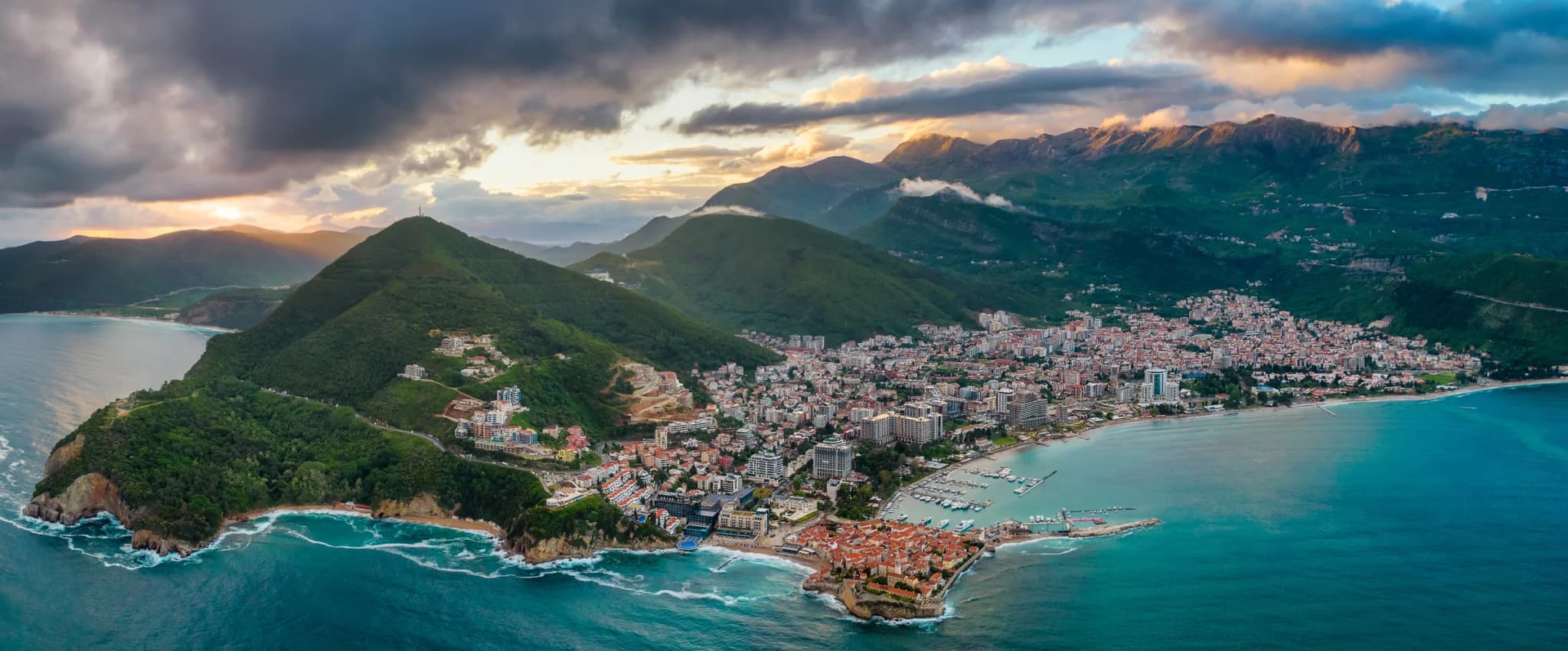
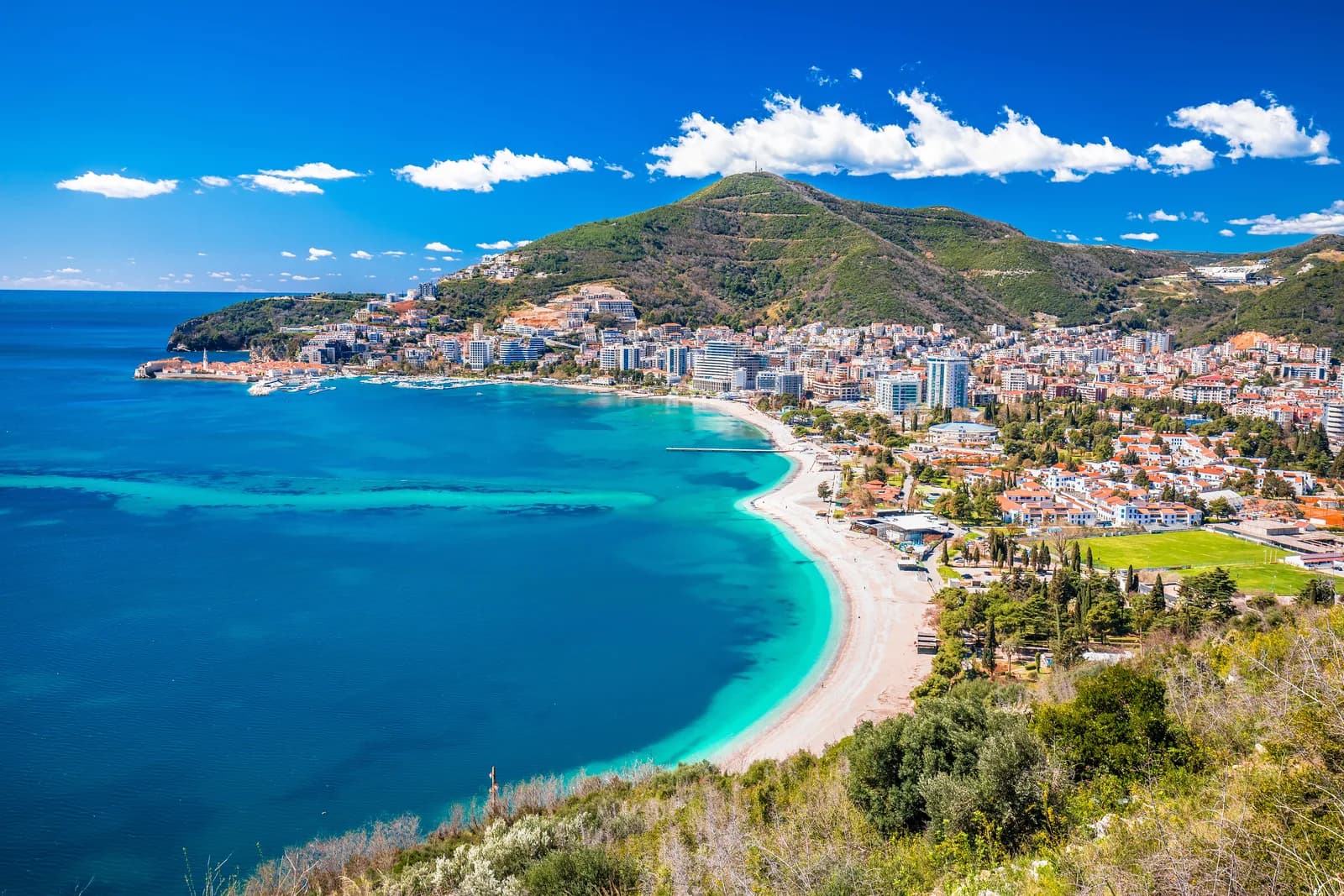
Budva is the beating heart of Montenegrin summer. Perched on a rocky peninsula that juts into the Adriatic, this ancient town — one of the oldest settlements on the entire coast, with roots stretching back 2,500 years — manages to be both a living museum and the undisputed party capital of the Ba...
20,000residents
1425first recorded
800 mof beach
Jul–Augthe busy months
Updated Originally published 51 min readby Pavle Obradović
Budva is the beating heart of Montenegrin summer. Perched on a rocky peninsula that juts into the Adriatic, this ancient town — one of the oldest settlements on the entire coast, with roots stretching back 2,500 years — manages to be both a living museum and the undisputed party capital of the Ba...
Budva is neither only a medieval postcard nor only a summer party city. Perched on a rocky peninsula that juts into the Adriatic, this ancient town — one of the oldest settlements on the entire coast, with roots stretching back 2,500 years — manages to be both a living museum and the undisputed party capital of the Balkans. By day, its honey-colored Old Town draws history lovers into a labyrinth of Venetian-era alleys and candlelit churches; by night, the waterfront transforms into a promenade of cocktail bars, open-air clubs, and street performers that keeps going until dawn.
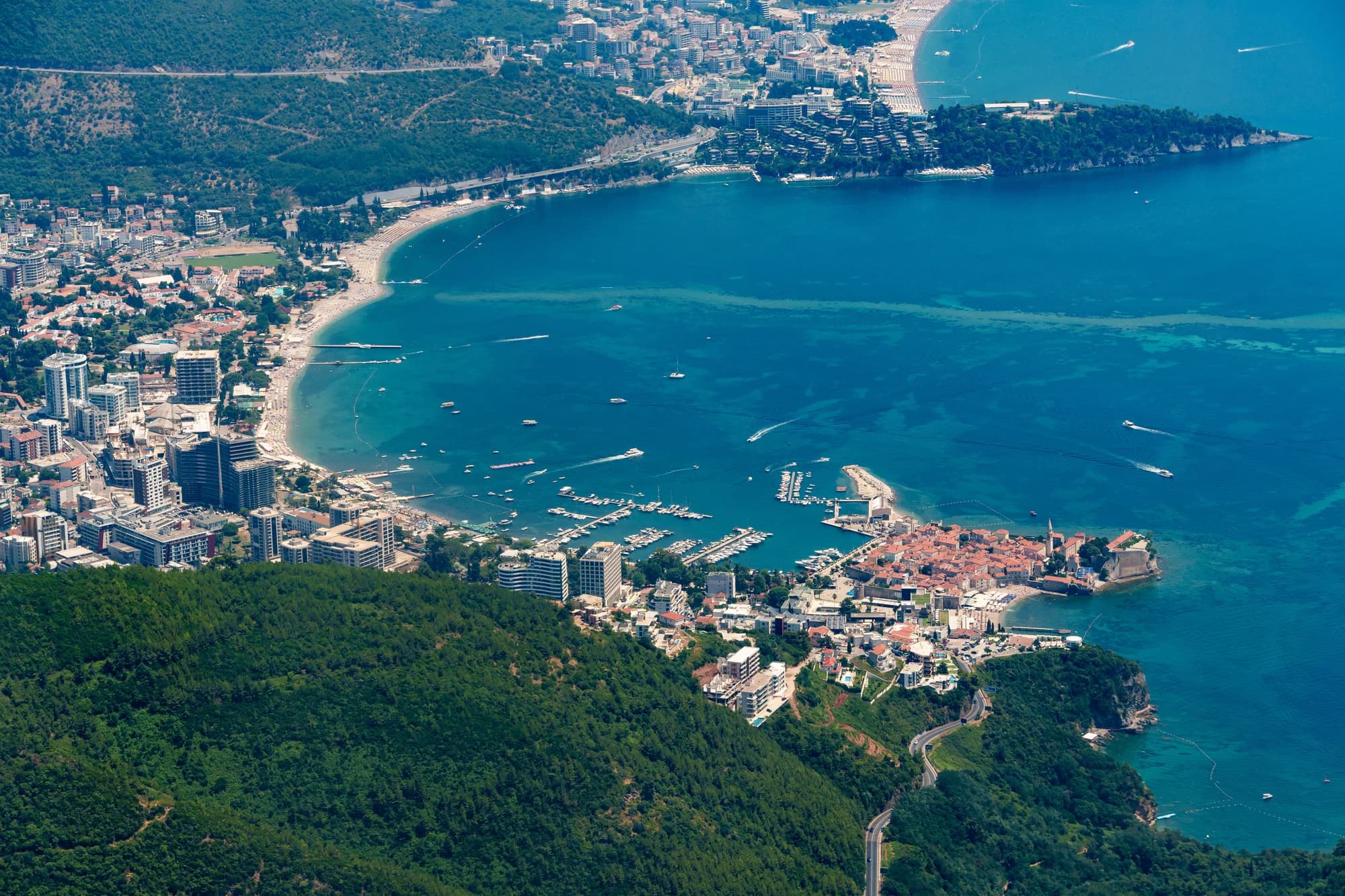
But Budva is far more than its nightlife reputation suggests. The Budva Riviera — a 35-kilometer stretch of coastline running from Jaz Beach in the north to Petrovac in the south — contains some of the finest beaches in the Mediterranean, the iconic island village of Sveti Stefan, and a handful of quiet fishing hamlets that feel a world apart from the summer buzz. Its Old Town contains evidence of more than 2,500 years of urban life, walls reshaped by Byzantines, Venetians, earthquakes and modern conservation, and museums that make the chronology visible. Outside the gates, a long urban beach, a wave-exposed path to Mogren and boat trips to Sveti Nikola require different practical decisions.
This guide separates mythology from archaeology, and permanent geography from changeable visitor information. Whether you are here for a week of beach lounging, a long weekend of cultural exploration, or a single action-packed day between Kotor and Dubrovnik, it will help you make the most of it — and it tells you plainly where the evidence is, what to verify today, and how to build a Budva visit that survives heat, waves, closures and traffic.
Budva at a Glance
Two kinds of information govern a Budva visit. The first is permanent: what a place is, and why it matters. The second changes weekly or hourly: opening times, admission prices, sea state, lifeguard duty. The table below keeps them apart.
Budva at a glance: evidence and daily checks
Place
Evidence-backed significance
Verify now
Old Town
Ancient occupation; layered fortified city
Event access and church openings
City Museum
Hellenistic, Roman and later collections
Current hours and displays
Walls
Byzantine antecedents; Venetian form
Weather, hours, admission
Citadel
Recorded in 1425; later reconstruction
Private-site entry and price
Mogren
Two beaches linked by tunnel
Wave safety on approach
Slovenska
1.6 km urban shore
Signed sector, flag, lifeguard
Sveti Nikola
Three beaches under 1 km offshore
Licensed boat, return, sea state
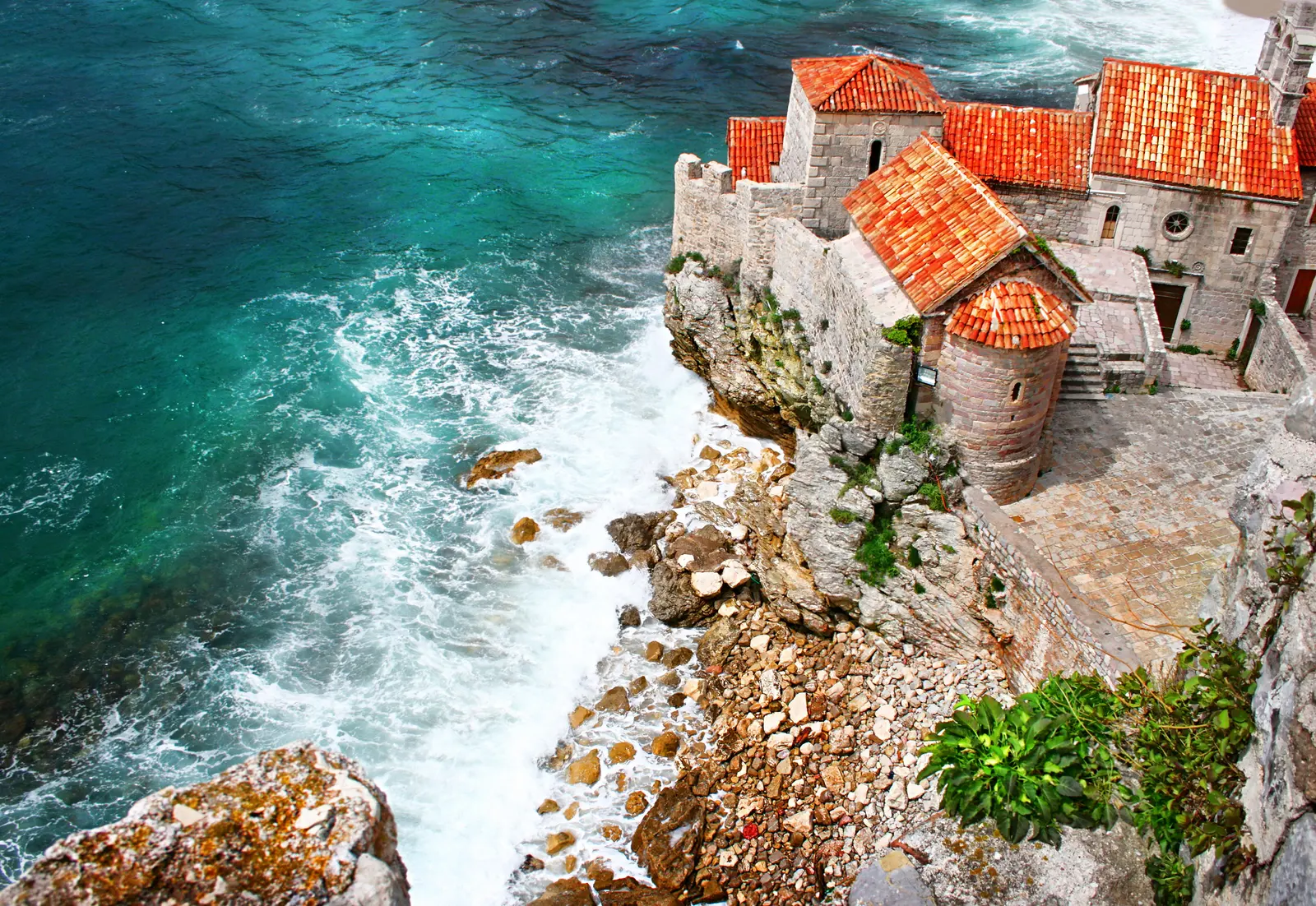
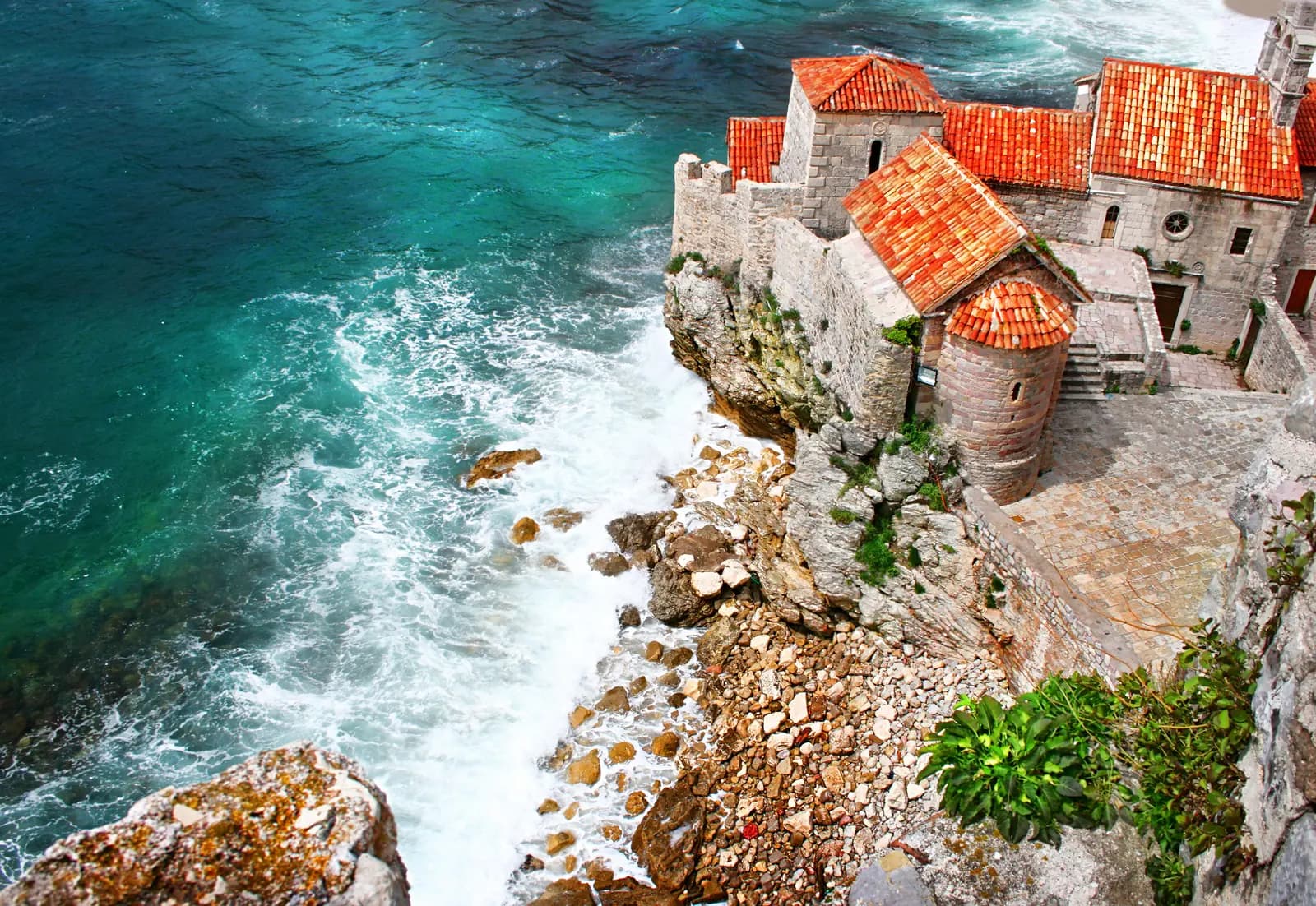
This licensed production image shows the walls meeting open water. It also illustrates why exposed coastal access must be judged from today’s waves, not a calm-weather itinerary.
Day trips
How far a day reaches
30 min
45 min
60 min
120 min
Budva Old Town: Stari Grad
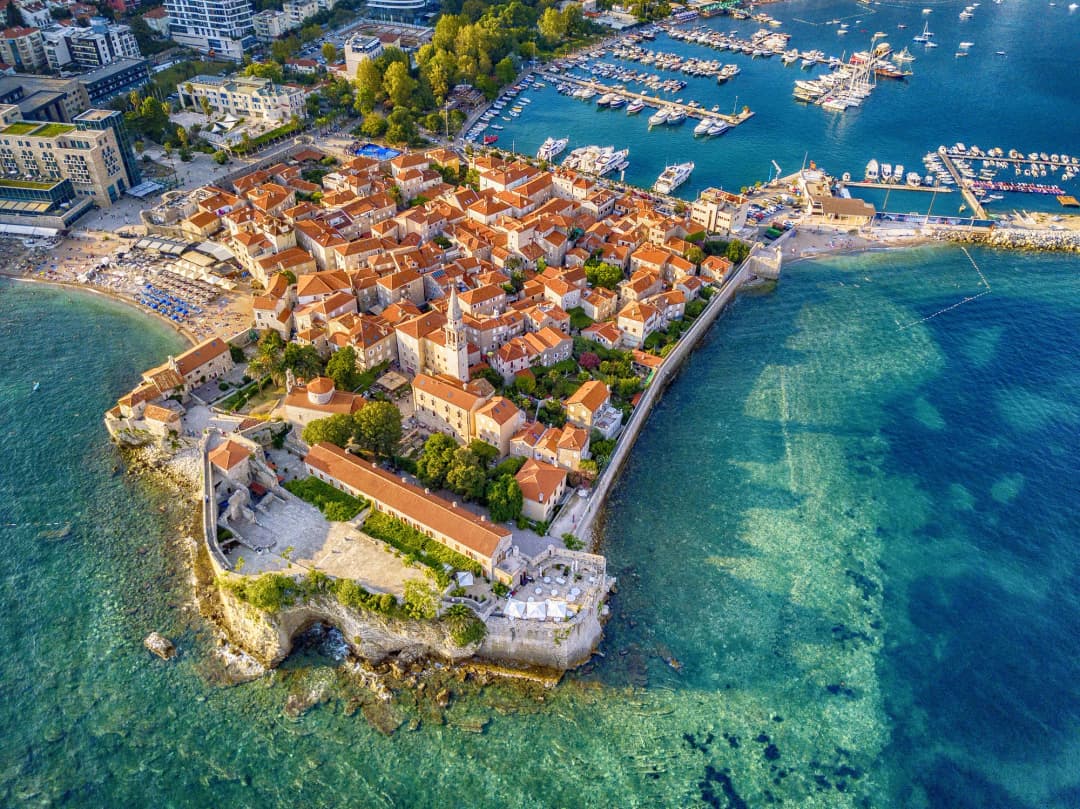
Budva's Old Town occupies a small, rocky peninsula connected to the mainland by a narrow isthmus. The entire complex is encircled by medieval walls — originally Venetian, heavily damaged in 1979, and meticulously reconstructed afterward. Despite the rebuilding, the Old Town does not feel like a replica. The stone is real, the proportions are authentic, and the atmosphere — especially early morning or late evening, when the day-trippers have departed — is genuinely evocative.
How to read the Old Town
Budva’s compact streets look coherent because reconstruction was extensive. They are not an untouched medieval time capsule. The museum’s walls history proposes early Byzantine fortifications between the sixth and ninth centuries, while the visible circuit largely reflects Venetian interventions from the fifteenth through eighteenth centuries and later Austro-Hungarian changes. Add the 1667 and 1979 earthquakes and the decade-long recovery that followed the latter, and the chronology explains why masonry from different periods can appear visually unified.
The Ministry of Culture treats the walls, bastions and Old Town as an integrated cultural property. Move through it as a living neighbourhood: keep church thresholds clear, avoid blocking narrow passages, respect private doors and use the installed bilingual interpretation rather than guessing at every stone.
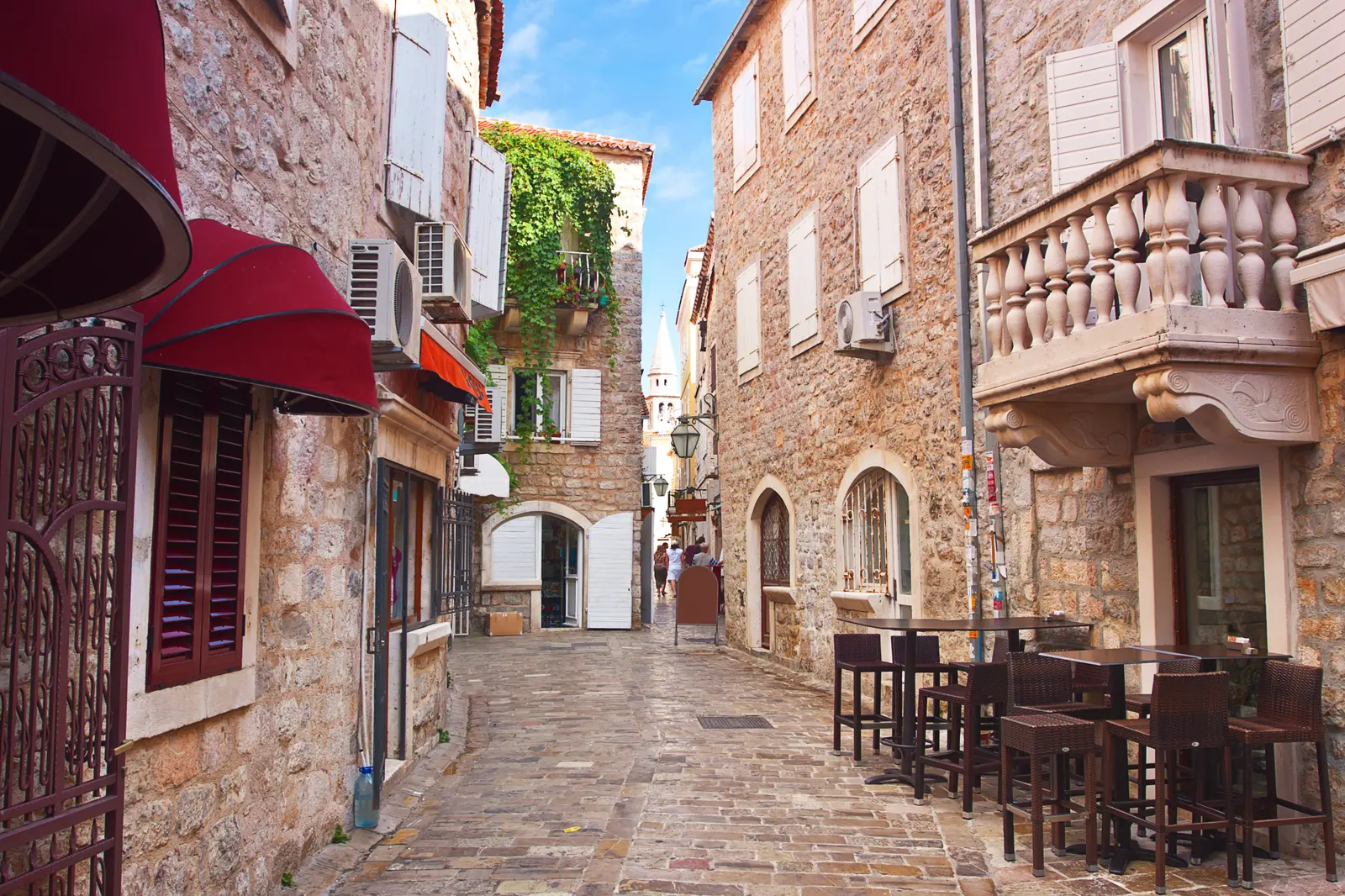
The visually verified image shows the compact pedestrian fabric inside the walls. The streets are historic, reconstructed and still actively used.
The Walls and Gates
You can walk a portion of the Old Town walls, accessing them from several points including near the Citadela. The circuit is short but atmospheric, offering elevated views over the terracotta rooftops and down into the lanes below. The walls are most impressive on the seaward side, where they drop directly to the rocky shoreline, and they offer the most direct reading of Budva’s geography.
As checked on 30 August 2026, the official walls page listed daily opening from 10:00 to 20:00 between April and November and €2 admission including a history brochure. Reconfirm before visiting: rain, wind, maintenance and events can override a published schedule.
Expect uneven stone, steps, exposed edges and limited shade. The route is not a casual choice for every mobility level or in every weather. Do not sit on barriers, climb beyond the public line or lean equipment over other visitors. If the walls are closed, the street circuit and museum remain a complete historical visit.
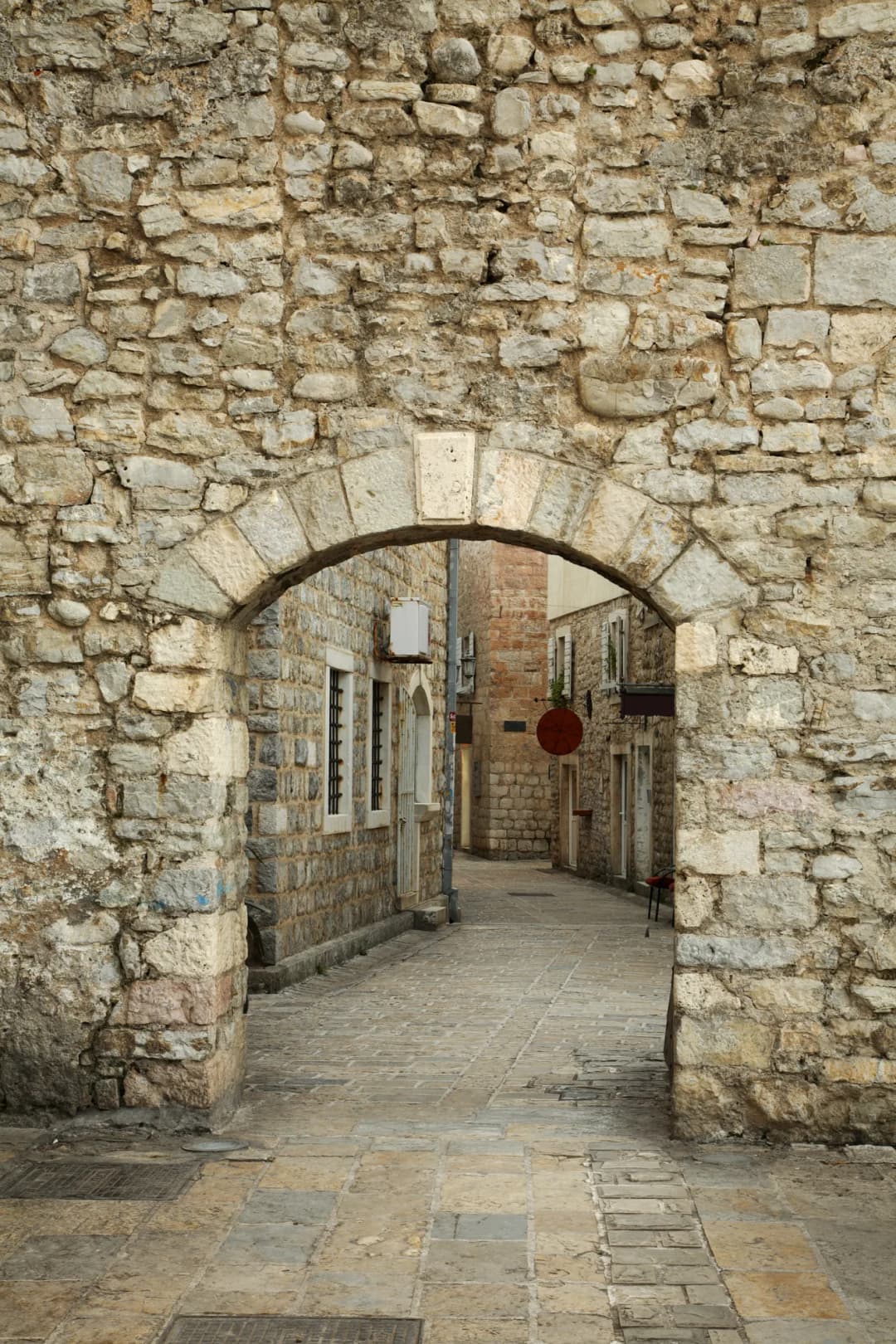
The main entrance to the Old Town is through a large gate on the landward (east) side, opening onto a small square that serves as the primary gathering point and orientation landmark. A second entrance, the Mogren Gate, pierces the western wall and leads directly out to a narrow coastal path that connects to Mogren Beach — one of the most pleasant short walks in Budva.
A gate through the wall. The entrances are the only breaks in the circuit — the main one on the landward side, the Mogren Gate through the western wall.
The Citadela
The fortress at the peninsula's southern tip is Budva's most prominent landmark. Built by the Venetians and reinforced over subsequent centuries, the Citadela served as a final defensive refuge and a command post overlooking both the open sea and the town harbor. It is first mentioned in 1425 and was substantially altered in the nineteenth century, when the former Santa Maria de Castello church was demolished and a garrison occupied the fort.
Today it houses a modest museum and a small library, but the real draw is the rooftop terrace, which offers panoramic views over the Old Town rooftops, Sveti Nikola island, and the coastline stretching south toward Sveti Stefan. There is also an open-air stage within the fortress walls that hosts performances during the summer festival season.
On admission, be careful: the Citadel is a separate, privately owned complex with museum and hospitality uses. Older accounts describe admission of a few euros, well worth it for the views alone, but no dependable current official hours or admission price were found in this review. Verify at its entrance rather than assuming the walls ticket covers it.
On the Citadela's outer wall, look for the small stone relief of two intertwined fish — a symbol of Budva that has become the town's unofficial emblem. Local legend holds that the fish represent two lovers who were forbidden from being together and threw themselves into the sea, transforming into fish so they could swim side by side forever.
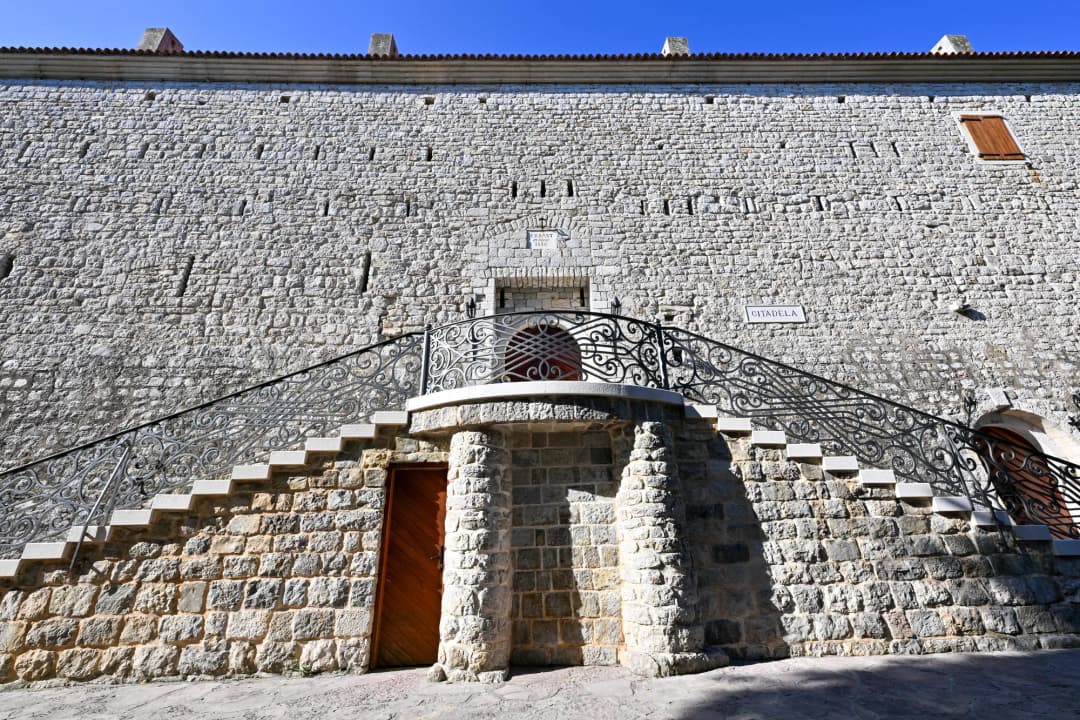
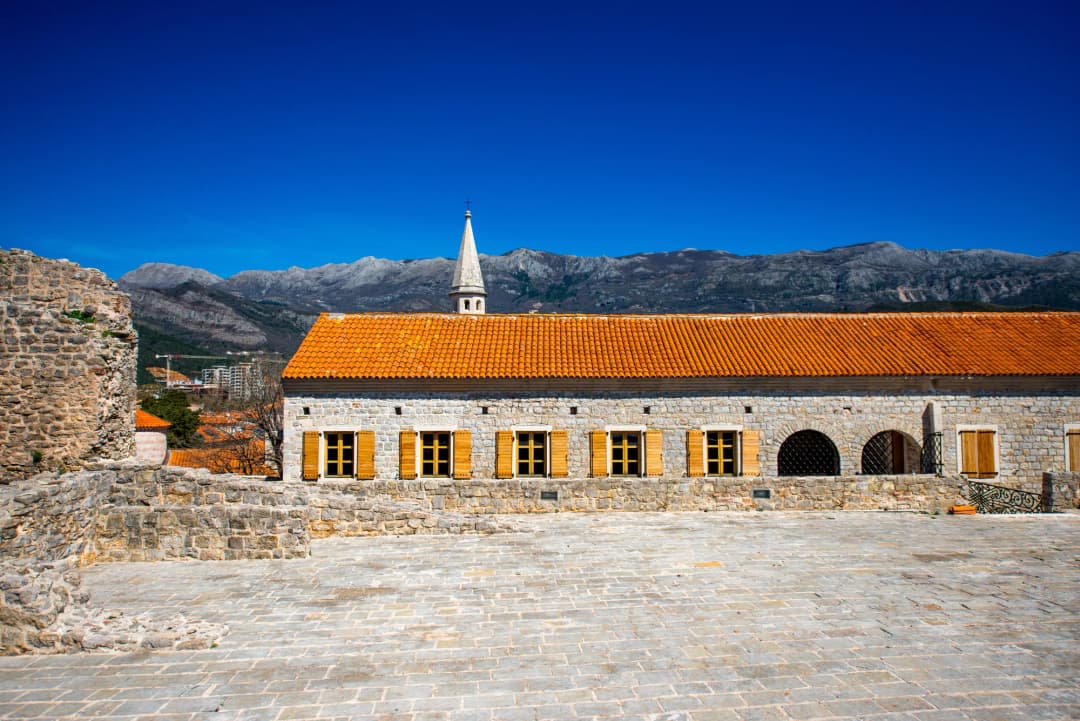
The entrance front. The ornamental double staircase and ironwork belong to the fort's later remodelling rather than its Venetian core.
Churches of the Old Town
For such a small area, the Old Town contains a remarkable concentration of religious buildings, reflecting centuries of coexistence between Catholic and Orthodox traditions. The church group compresses another millennium of the city's history. Budva Museums dates the early Christian basilica to the end of the fifth century, with a floor mosaic from the late fifth or early sixth century. St John has origins associated with the seventh century, Santa Maria in Punta with 840, St Sava with the twelfth century and Holy Trinity with 1804. An origin date never means every visible surface survives unchanged from that year.
Church of the Holy Trinity (Crkva Svete Trojice) — The Orthodox church just inside the main gate is immediately recognizable by its distinctive striped facade of alternating bands of red and white stone. Built in 1804, it stands directly opposite the older Catholic Church of St. Ivan, and the two buildings facing each other across the tiny square is one of Budva's most photographed scenes. Inside, the Holy Trinity church houses a fine iconostasis and several notable icons.
Church of St. Ivan (Crkva Svetog Ivana) — The Catholic cathedral dominates the Old Town skyline with its bell tower, the tallest structure on the peninsula. The church dates to the 7th century in its earliest form, though what you see today is primarily from later medieval reconstructions. The adjoining bishop's palace was once an important ecclesiastical center for the region.
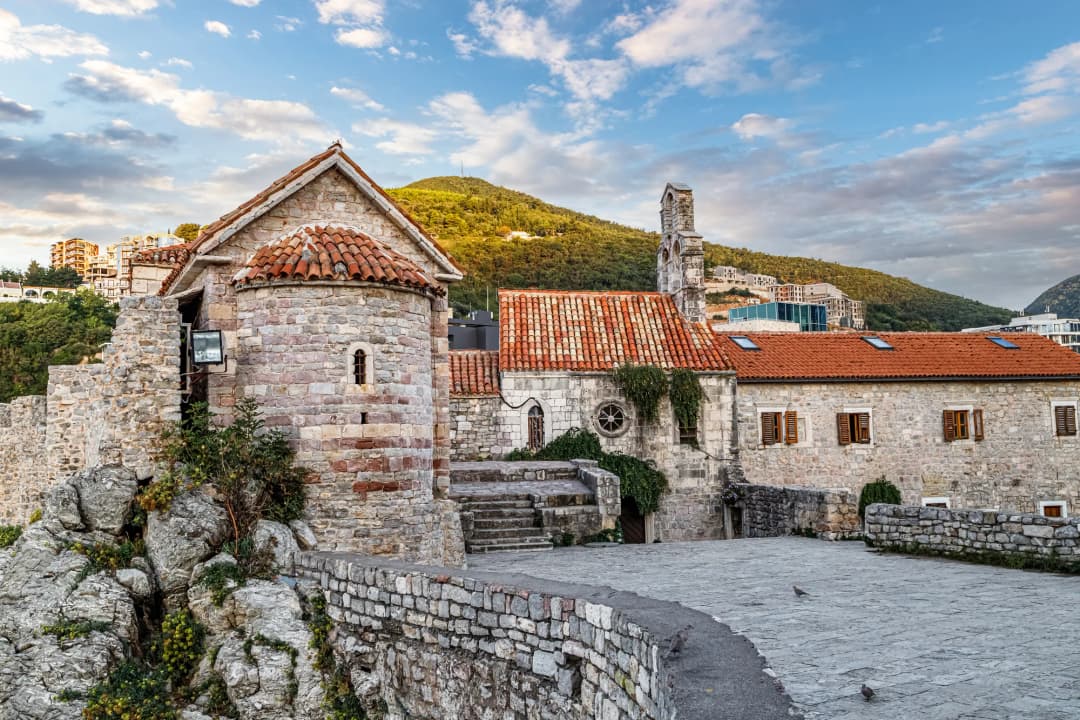
Church of Santa Maria in Punta — The oldest surviving church in Budva, dating to 840 AD. This tiny Benedictine chapel sits near the Citadela at the very tip of the peninsula. It no longer holds regular services but is occasionally used for concerts and exhibitions, its exceptional acoustics making it a memorable performance venue.
Five churches spanning fourteen centuries stand within a few hundred metres of one another here.
Library Square and the City Museum
Trg Pjesnika (Poets' Square), sometimes called Library Square, is the Old Town's most intimate plaza — a pocket-sized space surrounded by stone buildings with a few cafe tables and an almost village-like sense of enclosure. It is named for the small municipal library that overlooks it, and on summer evenings it occasionally hosts poetry readings and small musical performances.
If one paid indoor stop matters most, choose the Budva City Museum (Gradski Muzej), housed in a restored building near the Citadela. Its public description places archaeology on the first three levels and later cultural history on the fourth across more than 400 m², and the collection includes material from the Hellenistic, Roman, late-antique and later city. The museum covers the town's archaeological and cultural history from Illyrian and Greek times through the Venetian period to the 1979 earthquake and reconstruction. The collection is modest but well-curated, and the Roman-era jewelry and ceramics offer tangible evidence of just how old this settlement really is. Allow about 45 minutes for a visit.
The public visitor page was protected by a verification screen during this review, though its most recently checked listing remained available in the research record. Do not rely on copied hours from an old guide. Use the museum’s current visitor page or call its listed contact before setting out, especially if a particular floor or object is essential.
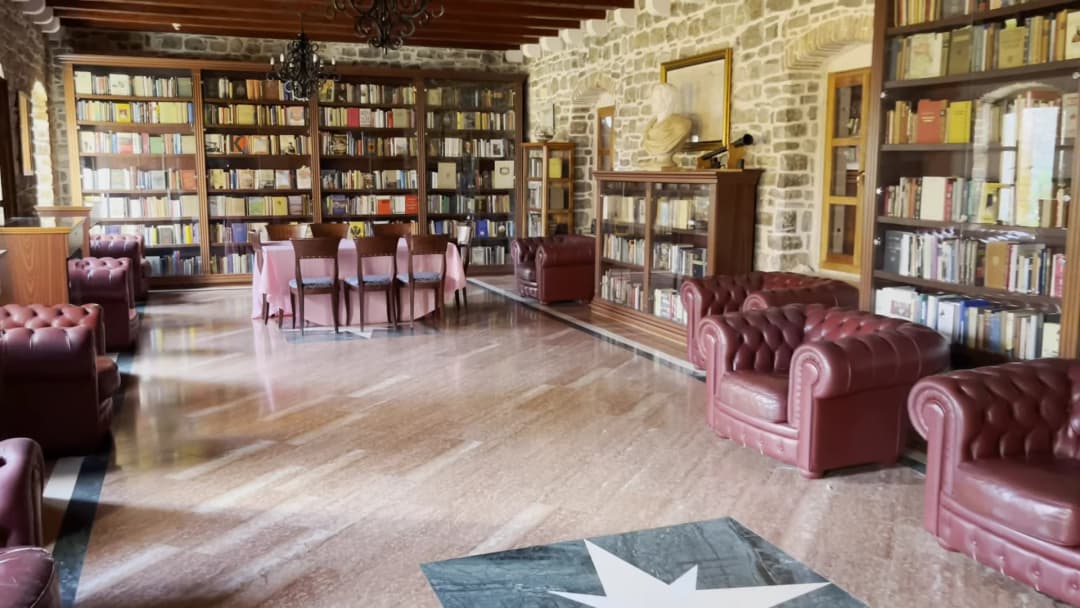
Inside the municipal library that gives the square its second name. Trg Pjesnika, the small plaza it overlooks, takes its own name from the poets.
The best sequence
A sensible sequence is museum first, streets second, walls last. The objects supply dates and context; the lanes and fortifications then become evidence rather than scenery. Treat the Citadel as a fourth and separate access decision. For a longer narrative, use our complete Budva guide.
Four stops, one coherent reading
Stop
What you see
Note
1 · MUSEUM
Objects + dates
Four levels
2 · STREETS
Gates + signs
Living city
3 · WALLS
Layers + view
Weather check
4 · CITADEL
Separate entry
Verify at door
If closed
Keep the sequence, skip the interior
Never bypass a barrier or treat a private door as public access
Source: muzejiigalerijebd.me, budva.travel
Best Beaches in and Around Budva
Budva's coastline is its greatest asset, and the beaches here are among the best in Montenegro. They range from bustling town beaches with full infrastructure to secluded coves accessible only by foot or boat. Choose by observable conditions rather than reputation: locate the signed organized sector, read today's flag and lifeguard duty, and treat a famous name as no guarantee of safe access on the day you arrive.
Mogren I and Mogren II
What the sources say
The Mogren beaches are Budva's finest and most iconic — two small crescent beaches beneath dramatic limestone cliffs, connected to each other by a short tunnel carved through the rock. They are reached via a scenic coastal footpath that begins at the Mogren Gate on the western wall of the Old Town: about a 10-minute walk along a cliffside path with intermittent Adriatic views. Budva Tourism lists the concrete approach from the Hotel Avala side at 350 m; that is a path figure, not the combined length of the two beaches, and it does not establish current usable area, supervision or services.
Mogren I is the first beach you reach — a beautiful arc of fine sand and pebble backed by cliffs, with sunbed rentals and a small beach bar. Mogren II is slightly smaller and often less crowded. The water at both beaches is remarkably clear, with a turquoise color that rivals anything in Greece or Croatia. Sunbed rental runs about EUR 10-15 for a pair with an umbrella. Arrive early in summer, as the beaches are small and fill up quickly.
The access is the catch. Budva Tourism describes the concrete approach from the Old Town side and explicitly warns that it is unsafe during southerly wind and strong waves. That warning should end the debate: if waves reach the path or barriers close it, choose another beach. Read the organized-sector board and flag on arrival. The full Mogren guide covers the approach and fallbacks.
The path to Mogren is an attraction in itself. Along the way, you pass the bronze statue of a dancer (Plesačica or "Ballerina"), poised on a rock above the waves — another Budva symbol and a relentlessly popular photo spot. The Budva ballerina story separates public art from the legends attached to it.
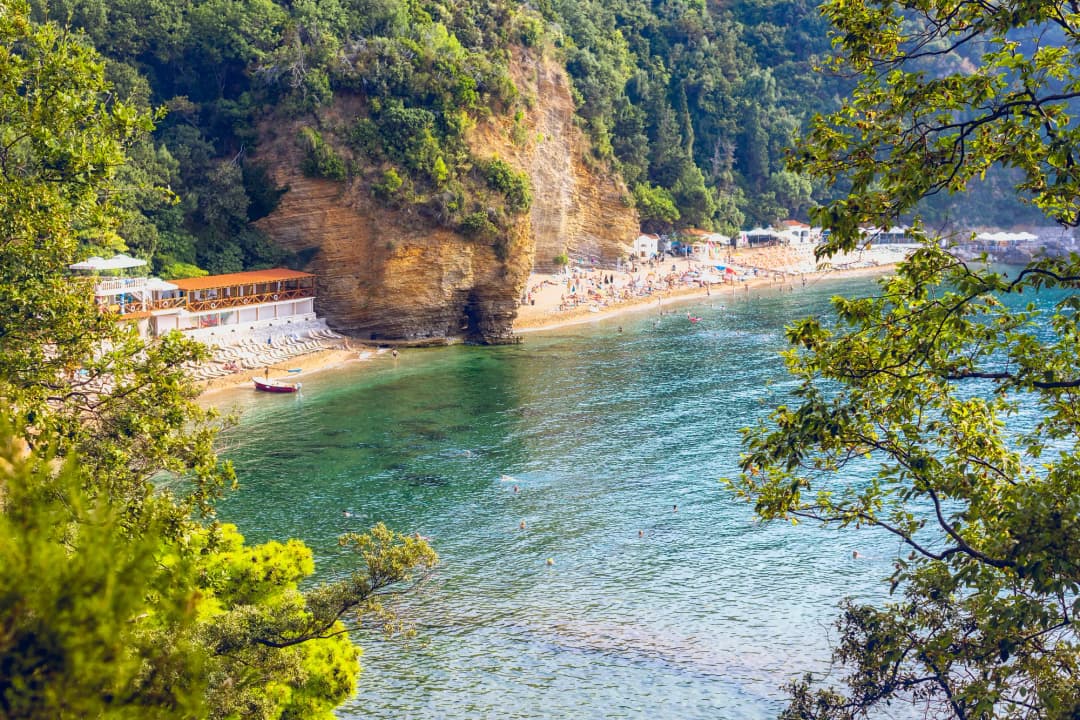
The two Mogren beaches, divided by the headland the path tunnels through. Mogren II, nearer the camera, is the smaller of the pair.
Slovenska Plaža (Slovenska Beach)
What the sources say
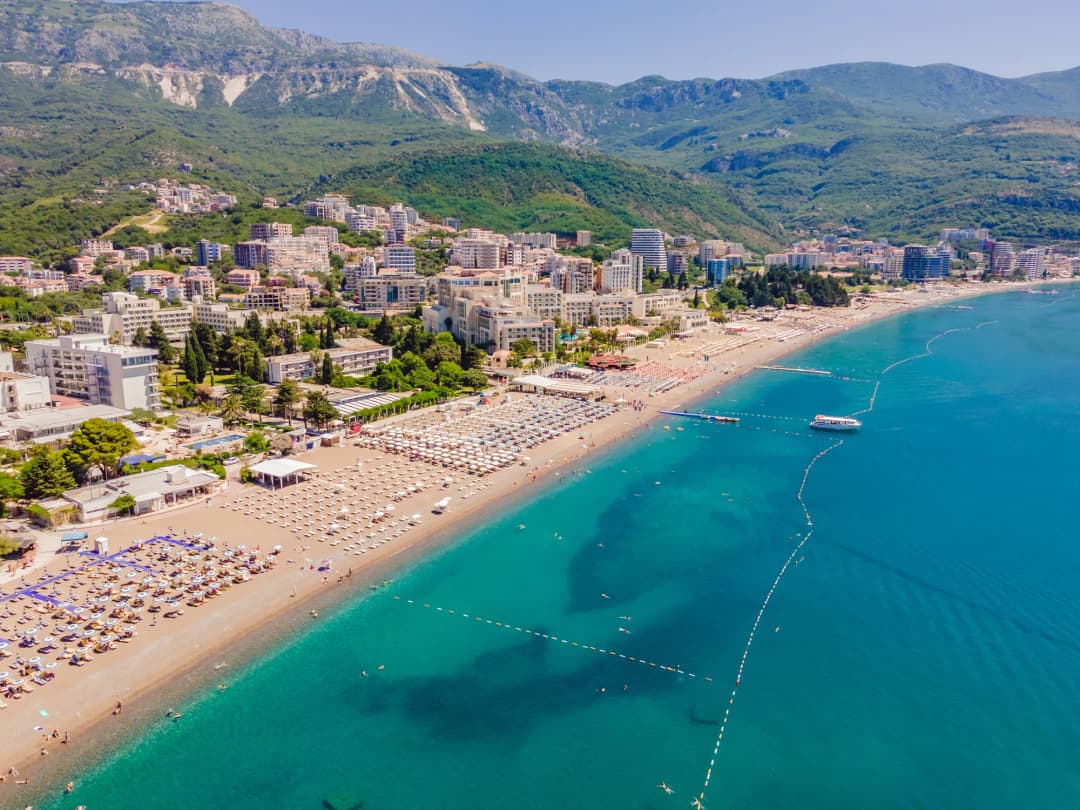
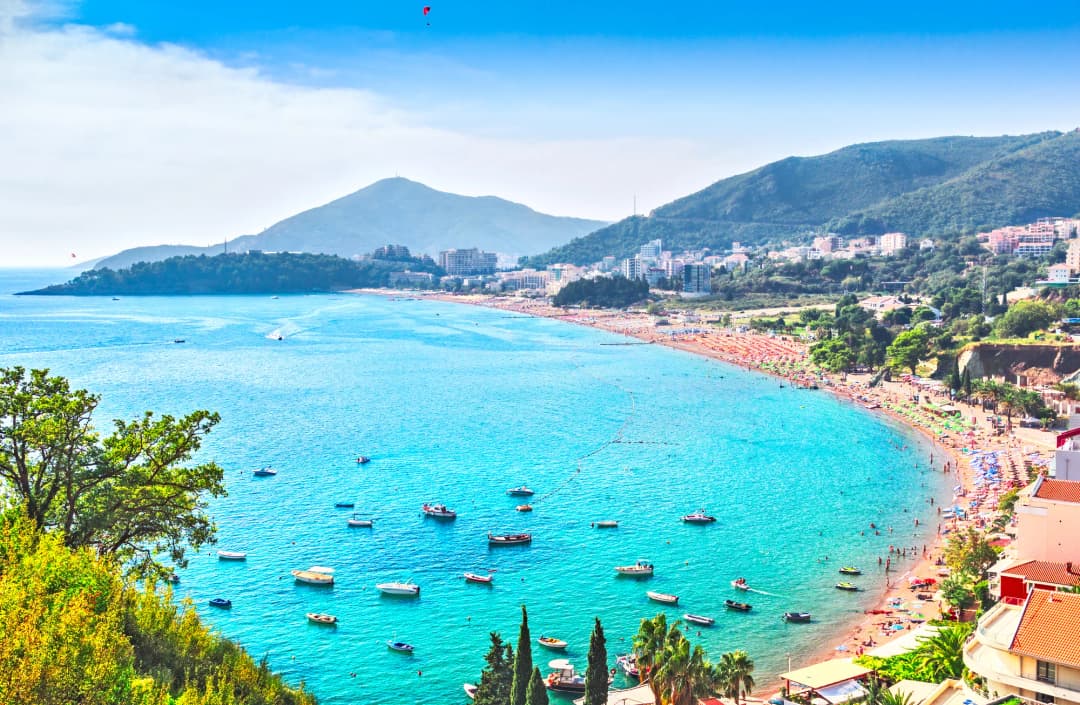
Budva's main town beach stretches for nearly two kilometers along the bay east of the Old Town, running parallel to the Slovenska Obala promenade, from the city harbour toward the Park area. Budva Tourism lists it more precisely at 1,600 m and 24,800 m², with pebble and intermittent sand, divided among multiple managed bathing units. It is not one identical beach experience.
It is the most accessible and most popular beach in Budva — and on a peak July afternoon, it can feel like half of southeastern Europe has had the same idea. That said, Slovenska Plaža has its merits: the infrastructure is excellent (showers, changing facilities, dozens of beach bars, restaurants steps away), the water is clean, and the gentle slope makes it suitable for families with small children. Some sections are free, others are operated by beach clubs that rent sunbeds. If you are looking for convenience over seclusion, this is your beach.
Choose a signed sector based on today’s flag, lifeguard duty, accessibility and services. If one section is crowded or unsuitable, do not assume the next is equivalent; read its own board. Carry footwear for mixed surfaces and never let commercial activity substitute for water-safety checks.
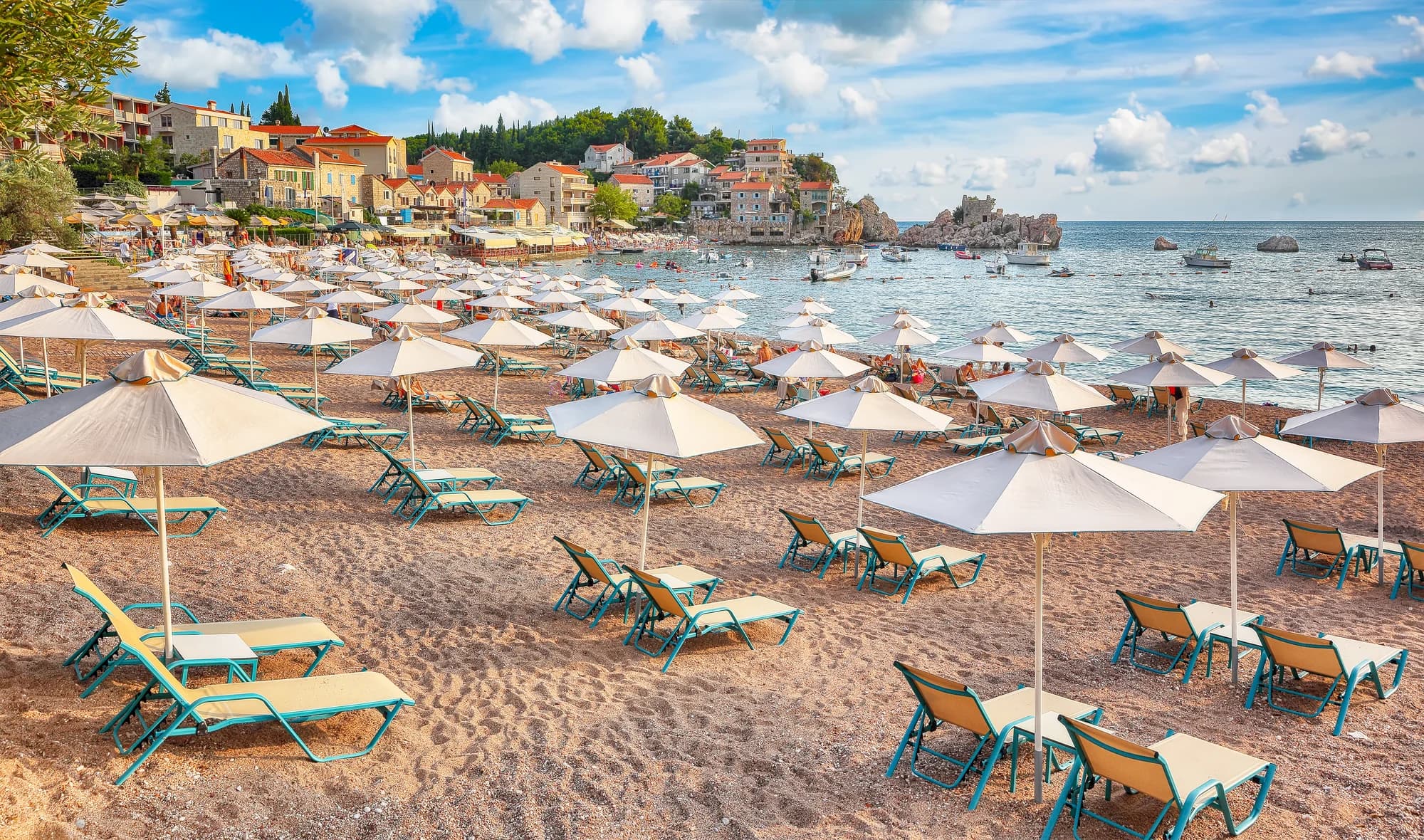
This licensed Budva-coast image illustrates an organized bathing setting; it does not identify today’s flag, lifeguard hours or a specific beach sector.
Jaz Beach
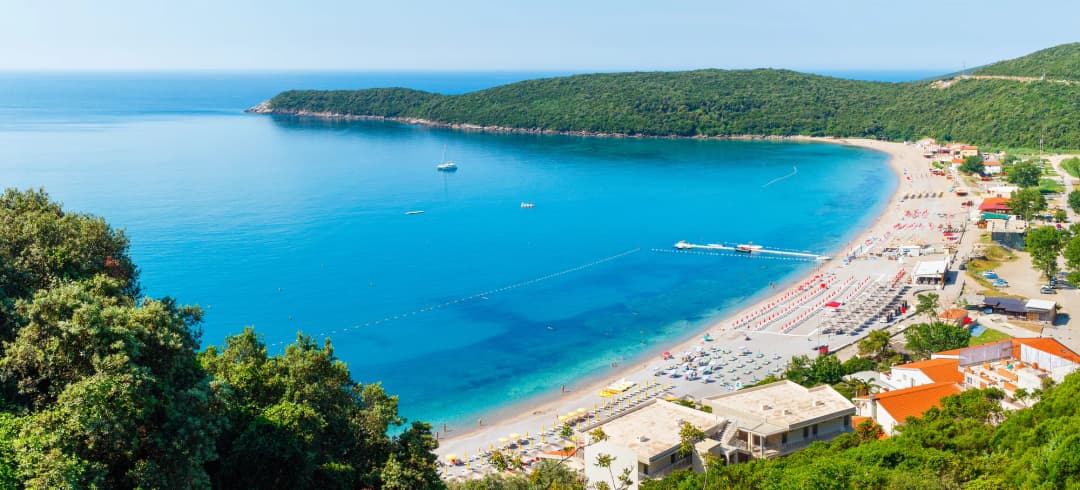
Five kilometers northwest of Budva, past a tunnel through the coastal hills, Jaz is one of Montenegro's most celebrated beaches — a broad, 1.2-kilometer stretch of mixed sand and fine pebble that faces the open Adriatic. The beach is divided into two sections: a larger public area and a smaller, more sheltered cove to the east.
Jaz has hosted major music events over the years, including concerts that drew tens of thousands and cemented its reputation as more than just a beach; it is also the home of the Sea Dance Festival. Even on ordinary days, the atmosphere here is more relaxed and spacious than at the town beaches, simply because of Jaz's generous proportions. There is parking above the beach (EUR 3-5 per day in summer), several beach bars, and sunbed rentals. The water deepens gradually, making it good for families.
Budva Tourism describes Jaz as two stretches, one of about 800 metres and one of about 400 metres, with a combined bathing area of 22,500 m².
Jaz from the road above. The 1.2-kilometre sweep is why it stays more spacious than the town beaches.
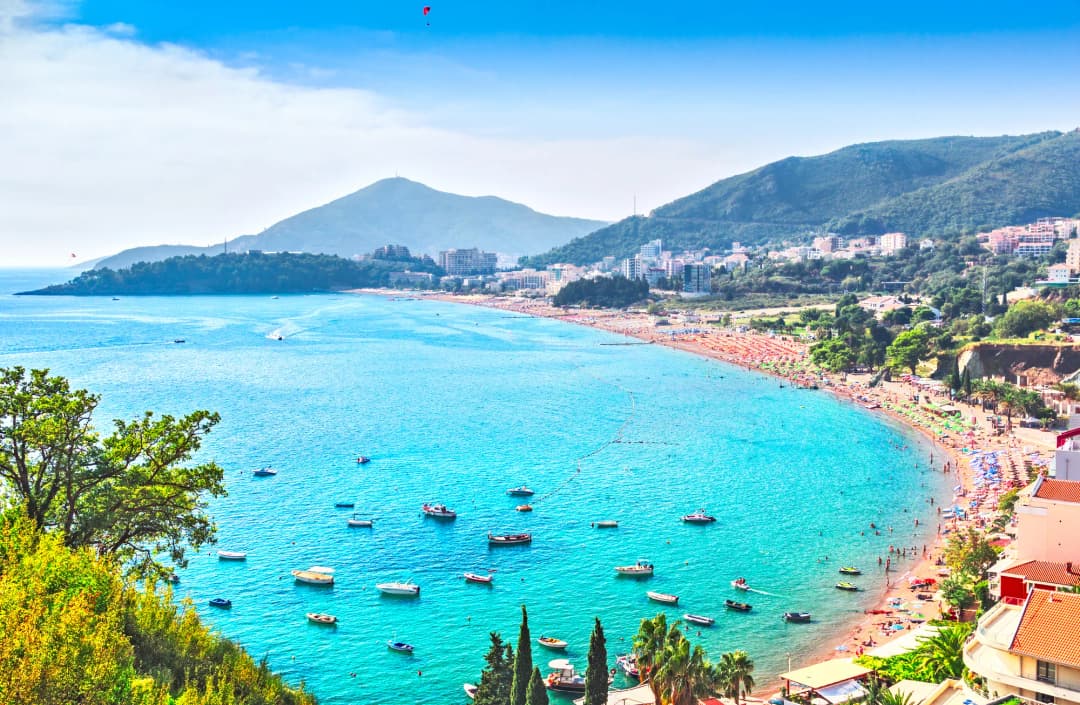
Technically a separate settlement about two kilometers south of Budva, Bečići is home to a long, gently curving beach that was once voted among the most beautiful in Europe. The sand here is finer than at most Montenegrin beaches, the water is clean and calm, and the setting — backed by hotels and the green slopes of the coastal hills — is undeniably attractive.
Bečići has developed into a resort area in its own right, with large hotels, restaurants, and a promenade that connects to Budva via a pleasant seaside walk (or a short drive through a tunnel). If you want a beach holiday with good infrastructure but slightly less intensity than central Budva, Bečići is an excellent choice.
Budva Tourism puts the beach at around 2,000 metres, which makes it one of the longest on this stretch of coast.
Bečići and Rafailovići share one bay: the 2,000-metre sweep Budva Tourism describes runs almost unbroken between them.
Kamenovo
Hidden between Bečići and Pržno, Kamenovo is one of the coast's best-kept secrets — though the secret has been getting out in recent years. This small beach sits at the bottom of a steep access road (or a footpath from the main highway), sheltered by rocky outcrops on either side. The sand is coarse, the water is exceptionally clear, and the handful of beach bars maintain a relaxed, bohemian atmosphere that feels removed from the Budva bustle. Kamenovo is where many locals go when they want a proper beach day without the crowds.
Richard's Head (Ričardova Glava)
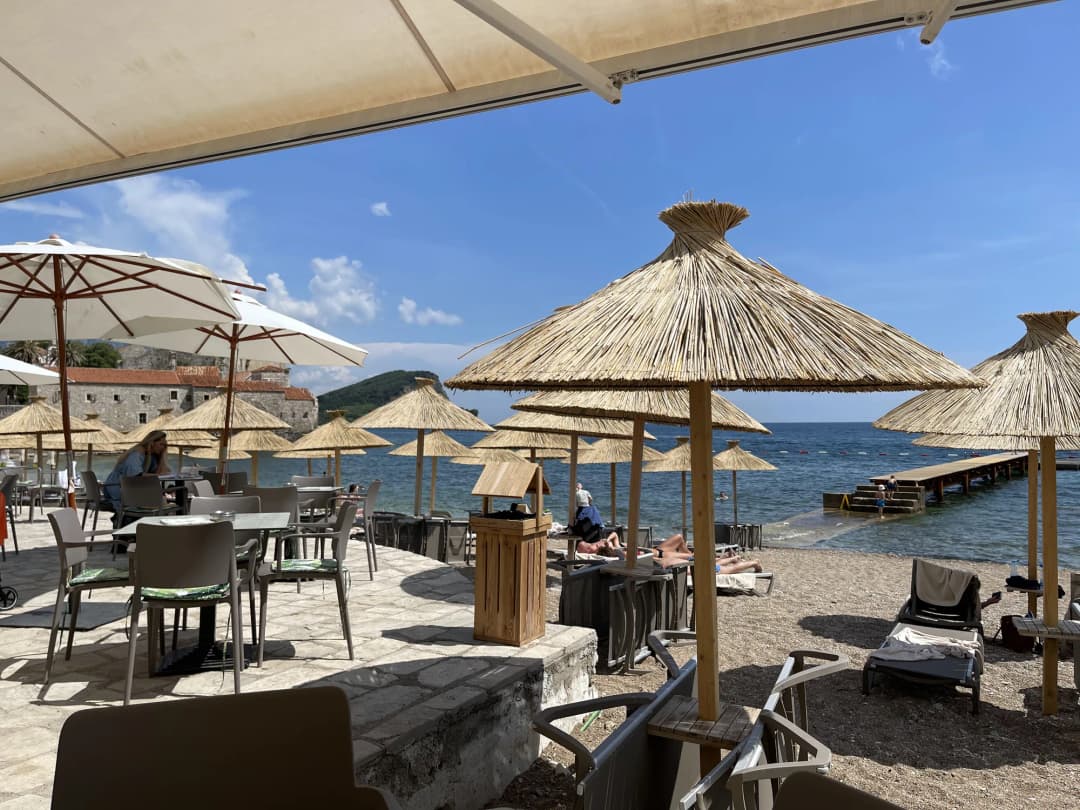
This tiny beach sits directly beneath the walls of the Old Town, tucked between the rocks on the southern side of the peninsula. It takes its unusual name from a local legend (or, depending on whom you ask, from American actor Richard Widmark, who reportedly favored the spot during filming in the area in the 1960s). The beach is minuscule — barely 50 meters long — but its setting is extraordinary: ancient walls rising directly above, clear water lapping at the rocks, and Sveti Nikola island framed in the distance. It is also one of the few beaches you can reach on foot from the heart of the Old Town in under two minutes.
Ričardova Glava at eye level. Fifty metres of sand, a bar terrace and a jetty, with the Old Town wall rising just out of frame to the left.
Pržno
A small fishing village about six kilometers south of Budva, Pržno has a tiny but charming beach framed by traditional stone houses and a handful of excellent seafood restaurants. The village retains a quieter, more authentic character than Budva proper, and its beach — while small — is pretty and well-maintained. Pržno also serves as one of the viewpoints for Sveti Stefan, visible on its promontory just to the south.
Sveti Nikola Island
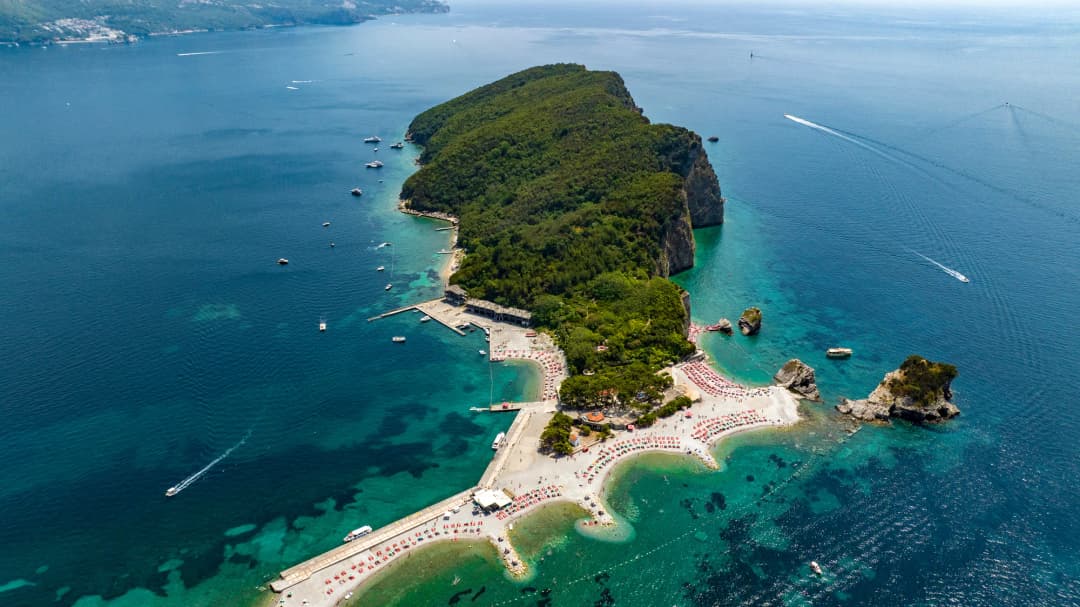
Sveti Nikola — nicknamed "Hawaii" by locals — is the large, undeveloped island visible from Budva's waterfront. It lies under 1 km offshore and has three beaches according to Budva Tourism. Small boats serve its main landing, while some southern coves are reachable only by boat. None of that makes the island swimmable from town for a general visitor.
In summer, water taxis shuttle visitors between Budva's waterfront and the island's beach — a rocky stretch with clear water and minimal facilities — for roughly EUR 3-5 round trip. It is a pleasant half-day escape from the mainland bustle and one of the cheapest beach days on the Riviera, since the island is typically less crowded than the mainland beaches. There are a couple of basic beach bars but no hotels or permanent structures. Bring water, sunscreen, and a towel — shade is limited.
Choose a licensed operator and confirm departure point, exact landing, return time, cancellation policy, lifejackets and sea-state decision. Ask whether boarding or landing requires stepping through water. Do not accept a one-way promise without a clear return arrangement.
On land, stay on established routes and away from cliff edges. The island’s vegetation and animal claims have been repeated widely, but they are not a promise of sightings. Pack out waste and do not feed wildlife. Our responsible Sveti Nikola day-trip guide gives the operator checklist.
Choose by observable conditions, not reputation
Option
First check
Second check
Before any beach
Check weather, waves and current notices
Unsafe or closed → choose a land-based alternative
Sveti Nikola from above: the beaches sit on the low sandbar at the island's landward end, a short boat ride from the town.
The Budva Riviera
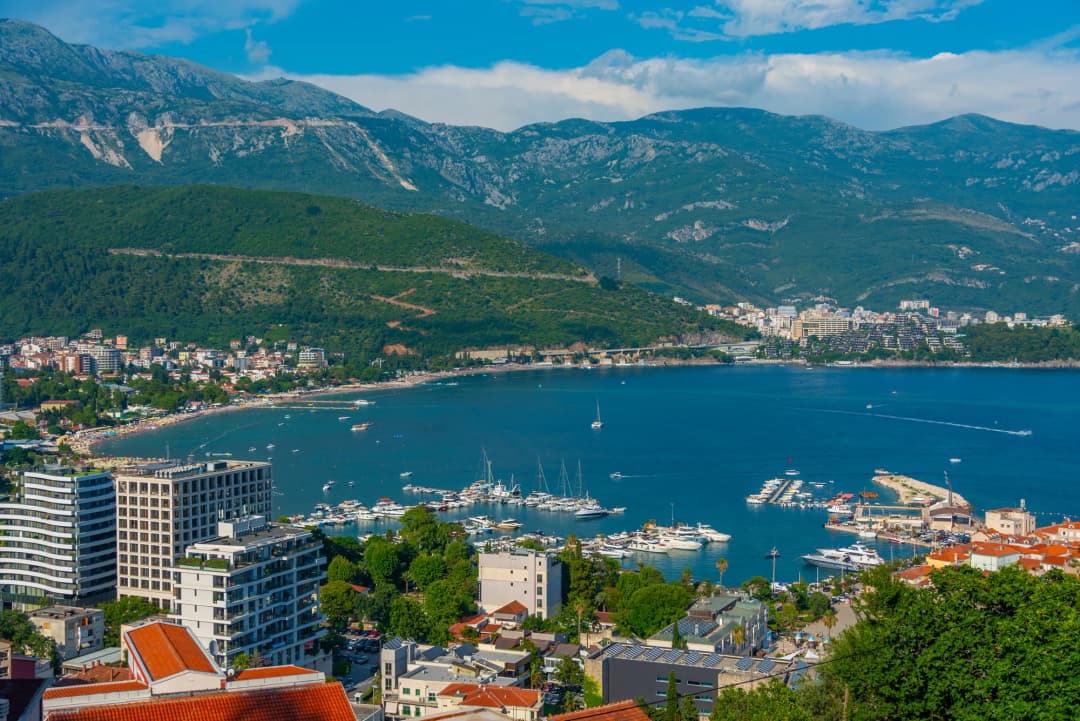
The term "Budva Riviera" refers to the entire coastal stretch from Jaz Beach in the northwest to Petrovac in the southeast — roughly 35 kilometers of coastline encompassing Budva, Bečići, Rafailovići, Pržno, Sveti Stefan, Miločer, Reževići, and Petrovac. It is Montenegro's most developed and most visited stretch of coast, and for good reason: the combination of beaches, historic sites, dramatic scenery, and tourist infrastructure is unmatched anywhere else in the country.
Driving the Budva Riviera from end to end takes about 40 minutes without stops, but you could easily spend a week exploring it properly. Each settlement has its own character. Rafailovići, wedged between Bečići and Kamenovo, is a small beachfront village that feels like a quieter annex of Budva's resort strip. Miločer, just north of Sveti Stefan, has a park and former royal beach that is among the most beautiful on the coast. Reževići is home to a medieval monastery perched above the sea. And Petrovac, at the southern end, is a family-friendly town with two beaches, a Venetian fortress, and a pace of life noticeably slower than Budva's.
The undisputed visual highlight of the Riviera is the view of Sveti Stefan — the fortified island village connected to the mainland by a narrow causeway, now operated as an exclusive resort. Even if you cannot access the island itself (it is reserved for hotel guests), the view from the roadside lookout above is one of Montenegro's most iconic images and an essential photo stop for anyone driving the coast.
Nature and Activities
Diving
Budva is home to Montenegro’s premier diving operations. The Budva Diving Center holds the distinction of being Montenegro’s only PADI 5-Star Dive Center, staffed by an international team of PADI-certified instructors with experience from dive sites around the world [19].
Over 10 exceptional dive sites are accessible from Budva, featuring shipwrecks, dramatic reef formations, and hidden caverns teeming with marine life. Available programs range from introductory experiences for beginners to advanced wreck, cave, and night dives for experienced divers. Peak diving season runs from June through September, when water temperatures are warmest and marine life is most active [19].
Boat Trips
The Budva marina serves as a departure point for a variety of boat excursions. Whichever you choose, use a licensed operator, wear provided safety equipment and confirm the return departure before you board:
Budva Riviera sightseeing tours: 2-hour guided cruises past St. Nikola Island, Sveti Stefan, Milocer Park, Przno, Kamenovo, and Becici, with swimming stops in the Adriatic
Island visits: Regular boats to St. Nikola Island (“Hawaii”) for beach days
Bay of Kotor excursions: Full-day trips to the UNESCO-listed Bay of Kotor
Sunset and evening cruises: Available throughout the summer season [6][19]
Hiking
While Budva itself is primarily a beach destination, several hiking options are accessible:
Coastal path walks between beaches along the Riviera
Trails in the hills above Budva with panoramic sea views
Durmitor National Park trails, including the popular 4 km circuit around Black Lake (day trip) [24]
Nightlife and Entertainment
Budva is, without question, the nightlife capital of Montenegro — and increasingly, of the broader Adriatic region — with options ranging from atmospheric Old Town wine bars to massive open-air clubs [13][23]. In July and August, the town operates on a schedule that would confuse most of northern Europe: dinner at 9 or 10pm, drinks from midnight, clubs from 1am, and the last stragglers heading home at dawn. If that sounds exhausting, rest assured that Budva also caters to those who prefer a cocktail at sunset and an early night.
Top Hill
The crown jewel of Budva nightlife and the town's flagship venue, Top Hill is an open-air mega-club perched atop Toplis Hill, approximately 8 minutes’ drive north of the Old Town, with panoramic views over Budva, the coastline and Sveti Nikola island. The setup is sophisticated: 16 RGB 2W lasers, a 120 KW Martin sound system, multiple bars (including vodka and wine bars), a jacuzzi, shisha bar, VIP area, and a massive dancefloor. It regularly books international DJs and performers, drawing crowds of 3,000 or more on peak nights. The production values — sound, lighting, VIP areas — rival anything in Ibiza or Mykonos, but at a fraction of the cost.
Top Hill operates primarily from June through September. Cover charges vary depending on the night and the headliner (EUR 10-30), and table reservations with bottle service are popular with groups. Drinks run EUR 6-12 for cocktails. The club runs shuttle buses from the Budva waterfront, or you can take a taxi (EUR 5-8). Love it or loathe it, Top Hill is a Budva institution and one of the defining nightlife experiences in the Balkans [13][23].
The view from the hill. Top Hill sits up here, about eight minutes from the Old Town, with the coast laid out below it.
Old Town Bars
Inside the walls, the Old Town's small squares and alleys fill with bar tables on summer evenings, creating an atmosphere that is more convivial than clubby. The bars here tend toward cocktails, wine, and craft beer, with music ranging from chill lounge to live acoustic sets. Poets' Square is particularly atmospheric after dark, its stone walls lit by candles and string lights. Prices in the Old Town are moderate by European standards: EUR 4-6 for a beer, EUR 7-12 for a cocktail.
Slovenska Obala
The main waterfront promenade east of the Old Town — Slovenska Obala — is lined with bars, cafes, and restaurants that constitute Budva's most accessible after-dark scene. This is where you go for people-watching, a casual drink, and the gentle buzz of a seaside town in full summer mode. The promenade is at its liveliest between 9pm and midnight, when families, couples, and groups of friends mingle along the palm-lined walkway. Between the Old Town and the promenade, the bars and clubs keep the party going until the early morning hours throughout summer [13].
Trgulj and Pirates Bar Area
Between the Old Town and the main waterfront, a cluster of bars around the Trgulj area (sometimes called the "bar strip") caters to a younger, more party-oriented crowd. Pirates Bar, one of the longest-running establishments in this zone, is a Budva institution — lively, unpretentious, and reliably packed. The bars here tend to be louder, cheaper, and more boisterous than the Old Town options.
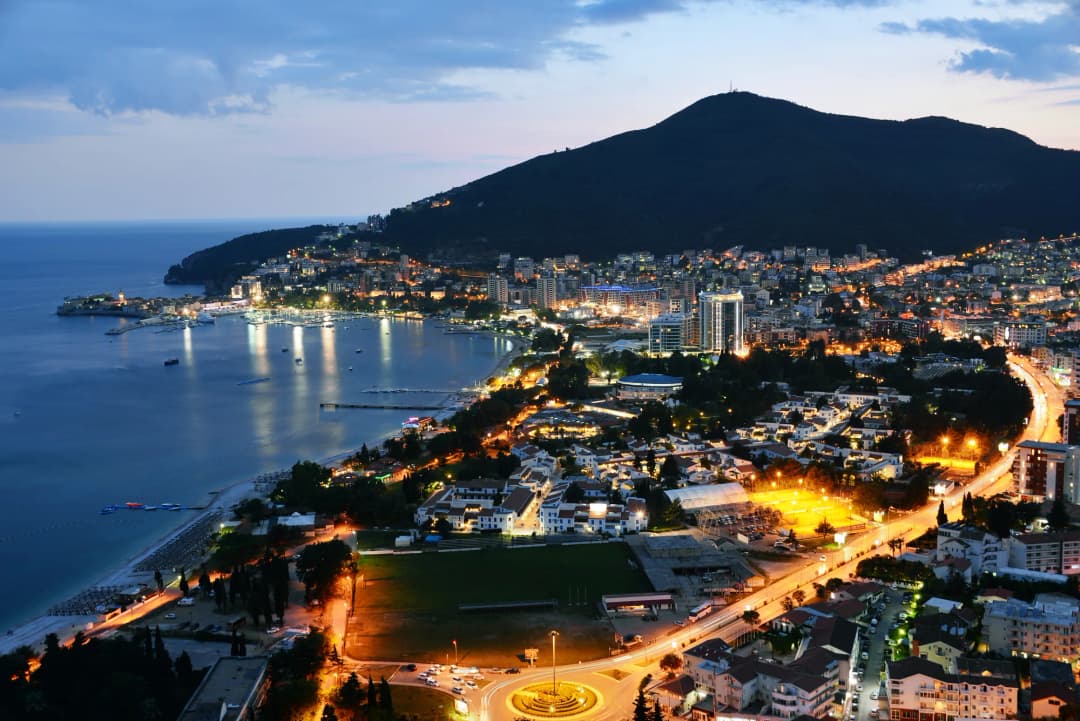
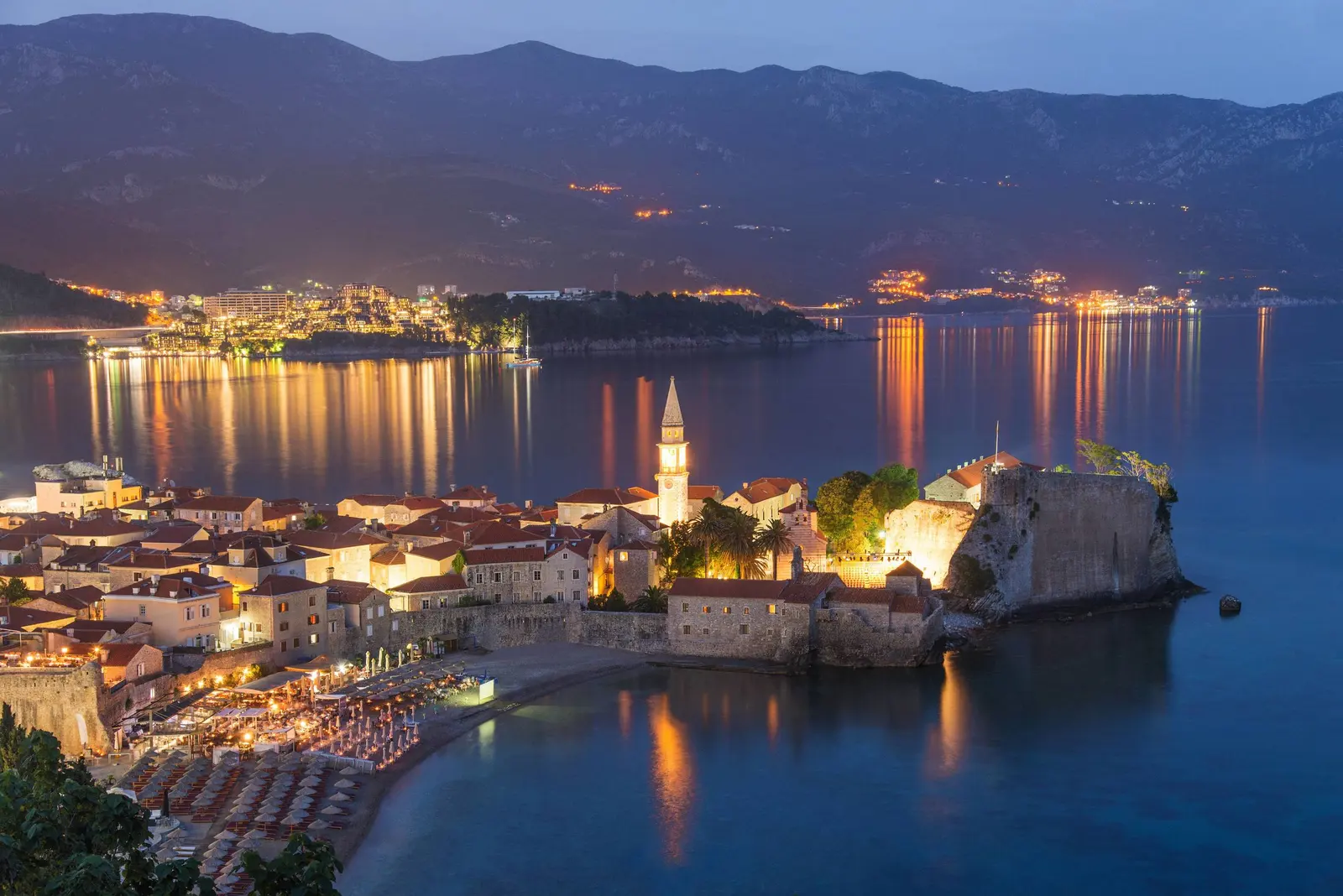
The licensed night view shows Budva’s illuminated waterfront setting; it does not establish a current event, venue or operating hour.
Culture and Events
Grad Teatar Budva (Theatre City Festival)
Budva's summer arts festival, GRAD TEATAR, is the town's most prestigious cultural event and one of the most important cultural manifestations in Montenegro and the wider region. Founded in 1987, it takes place annually during July and August — with the program typically opening in late June — and transforms the Old Town’s squares, church courtyards, stone terraces, fortress walls and the Citadela into open-air performance venues [11][12].
The program features drama, dance, music, visual arts, literature, and experimental performance, including concerts of classical and contemporary music, art exhibitions, poetry readings, film screenings and international guest performances. The festival attracts over 15,000 attendees each year and effectively rebuilds the Mediterranean cultural spirit of the Old Town during the summer months [11][12]. Many performances are free; ticketed events are typically EUR 5-20. Check the local tourist office for the current season's program.
Sea Dance Festival
Held on Jaz Beach, the Sea Dance Festival is a major electronic and dance music festival that has been nominated for Best New Festival and Best Medium-Sized Festival in Europe by the European Festival Awards (EFA). The multi-day event typically runs in mid-July and draws an international crowd of music fans to the beach setting, featuring major DJs and live acts across multiple stages [13].
Where to Eat in Budva
Budva's dining scene reflects its dual identity as both an ancient coastal town and a modern resort, and its position at the crossroads of Mediterranean seafood culture and hearty Balkan culinary traditions, with a strong Italian influence [20][21]. You will find everything from traditional konobas (stone-walled taverns) serving recipes that have not changed in generations to slick waterfront restaurants with international menus and designer interiors.
One caveat before any recommendation: Budva’s restaurant scene changes faster than its walls. Use current menus and prices, and read the Montenegro food guide for dish context rather than a permanent venue ranking.
Seafood and Traditional Konobas
The backbone of Budva dining is the konoba — a traditional restaurant typically housed in a stone building with a shaded terrace, serving fresh seafood, grilled meats, and Montenegrin staples. The best konobas source their fish daily from local boats and prepare it simply: grilled whole, drizzled with olive oil, and served with Swiss chard (blitva) and boiled potatoes. This is not complicated food, but when the fish is fresh and the setting is right, it is exceptional.
Look for konobas in Pržno and the side streets just outside the Old Town walls. Expect to pay EUR 12-20 for a grilled fish main course, less for pasta or risotto dishes. Seafood risotto (often made with cuttlefish ink, turning it a dramatic black) is a signature dish of the coast and should not be missed.
Old Town Restaurants
Dining inside the Old Town walls comes with an atmosphere surcharge, but several restaurants justify the premium. Tables set on ancient stone squares, candlelit alleys, and terraces overlooking the sea create a setting that elevates even a simple meal. The best Old Town restaurants focus on Mediterranean-Montenegrin cuisine: fresh pasta, grilled seafood, risottos, and salads built around local ingredients.
A full dinner for two with wine in an Old Town restaurant typically runs EUR 50-80 — expensive by Montenegrin standards but reasonable by broader Mediterranean comparison.
Beach Restaurants
Several of the beaches along the Riviera have restaurants that are destinations in their own right. The beach restaurants at Pržno and Kamenovo are particularly well-regarded, serving fresh seafood in a setting where you can eat with your feet nearly in the sand. Prices at beach restaurants vary widely — a simple lunch of grilled squid and salad might be EUR 12-15, while a full seafood platter at an upscale spot could reach EUR 40-50.
Notable Restaurants
Restaurant Porto: Near Budva Marina, specializing in seafood and traditional coastal Montenegrin cuisine, beloved by both locals and visitors
Konoba Bocun: A family-run establishment in north Budva serving traditional Montenegrin cuisine for generations
Restoran Rivijera: Located in the Old Town, offering one of the best selections of traditional dishes
Kuzina: The best spot in Budva for heartier inland Montenegrin specialties [20][21]
Local Specialties to Try
Crni rižoto (black risotto): Squid ink risotto made with rice and fresh seafood, rich and briny — one of the most iconic coastal dishes and a staple of every menu.
Buzara: Prawns or mussels cooked in a sauce of white wine, garlic, tomato, and breadcrumbs — a dish borrowed from the Venetian tradition and perfected here.
Njeguški pršut: Montenegro’s famous smoked ham from the Njegoš mountain village, often served as an appetizer with local cheeses.
Njeguški steak: A rolled, stuffed veal or pork cutlet filled with Njeguški prosciutto and cheese — similar to cordon bleu — named for the mountain village where the prosciutto originates.
Lamb ispod sača: Lamb slow-cooked “under the bell” (a traditional clay or metal dome), a hearty inland specialty.
Ćevapi: Minced lamb and beef sausages, a Balkan staple.
Makarule sa pašticadom: A traditional beef stew served with homemade pasta.
Fresh grilled seafood: Fish, squid, and mussels grilled and drizzled with olive oil and herbs.
Riblja čorba: Fish soup, thick and hearty, served as a starter in most seafood restaurants.
Priganice: Fried dough balls dusted with sugar or drizzled with honey, a local snack sold at bakeries and market stalls.
Vranac wine: Montenegro's signature red grape, producing wines that range from everyday table pours to serious, oak-aged bottles. Order it everywhere.
Day Trips from Budva
Budva's central coastal position makes it an excellent base for day trips in every direction, and for exploring Montenegro’s diverse landscapes. Here are the best options.
The most famous image of Montenegro: a tiny fortified island covered in terracotta-roofed stone houses, connected to the mainland by a slim causeway. Originally a 15th-century fishing village, Sveti Stefan was converted into a luxury hotel in the 1960s and has hosted everyone from European royalty to Hollywood stars. The island itself is accessible only to hotel guests, but the view from the roadside lookout above, or from the public beach flanking the causeway, is the real attraction. The nearby Miločer Park, with its botanical garden and former royal beach, is open to visitors and well worth exploring.
The UNESCO-listed walled town at the head of Europe's southernmost fjord is Montenegro's most complete medieval settlement and an essential day trip. Climb the 1,350 steps to the Fortress of San Giovanni, explore the Romanesque cathedral, get lost in the cat-filled alleys, and eat lunch on the waterfront in nearby Muo or Prčanj. Allow a full day if possible, or a minimum of half a day for the highlights. The wider bay — with the medieval towns of Kotor, Perast and Herceg Novi — sits between 45 minutes and 1.5 hours from Budva by car.
Lovćen National Park (40km, 1 hour)
The mountain that defines Montenegro — literally, since Crna Gora means "Black Mountain" — rises above the coast to 1,749 meters. The drive up is spectacular, with switchback roads offering vertiginous views of the bay below; the dramatic Kotor serpentine road takes roughly 1.5 hours. At the summit of Jezerski Vrh sits the Mausoleum of Petar II Petrović Njegoš, Montenegro's poet-king and national hero. The mausoleum is a masterpiece of mid-20th-century architecture, and the views from the top encompass the entire country on a clear day. On the way, stop in the mountain village of Njeguši to sample the country's finest prosciutto and cheese.
The historic royal capital of Montenegro, set in a mountain valley — and the city where Budva's excavated objects were sent for conservation before their return in 2003.
Skadar Lake (50km, 1 hour)
The largest lake in the Balkans straddles the Montenegro-Albania border and is a national park renowned for its birdlife — including Europe's largest pelican colony — its water lilies, and its scattered island monasteries. From Budva, drive to Virpazar, the main gateway village, and take a boat tour (EUR 15-25 per person for a 2-hour cruise). The surrounding hillsides are dotted with small family wineries producing Vranac and Krstač, and several offer tastings. The combination of a boat trip and a winery visit makes for an outstanding day out.
Once a modest naval base, Tivat has been transformed by Porto Montenegro — a luxury marina and waterfront development that attracts superyachts from across the Mediterranean. The promenade is lined with upscale restaurants, designer boutiques, and a naval heritage museum. It is a striking contrast to Budva's ancient character and worth a visit for lunch, an afternoon stroll, or simply to gawk at yachts the size of apartment buildings.
A dramatic Orthodox monastery built into a sheer cliff face nearly 3,000 feet above the valley floor, dedicated to Saint Basil of Ostrog. See our Ostrog guide for the full picture.
A UNESCO World Heritage mountain park featuring the Black Lake, Tara River Canyon (Europe’s deepest), and spectacular alpine scenery — typically a full-day excursion, and covered in depth in our Durmitor guide [24].
Shopping in Budva
Budva is not a shopping destination in the way that Milan or Paris might be, but it offers a pleasant mix of options for visitors looking for souvenirs, local products, or everyday necessities.
Old Town Boutiques
The lanes of the Old Town are lined with small shops selling souvenirs, jewelry, clothing, and local crafts. The quality varies — some are generic tourist tat, others stock genuinely attractive handmade items. Look for silver and coral jewelry (a longstanding Adriatic tradition), olive wood kitchenware, lavender products from the Montenegrin hinterland, and bottles of local wine and rakija (fruit brandy). Several art galleries in the Old Town sell work by Montenegrin painters and photographers. The paired-fish motif from the Cadmus legend turns up on a great deal of it.
The Green Market (Zelena Pijaca)
Located just outside the Old Town walls on the mainland side, Budva's daily market is a sensory experience and a window into everyday local life. Vendors sell seasonal fruit and vegetables, local honey, dried figs, nuts, olive oil, homemade cheese, and smoked meats. In summer, the stone fruit (peaches, nectarines, cherries) is extraordinary. The market is busiest in the morning, and prices are significantly lower than in tourist-oriented shops. Even if you are not self-catering, the market is worth a visit for atmosphere and affordable snacking.
TQ Plaza and Budva Mall
For more conventional shopping — clothing chains, electronics, a supermarket — the TQ Plaza shopping center on the main road through town has the largest selection. It is utilitarian rather than glamorous, but it meets practical needs. Several smaller malls and shopping streets along the main Budva-Bečići corridor carry international brands at prices comparable to or slightly below Western European levels.
Where to Stay in Budva
Your choice of area in Budva will significantly shape your experience. The town spans several distinct neighborhoods, each with a different character and price point. In broad terms: stay near the Old Town for the strongest walking-based cultural visit; stay along Slovenska for easier access to a long urban shore; use Bečići or the Sveti Stefan side if you want a different beach rhythm and accept the transport trade-off. The Sveti Stefan area guide makes that comparison explicit.
Old Town and Immediate Surroundings
Best for: Atmosphere, walking access to restaurants and nightlife, romance, first-time visitors who want to be in the heart of the action.
What to expect: Restored stone apartments and small boutique hotels within or directly adjacent to the medieval walls. The setting is incomparable — you are literally sleeping inside a 2,500-year-old town — but expect narrow staircases, compact rooms, noise from bars (especially on summer weekends), and no car access. Luggage must be carried or wheeled over cobblestones.
Price range: EUR 80-200/night in summer, dropping significantly in shoulder season.
Slovenska Obala (Main Waterfront)
Best for: Families, convenience-seekers, those who want beach access and a range of dining options on their doorstep.
What to expect: A mix of larger hotels, apartment complexes, and private rentals along the promenade and the streets behind it. You are steps from Slovenska Beach, surrounded by restaurants and shops, and within a 10-minute walk of the Old Town. This area has the most infrastructure but also the most crowds and noise in peak season.
Price range: EUR 60-150/night in summer.
Bečići
Best for: Beach-focused holidays, families with children, resort-style stays, visitors who want proximity to Budva without being in the thick of it.
What to expect: Large resort hotels and apartment complexes line the Bečići beachfront. The beach here is excellent — long, sandy, and well-serviced. A promenade and a short tunnel connect Bečići to Budva proper (about a 20-minute walk or a 5-minute drive). The area is quieter than central Budva, especially in the evenings.
Price range: EUR 50-180/night in summer, depending on the property.
Rafailovići
Best for: A quieter alternative to Bečići with a more village-like feel, good for couples and those who want to be near the beach but away from the busiest areas.
What to expect: Smaller hotels and apartments in a compact beachfront settlement between Bečići and Kamenovo. Rafailovići has its own small beach, a handful of restaurants, and a laid-back atmosphere. It connects to Bečići by a beachfront walk.
Price range: EUR 40-120/night in summer.
Getting There and Around
Budva Tourism publishes current transport contacts and routes, but schedules change. Verify the operator, stop and return departure on the day. “Budva bus station” is not enough detail when a service uses a different roadside stop or when summer traffic affects connections. For national transport, money and connectivity basics, begin with the first-time Montenegro guide.
By Air
Montenegro has two international airports, both within easy reach of Budva.
Tivat Airport (TIV) is the closer option — just 20 kilometers away, about 25 minutes by car. In summer, Tivat receives direct flights from many European cities. A taxi from Tivat Airport to Budva costs approximately EUR 25-30.
Podgorica Airport (TGD) is the capital's airport, about 65 kilometers from Budva (approximately 1 hour 15 minutes by car). It operates year-round with a wider range of connections. A taxi to Budva costs EUR 50-70, or you can take a bus from Podgorica bus station (frequent service, EUR 7-9, about 1.5 hours).
By Bus
Budva's bus station is centrally located, about a 10-minute walk from the Old Town. Regular services connect Budva to all major Montenegrin destinations: Kotor (30 minutes, EUR 3-4), Podgorica (1.5 hours, EUR 7-9), Herceg Novi (1.5 hours, EUR 5-7), Cetinje (45 minutes, EUR 4-5), and Ulcinj (2 hours, EUR 7-9). International services run to Dubrovnik (3-4 hours, including border crossing), Belgrade, and Sarajevo.
By Car
Budva sits on the coastal highway (E65/Jadranska Magistrala). Driving from Tivat takes 25 minutes, from Kotor 30 minutes, from Podgorica about 1 hour 15 minutes via the Sozina tunnel. In summer, traffic through Budva can be severe — the stretch between Jaz Beach and Bečići is notorious for gridlock on peak afternoons and weekends.
Parking
Parking is Budva's perennial headache in summer. The main public parking areas near the Old Town and waterfront fill early and charge EUR 1-2 per hour (more in the immediate Old Town vicinity). If you are staying in the Old Town itself, arrange parking with your accommodation in advance — most Old Town properties have arrangements with nearby garages. The best strategy is to park once and walk or use taxis for the duration of your stay. For beach trips along the Riviera, driving and parking at individual beaches is usually feasible outside of peak afternoon hours.
Use lawful signed parking and never block resident, delivery or emergency access near the Old Town. A map pin is not parking inventory. In high season, build slack between a beach, museum booking and onward transfer rather than scheduling them back-to-back.
Getting Around
Central Budva is compact and best explored on foot. The Old Town is entirely pedestrian, and the walk from the Old Town to Bečići along the promenade takes about 20 minutes. For longer trips along the Riviera, local buses connect Budva to Bečići, Sveti Stefan, and Petrovac at low cost (EUR 1-3). Taxis are widely available and relatively affordable — a ride within the greater Budva area rarely exceeds EUR 10. In summer, water taxis operate between Budva's waterfront and several beaches, including trips to Sveti Nikola island (EUR 3-5 round trip).
Practical Safety and Accessibility
Old Town: expect polished stone, steps, narrow passages and summer heat. Choose street-level interpretation if walls or towers do not suit your mobility.
Mogren: obey the official strong-wave warning; never pass a closure or wave-washed section.
Beaches: locate the signed organized sector and read the flag and lifeguard duty.
Boats: use a licensed operator, wear provided safety equipment and confirm the return.
Night: keep a planned route back; do not rely on the last unverified departure.
Emergency: call 112 for a genuine emergency in Montenegro.
Beyond that checklist, the main considerations are sun exposure (the Adriatic sun is intense in summer — sunscreen, hydration, and shade are essential), sea conditions (generally calm, but rocky entries can be slippery), and traffic (drivers in Montenegro can be aggressive, and pedestrians should exercise caution on the main coastal highway).
A Resilient Two-Day Budva Plan
Day one: evidence first. Confirm the City Museum, then walk the interpreted streets and church cluster. Use the walls only if open and suitable for your mobility and the weather. Treat the Citadel as a separate entry decision. Finish with the Old Town exterior and harbour rather than committing to a time-sensitive event.
Day two: choose one water mode. In safe conditions, choose Mogren for a compact beach approach, a signed Slovenska sector for the urban option, or a licensed Sveti Nikola boat for an island day. Do not attempt all three. Keep one land alternative — museum, gallery, shaded meal or regional excursion — for wind, heat or closure.
Practical Tips and FAQ
When is the best time to visit Budva?
The short answer: May, June, or September. These months offer warm weather (22-30 degrees Celsius), water temperatures comfortable for swimming (especially from June onward), manageable crowds, and lower accommodation prices than the July-August peak.
July and August are the undeniable peak — the weather is hot (30-35 degrees Celsius, sometimes higher), the sea is at its warmest (24-26 degrees Celsius), and the nightlife and festival scene are in full swing. But the crowds and prices are at their maximum too. If you thrive on energy and do not mind sharing your beach with thousands of others, peak summer Budva delivers. If you prefer space and tranquility, avoid it.
October is pleasant for sightseeing and still warm enough for swimming in the early part of the month, but the nightlife and festival scenes wind down significantly. Winter (November through March) is mild on the coast (8-14 degrees Celsius) but very quiet, with many restaurants and hotels closed.
How many days do you need in Budva?
Three to four days is ideal. This gives you time for a thorough exploration of the Old Town (half a day), beach time at two or three different beaches (one to two days), the Budva Riviera drive including Sveti Stefan (half a day), and a day trip to Kotor or Lovćen. If you are primarily interested in beaches and nightlife, a full week passes easily. Two days allow one evidence-led Old Town day and one water or coast day. A single day can cover the museum, streets and exterior fortifications if current access aligns — enough for the Old Town and one beach, but you will only scratch the surface.
Is Budva really more than 2,500 years old?
Material evidence supports an ancient urban centre, including gate pylons dated to the seventh–sixth centuries BCE and extensive later finds. That does not make every visible building ancient or prove the Cadmus myth.
Is the Old Town entirely medieval?
No. It contains ancient, late-antique, medieval, Venetian, Austro-Hungarian and modern conservation layers. The walls’ present appearance owes much to Venetian intervention and earthquake rebuilding.
Are the walls open every day?
The official page listed daily 10:00–20:00 access from April through November and €2 admission when checked on 30 August 2026. Reconfirm for weather, maintenance, events and price changes.
Can I visit the Citadel with the walls ticket?
Do not assume so. The Citadel is a separately managed private complex. Verify entry and price at its entrance.
Is Mogren always accessible?
No. Budva Tourism warns that its approach is unsafe during southerly wind and strong waves. Choose another beach when the path is wave-washed or closed.
Which beach is easiest from the centre?
Slovenska is the long urban shore; Mogren is compact but its approach is weather-dependent. Choose a signed sector by today’s flag, supervision and access — not by reputation alone.
Can I swim to Sveti Nikola?
This guide does not recommend it. Use a licensed boat operator and confirm landing, weather and return. The short visual distance does not remove open-water and traffic risks.
Can you visit Sveti Stefan?
The island itself is operated as an exclusive resort and is only accessible to hotel guests. However, you can enjoy the view from the roadside lookout above (free, and one of the best photo opportunities in Montenegro), use the public beach on the mainland side of the causeway, and visit the nearby Miločer Park and its beaches. The experience of seeing Sveti Stefan from the outside is honestly more rewarding than many visitors expect — the island's beauty is in its silhouette and its setting, best appreciated from a distance.
Is Budva safe?
Yes. Budva is a safe destination by any reasonable standard. Violent crime against tourists is essentially unheard of. Petty theft — pickpocketing in crowded areas, items disappearing from unattended beach towels — occurs but is not rampant. Standard precautions apply: do not leave valuables unattended on the beach, be aware of your surroundings in crowded nightlife areas late at night, and secure your accommodation.
Budget tips
Eat at the green market for breakfast or lunch — fresh fruit, bread, cheese, and smoked meats cost a fraction of restaurant prices.
Choose free beach sections rather than paying for sunbeds. Most beaches have public access areas alongside the paid sections.
Visit Sveti Nikola island by water taxi for a cheap beach day — it is less crowded than the mainland beaches and the round-trip fare is minimal.
Drink local: A glass of Montenegrin wine or a Nikšićko beer costs EUR 2-4 at most bars, while imported brands and cocktails are two to three times more.
Book accommodation with a kitchen and self-cater for some meals. Apartments with kitchenettes are widely available and often cheaper than hotel rooms.
Travel in shoulder season: Prices for accommodation can drop 40-60% in May or October compared to August.
Is Budva too touristy?
It depends on when you come. In August, central Budva is intensely crowded — beaches packed, Old Town shoulder-to-shoulder, traffic frustrating. But the same town in late September is warm, relaxed, and uncrowded, with locals reclaiming the waterfront and the Old Town regaining its intimate character. Even in peak season, escaping the crowds is straightforward: head to Kamenovo or Pržno instead of Slovenska Beach, explore the Old Town early morning or late evening, and remember that the Budva Riviera extends far beyond the town center. The crowds concentrate in a small area; the beauty extends for 35 kilometers.
What Travelers Say
TripAdvisor
Budva consistently ranks as TripAdvisor’s top destination in Montenegro. The Old Town receives overwhelmingly positive reviews, with visitors praising its atmospheric streets, historical depth, and photogenic beauty. The Citadel and city wall walks are highlighted as must-do experiences. Diving operations receive excellent ratings, with reviewers praising well-organized centers, quality equipment, and diverse underwater sites. Common criticisms focus on summer overcrowding, aggressive pricing at some beach establishments, and traffic congestion during peak season [9].
Lonely Planet
Lonely Planet highlights Budva as Montenegro’s most-visited destination and emphasizes the quality of the Old Town experience, describing it as one of the coast’s finest. The guide notes both the appeal of the beaches and cultural events and the reality that peak season brings extreme crowds, recommending shoulder-season visits for a better experience [1][6].
Travel Blogs and Independent Reviews
Independent travel bloggers consistently describe Budva as a highlight of Montenegro travel, emphasizing:
The extraordinary contrast between ancient history and modern beach culture
The value proposition compared to similar destinations in Croatia or Greece
The quality of the Budva Riviera beaches, particularly Mogren and Jaz
Sveti Stefan as a must-see viewpoint even if the resort is closed
The excellent food scene blending Mediterranean seafood with Balkan traditions
Night entertainment that rivals much larger Mediterranean resort towns
Common advice includes visiting in June or September to avoid peak crowds, renting a car to explore the wider Riviera, and spending at least 2–3 days to fully appreciate both the historical and beach aspects of the destination [8][20][24].
A Brief History of Budva
Before the legend
Budva claims to be one of the oldest continuously inhabited settlements on the Adriatic coast, and the evidence supports the boast. Archaeological finds on the peninsula date human habitation to at least the 5th century BC, when Illyrian tribes established a fortified settlement here. Greek colonists arrived not long after — legend attributes the town's founding to Cadmus, the mythological Phoenician prince who was exiled from Thebes and wandered the coast with his wife Harmonia before settling on this rocky promontory. In one local version, the exiled Theban founder and his wife reach the Adriatic and become two fish; the paired-fish image survives in tourism and souvenirs to this day. The story is almost certainly myth — mythology, not excavation evidence — but it speaks to how ancient Budva felt even to the ancients themselves.
The archaeology is strong enough without turning myth into fact. Budva Museums dates pylons from an ancient gate to the seventh–sixth centuries BCE and documents Hellenistic, Roman and late-antique material from the necropolis. The institution uses 1938 for Budva’s recognition as a major archaeological site; Budva Tourism says the necropolis was discovered in 1937. “Late 1930s” is more honest than pretending the two public accounts say exactly the same thing.
Rome, Venice and the long Adriatic sequence
The Romans folded the town into the province of Dalmatia, naming it Butua. After the fall of the Western Empire, Budva passed through Byzantine hands and then, like much of the Montenegrin coast, came under the long and formative rule of the Venetian Republic. Official tourism history places Venetian rule from 1442 to 1797. Venice shaped Budva's architecture, its maritime traditions, and its cultural identity. The compact walled town you see today — the narrow streets, the stone palazzos, the fortified citadel at the peninsula's tip — is fundamentally Venetian in character, even if the materials and the spirit are distinctly Montenegrin.
After Venice fell to Napoleon, Budva followed the familiar Adriatic trajectory: a brief French interlude, then Austro-Hungarian rule until World War I, incorporation into the Kingdom of Yugoslavia, and decades under Tito's socialist federation. Through it all, Budva remained a small, quiet fishing town — picturesque but unremarkable on the European stage.
The earthquakes and the rebuilding
Two events transformed modern Budva. The first was the devastating earthquake of April 15, 1979, which struck the entire Montenegrin coast and reduced much of Budva's Old Town to rubble. It was not the first: the city also suffered severe earthquake damage in 1667. The reconstruction that followed 1979 — painstaking, largely faithful to the original Venetian-era designs — lasted roughly a decade but ultimately gave Budva the beautifully restored Old Town it has today. Ironically, the earthquake may have saved Budva's heritage: without the forced restoration, the slow decay of neglect might have done equal damage over the following decades.
It also reshaped what is known about the ancient city. Systematic work after 1979 exposed a large burial area spanning several periods. The earthquake did not “gift” archaeology to the city; it damaged homes and monuments, then created conditions for rescue excavation and a long recovery. Objects went to Cetinje for conservation and returned to the City Museum in 2003.
Myth, archaeology and discovery are different layers
Layer
Evidence
CULTURAL MYTH
Cadmus, Harmonia and the paired fish
7th–6th c BCE
Ancient gate pylons and urban evidence
LATE 1930s
Necropolis recognized as a major site
AFTER 1979
Rescue excavation, conservation and reconstruction
Takeaway
The myth is meaningful; the archaeology proves antiquity
Source: muzejiigalerijebd.me, budva.travel
The second transformation was tourism. Beginning in the 1980s but accelerating after Montenegrin independence in 2006, Budva evolved from a sleepy coastal town into the country's premier resort destination. Today, it is by far the most visited city in Montenegro, with a resident population of roughly 20,000 that swells tenfold in peak season — a fact that shapes everything from restaurant prices to traffic congestion.
Restored stone and new tile. Almost everything standing in the Old Town today was put back after 1979, largely to the Venetian-era designs.
Written by
Pavle Obradović
Pavle Obradović is from Herceg Novi. He was Manager of Montenegro.com, then Director of the Herceg Novi Tourism Organization, and is now Coordinator for Investment and Development Projects at the Municipality of Herceg Novi. He holds a BSc in International Hospitality and Service Management from the Rochester Institute of Technology (RIT).
···
Updated · Originally published
Montenegro Travel Newsletter
Get weekly stories, guides, and insider tips about Montenegro delivered to your inbox.